
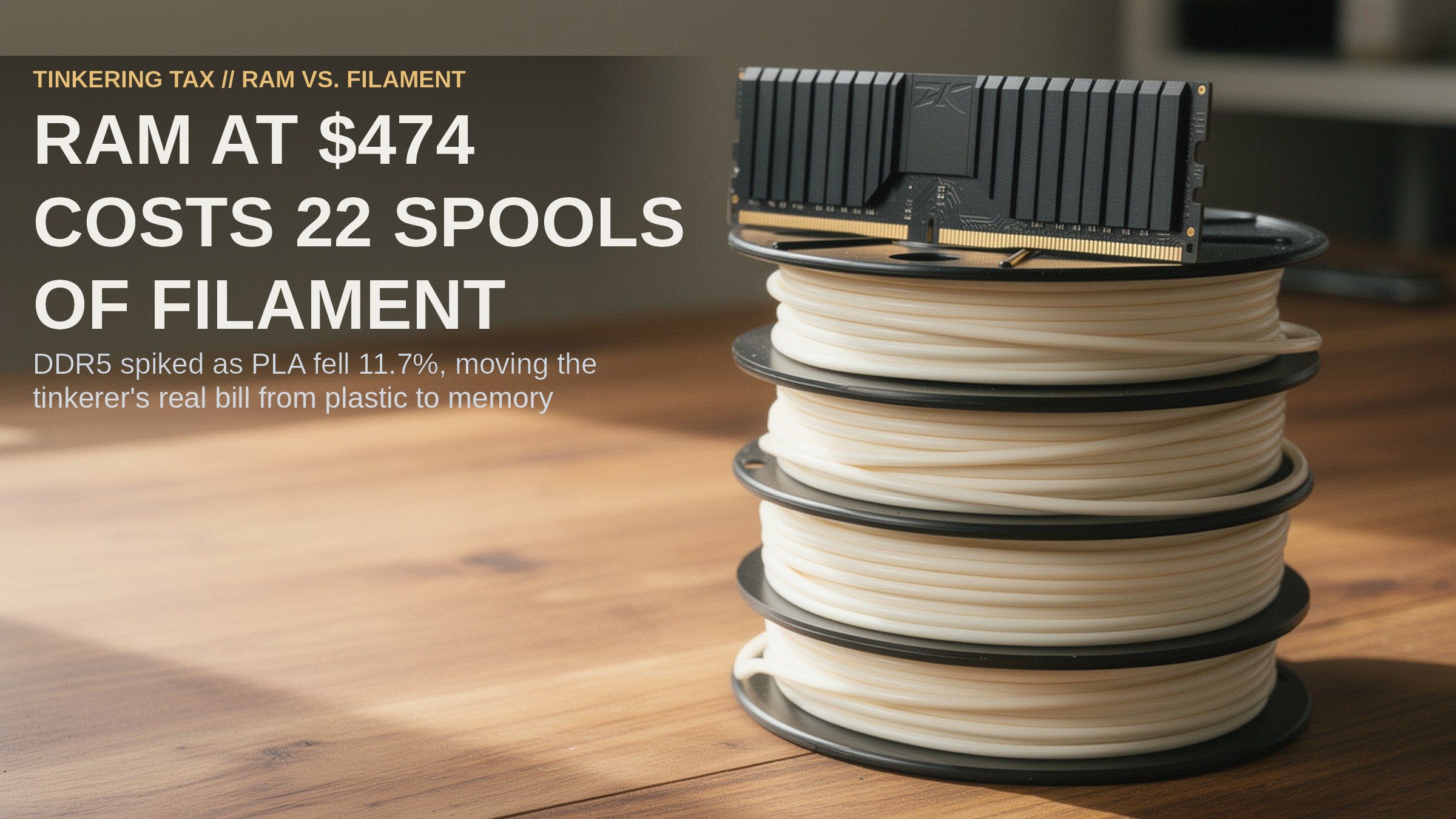
A 32-gigabyte kit of random-access memory (RAM) — the Double Data Rate 5 (DDR5) kind desktops use — now costs $474 at its tracked best U.S. price, against a lowest-ever record of $72 [1]. SpoolHound’s median for polylactic acid (PLA), the plastic most home printers run, sits at $20.99 a kilogram [2]. Divide one by the other and the kit is worth about 22 one-kilogram spools of filament. While the kit climbed, the plastic fell: global PLA prices dropped 11.7% in the last 30 days [2]. If you tinker on both benches, the hobby’s bill just moved from what you print to what your machine remembers.
At a glance
Home tinkerers who run a 3D printer and a server are watching their two supply shelves move in opposite directions this month. Filament is getting cheaper, memory is not, and one kit now equals about 22 spools on the bench.
Where the shelves split
The sequence is short. Tom’s Hardware’s tracking table, refreshed on 17 November, now reads:
| Kit | Best U.S. price | Lowest-ever tracked |
|---|---|---|
| DDR5-6000 32GB | $474 | $72 |
| DDR5-6000 64GB | $949 | $159 |
The same page notes that a kit sold for $100 to $200 in October 2025 and “now starts at $350, if it’s even in stock” [1]. Its explanation is scarcity: retailers are repricing DDR5 to current market conditions, and scalpers and automated shopping bots clear what little stock is left [1].
The filament shelf moved the other way. SpoolHound’s daily index, read on 21 November, records global PLA at €18.06 per kilogram across 47 stores, down 11.7% against 30 days earlier [2]. A store-level check at ten manufacturers’ own shops found PLA at 1.9 cents a gram, with Bambu Lab’s European store cutting PLA Basic from €25.99 to €19.99 [3]. The maker market is running holiday sales in the exact window the parts market went vertical.
I read both indexes twice before accepting that neither mentions the other. The memory story is written for PC builders deciding whether to buy, and the filament story is written for makers deciding what to stock. But they price the same hobby. A tinkerer who buys one spool a month runs on roughly $21 of plastic in that time, and a single memory upgrade now buys more than a year of it [2]. The board-level version of this squeeze already landed earlier this month, when Raspberry Pi repriced its 16-gigabyte board for the same memory shortage [4]. Your Cheap Board Now Costs $385 walks through that repricing board by board.
By the numbers
- $3,303: The cheapest tracked 128GB DDR5-6400 kit, against a $329 record [1].
- €18.06 a kilogram: The global PLA average across 47 stores and 14,223 listings [2].
- 1.9 cents a gram: What PLA costs at ten manufacturers’ own stores [3].
What to watch
Black Friday is testing both shelves at once, and the people closest to each are behaving differently. The makers are cutting real prices: Bambu’s €6 reduction landed three weeks before the holiday, and Prusament is already discounted [3]. The builders are mostly holding off, because the tracker warns that kits are scarce and scalpers clear the cheap stock first [1].
What I’d watch next is whether the exchange rate holds into December. The buyers running both benches are redoing the upgrade math against consumables: one memory kit equals about 22 months of hobby plastic at the current median [2]. The comparison cuts the other way too. The plastic saving is small in absolute terms, so it cannot fund the memory purchase — it only tells you which purchase to defer, and deferral works only while the machine still runs without the upgrade.
The catch
Both numbers are snapshots of moving markets, and neither is your price. The kit figure is the best tracked listing on one day [1]. The $72 record is a historical low, and the sticker you would pay today is higher [1]. A median also hides the premium brands, which the same index prices past $26.60 a kilogram [2]. What I keep from the month is the unit itself: pricing an upgrade in spools makes the two shelves comparable, and this month the comparison says memory is the expensive half of the hobby.
Related reading
Related reading
Sources
- [1] Tom’s Hardware, “RAM price tracking 2026 — lowest price on DDR5 and DDR4 memory of all capacities” — https://www.tomshardware.com/pc-components/ram/ram-price-index-2026-lowest-price-on-ddr5-and-ddr4-memory-of-all-capacities
- [2] SpoolHound, “The Filament Price Index” — https://spoolhound.com/filament-price-index
- [3] 3D Printing Cost Calculator, “PLA & PETG Filament Price per Gram and per Kg” — https://3dprintingcostcalculator.com/news/filament-price-per-gram
- [4] Raspberry Pi, “Price rises for some 16GB Raspberry Pi products” — https://www.raspberrypi.com/news/price-rises-for-some-16gb-raspberry-pi-products/