
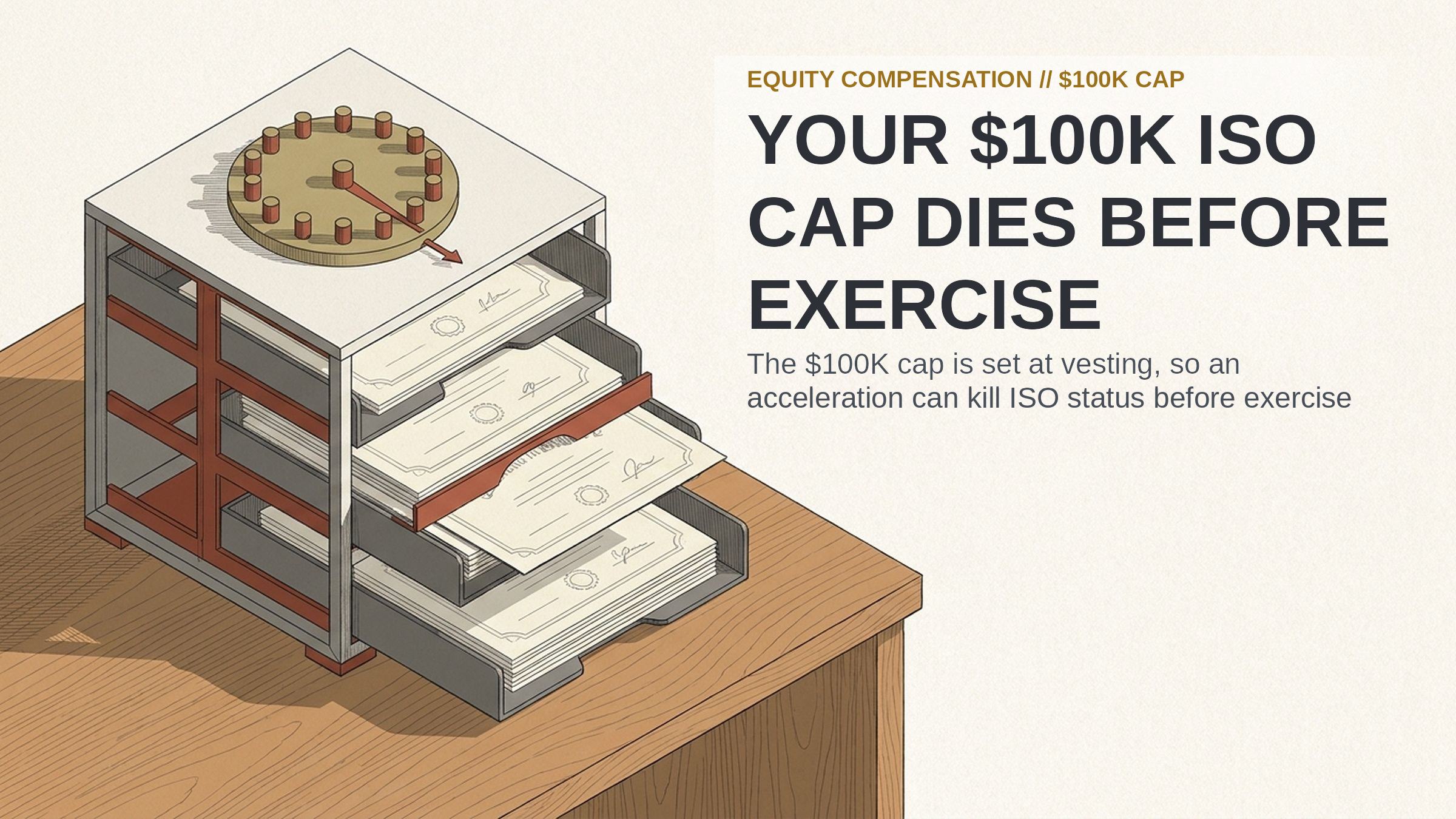
Your incentive stock option (ISO) cap is $100,000 of stock per calendar year, and the calendar that decides the cap is set long before you sign an exercise form. An ISO is a grant that can be taxed as a long-term gain instead of wages. Most holders think that label is settled when they exercise. It is settled when each slice of the grant first becomes buyable, at the share price on the day it was granted. That is why a buyout is the moment the label can go dead: the deal usually makes every remaining slice buyable at once, and a slice exercised after that trigger is a plain option in full.
At a glance
- The shift: Tax treatment is set by the year a slice becomes buyable, not the year you exercise.
- The number: $100,000, the grant-date value that qualifies per calendar year.
- The risk: A buyout’s acceleration pushes everything past the cap out of the ISO bucket.
Why the calendar decides it
The tax code measures the cap once a year. Options that become buyable for the first time in a calendar year are valued at the share price on grant day, and anything past $100,000 in one year is treated as an option that is not an ISO [1]. The same rule counts grants in the order they were made, so an older award fills the year before a newer one gets a look [1]. Nothing about your exercise date enters it.
The Treasury’s own examples make the point better than any adviser. In the first, a worker gets an option he can exercise at once every January for ten years, then he exercises all ten in one later year [3]. Every one still counts as an ISO, because no single year’s grant crossed the line [3]. Exercise timing played no part; the test ran year by year, as each option became buyable. I read that first example twice before I believed the exercise date did no work.
Acceleration is where the trap sits, and this is the part advisers skip. The rules count an option in the year its acceleration clause fires, and a change of control that makes every option buyable at once counts as that trigger [4]. Its third example runs three options against one year’s allowance. The first stays qualified, the second splits into a qualified part and a nonstatutory part, and the third, exercised after the deal, fails in full [4]. A nonstatutory option is the plain kind: wages when you exercise it.
One piece of folk advice falls at the same wall. Selling early does not undo the split. The rules say an early sale has no effect on whether an option crossed the ceiling [4]. The cap is spent when the slice becomes buyable, not when the cash lands.
By the numbers
- $400,000 grant-day value: A four-year grant that spreads a quarter of its value into each calendar year stays wholly ISO up to this total [1].
- 110,000 of grant-day value: The regulation’s acceleration example pushes two options past the ceiling, so one is split and the third fails [4].
- $135,980 median pay: The 2025 median yearly wage for software developers, the pay the ceiling is read against [5].
The order that protects the label
The order matters more than the paperwork. The clause does not count until it fires, so an option exercised before that point keeps its label [4]. In its fourth example, a worker exercises a slice in June, a change of control lands in September, and that slice stays qualified while a later one is split [4]. Anyone watching a deal close has a reason to read the date, not the term sheet.
A second rule bites large holders harder than employees expect: ownership above ten percent changes the terms. The price must then be at least 110 percent of fair market value, and the option runs five years or less instead of ten [2]. Crossing that line quietly raises the price and shortens the clock.
I had missed the certificate rule until I pulled the fourth example apart. The rules let a company issue separate certificates, or mark shares in its own records, to say which ones were bought under the qualified option and which under the plain one [4]. Without that mark, shares count as ISO up to the ceiling and plain after it [4]. Divide the ceiling by the grant-day share price to get the shares that fit, so a lower grant-day price buys more ISO shares for the same money.
The catch
The label’s value is uneven. What I keep tripping on is how much the timing moves it. The gain sits in the gap between the strike price and the share value on the day you buy, and inside an ISO that gap is not wages while you hold [6]. It goes into the alternative minimum tax (AMT), a second tax calculation, and the whole gain stays a capital gain only if you hold past the statutory period [6].
A plain option reports the gap as wages the day you exercise. Timing is the lever, and it cuts both ways. Buy near a zero gap and the downgrade costs almost nothing. Buy into a big gap and the same downgrade is the difference between a capital gain and wage income on a real number.
The history is the rest of the answer: the ceiling went into the code in 1981 and has never been indexed, so it shrinks against pay every year pay grows [1]. At the 2025 software developer median it is 73.5 percent of one year’s salary [5], so a strong package can pass the yearly limit with nothing unusual going on.
The open question is what the plain share does to an offer once the ceiling has split it. The total-compensation model prices base, cash and vesting stock against a growth guess, which is where the split shows up in the number.
Related reading
Sources
- Cornell Legal Information Institute, “26 U.S.C. § 422 — Incentive stock options” — https://www.law.cornell.edu/uscode/text/26/422
- Cornell Legal Information Institute, “26 U.S.C. § 422(c)(5) — 10-percent shareholder rule” — https://www.law.cornell.edu/uscode/text/26/422
- Code of Federal Regulations, “26 CFR § 1.422-4 — $100,000 limitation, Example 1” (title 26 current as of 11/04/2026) — https://www.ecfr.gov/current/title-26/section-1.422-4
- Code of Federal Regulations, “26 CFR § 1.422-4 — $100,000 limitation: rules (b)(4), (b)(6) and (c), with Examples 3 to 6” (title 26 current as of 11/04/2026) — https://www.ecfr.gov/current/title-26/section-1.422-4
- O*NET OnLine, “15-1252.00 — Software Developers, median wages (2025)” — https://www.onetonline.org/link/summary/15-1252.00
- Internal Revenue Service, “Publication 525 (2025), Taxable and Nontaxable Income — statutory and nonstatutory stock options” — https://www.irs.gov/publications/p525