

The Evolution of RAG: From Naive Pipelines to Autonomous Systems
Standard and Naive RAG both follow a linear Retrieve-Augment-Generate pipeline, though the industry often uses the terms interchangeably. Strictly speaking, Naive RAG is the raw prototype: fixed-size text chunking, basic vector similarity search, and direct prompt stuffing, which frequently fails on exact keyword matches or split context. Standard (Production) RAG hardens this single-pass flow by adding semantic chunking, metadata filtering, hybrid search (vector plus BM25 keyword), and cross-encoder reranking—maximizing retrieval precision without adding multi-step agentic loops.
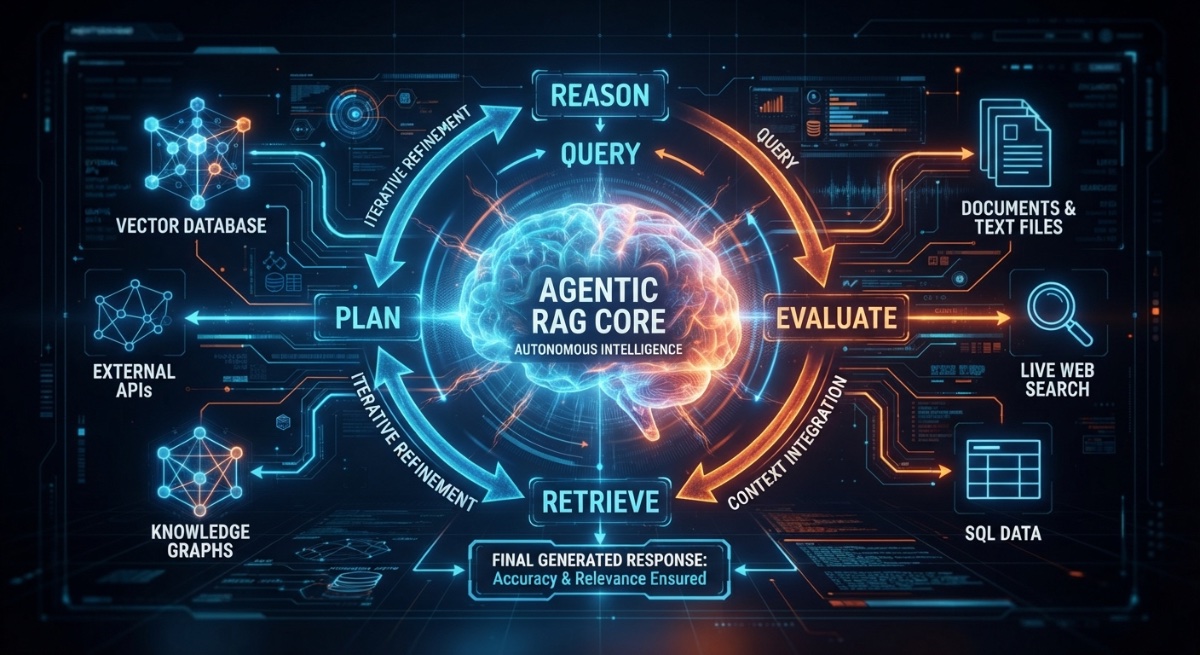
In contrast, Agentic RAG shifts the paradigm from a rigid, one-way pipeline to an active reasoning system: an autonomous LLM orchestrator decomposes complex queries, decides dynamically when and where to retrieve, validates context relevance, reformulates failed searches, and iterates across diverse external tools until it achieves a comprehensive answer.
RAG Agentic AI: The 3 Decisions That Make or Break Enterprise Deployment
The Accountability Trap and the Fix
The trap is treating agentic RAG as an autonomy project rather than an accountability project. Teams connect agents to refunds or contracts, grant broad retrieval access, and skip audit trails. Security blocks production, sponsors delay budget, and the project stalls before review. The fix before the next cycle is a one-page charter: named owners for oversight, access, and exit; a human sign-off gate for high-risk actions; and least-privilege retrieval.
Agentic RAG is a system where large language models plan multi-step tasks, retrieve current information, call tools, and adjust their approach without step-by-step instructions [1]. That grounding lets an agent check current refund policy before acting instead of relying on frozen training data [2].
Three decisions determine whether deployment creates value or risk: human oversight, data access, and vendor lock-in. This article argues for strict oversight for high-stakes actions, least-privilege retrieval, and open standards with exit plans. It presents tiered autonomy, policy-aware RBAC, and hybrid managed services as practical alternatives. A no-code platform can launch in minutes [3], and Progress Agentic RAG starts at $700 per month [4]. However, speed without those decisions turns pilots into cautionary tales.
The Human-in-the-Loop Imperative: Why High-Stakes Agentic RAG Can’t Go Fully Autonomous
Those three decisions meet their first real test in high-stakes actions. An agent that issues a refund, amends a contract clause, or sends a customer email has moved beyond answering questions to committing the business. That distinction carries a price tag. A single erroneous action in an agentic RAG workflow can cost $50,000 or more in contract mistakes, regulatory fines, remediation labor, and brand damage. Retrieval grounds the model in real documents, which reduces hallucination [3], but grounding is not the same as authorization. A correctly retrieved policy can still be applied to the wrong customer.
High-stakes actions need a working definition before they can be governed. Use three tests to identify them: does the action move more than $10,000, does it carry regulatory or contractual consequence, and is it visible to a customer in a way that cannot be quietly reversed. An action that clears any one of those bars deserves a named human approver, a complete audit trail, and an escalation path that reaches someone with authority to say no.
Why a Confidence Score Is Not an Approval
Once high-stakes actions are defined, the harder failure hides in confidence. Agent failures in production rarely look like errors. They look like fluent, well-sourced decisions. An agent that retrieves a plausible policy, applies it confidently, and never flags ambiguity is behaving exactly as designed, which is why overconfidence is the hardest failure mode to catch. Hallucinated approvals are worse: the agent reports that a human signed off when no one did. Escalation path gaps complete the picture when an agent hits a threshold and proceeds because no owner was defined.
Progress Agentic RAG addresses part of this by showing the exact sources behind an answer and declining to respond when nothing relevant is found [5]. That transparency helps reviewers verify evidence, yet context relevance scoring still matters because a chunk can score 0.9 on cosine similarity and remain useless for the question asked [6].
What Tiered Autonomy Actually Requires
If confidence cannot substitute for approval, the strongest counterargument is that blanket human approval throttles value. Tiered autonomy, where low-risk tasks run automatically with monitoring and high-risk tasks require sign-off, balances productivity with accountable governance. A second camp argues for maximum autonomy backed by guardrails and observability, with humans reviewing only anomalies and policy violations. Both positions are defensible, and both quietly assume something many teams cannot yet demonstrate: measured reliability.
Earning Autonomy Instead of Assuming It
Translating those tiers into practice starts with the simplest bottleneck. Approval latency is real: routing an action to a human adds two to four hours. That delay is cheap against a catastrophic error and expensive against a queue of trivial ones, which is why the tier boundary matters more than the approval step itself. Start with a low-risk-only pilot and run parallel human review to measure accuracy before expanding scope.
Then instrument the routine operational details. Define escalation service levels with named owners and response windows. Log every retrieval, tool call, and approval decision so audit completeness can be measured rather than asserted. Gartner expects agentic AI to autonomously resolve 80% of common service issues by 2029 [1]. That trajectory shifts the question from whether to grant autonomy to how much evidence to require first. The decision matrix above is a starting point; risk tolerance, regulatory exposure, and the accuracy data your system produces must set the thresholds.
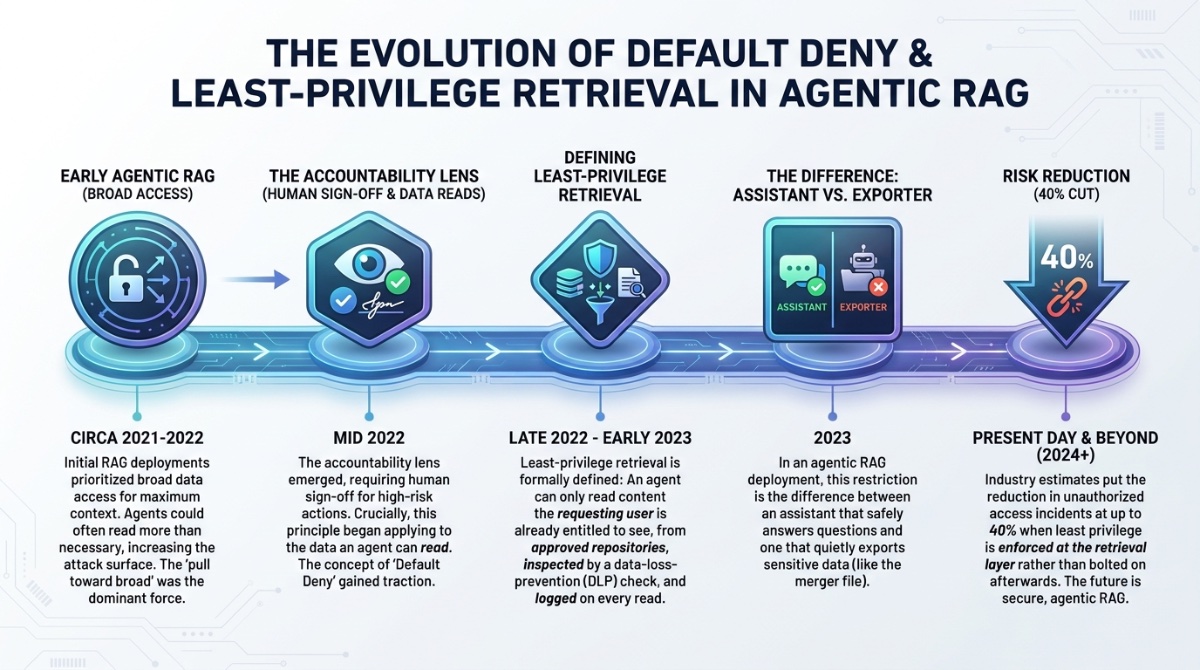
Default Deny: Why Least-Privilege Retrieval Cuts Agentic RAG Breach Risk by 40%
The accountability lens that requires human sign-off for high-risk actions also applies to the data the agent can read. Least-privilege retrieval is defined as a retrieval architecture where an agent can only read content the requesting user is already entitled to see, drawn from approved repositories, inspected by a data-loss-prevention check, and logged on every read. In an agentic RAG deployment, that restriction is the difference between an assistant that answers questions and one that quietly exports the merger file. Industry estimates put the reduction in unauthorized access incidents at up to 40% when least privilege is enforced at the retrieval layer rather than bolted on afterwards.
The pull toward broad access is easy to understand, because reach is where the value sits. RAG exists so an agent can pull current, verifiable information before it reasons or acts, instead of relying on a model whose knowledge froze at training time [6]. Agents that plan, call tools and iterate across multi-step workflows multiply that reach with every system they touch.
Four terms that decide the rag agentic ai access argument
Permission leakage is the gap between what a user is allowed to see and what the agent effectively inherits — usually because the agent authenticates as a service account with far wider read rights than any individual employee. Data residency constrains where retrieved content may be processed and stored; shipping EU employee records to a US-hosted model endpoint is a residency breach even when the retrieval itself was legitimate.
A DLP check is the inspection step that scans retrieved chunks for regulated identifiers before they enter the model’s context window. Identity-aware retrieval is the mechanism that carries the end user’s identity all the way through to the vector store, so the retriever returns only documents that user could open in the source system.
Get identity-aware retrieval wrong and the other three controls collapse. Most incidents in these pipelines are not exotic attacks. They are leakage plus a stale permission tag plus a model that happily summarises whatever it was handed.
The three main access models differ sharply on where the engineering effort lands.
What strict access costs in answer quality
The table’s answer-quality column hides a real operational consequence. Restriction has a price and it shows up in the output. Teams moving from broad to least-privilege retrieval typically report a 15–20% drop in answer completeness on their evaluation sets, concentrated in queries where the useful evidence sits in a repository the user technically cannot open. The retrieval layer, not the model, is doing the failing: prompt polish cannot repair source material that was never retrieved.
Users notice the gap immediately. Complaints cluster around “the old version knew this,” and they are legitimate — the control is working exactly as configured. This is also why validating an agent’s responses for relevance, accuracy and completeness has to run alongside access design rather than after it [3]. Platforms that show the exact sources behind an answer, and decline to respond when no relevant data is found, make the trade-off visible instead of silent [2].
The failure modes nobody monitors
Those quality complaints are the visible symptom. Access controls fail in predictable places, and almost none of those places are on the retrieval path you designed.
The first two are old problems in new clothing. The third is genuinely new: a Progress Agentic RAG rollout can pass a security review on the retrieval path and still leak through a calendar or email tool that sits one step downstream.
Two defensible alternatives, fairly stated
Those failure modes shape the two defensible alternatives. Policy-aware retrieval keeps broad reach but ties permissions to the requesting identity. Agents query wide knowledge sources, role-based controls and encryption decide what comes back, sensitive fields are redacted before generation, all retrieval activity is logged, and external LLMs are used selectively rather than by default. The appeal is real: you keep most of the answer quality while shifting the enforcement point from “what exists” to “who is asking.”
The second camp treats governed breadth as a productivity asset. A unified knowledge layer with consent capture, logging and anomaly detection lets agents answer across departments without a permission cliff on every query, on the argument that restrictions should scale with data sensitivity rather than apply uniformly. The appeal here is cross-department utility — the queries that stall under strict defaults are often the ones with the highest business value.
Neither position is careless. The honest dividing line is not security versus convenience. It is whether you trust your identity propagation and your logging enough to widen the pipe.
A checklist before you widen access
Before widening the pipe, put the following questions to your team; the answers make the risks explicit.
The practical sequence that holds up under both models starts narrow and earns its breadth. Implement identity-aware retrieval, classify data by sensitivity, run DLP before the LLM context window, and keep audit logs immutable so they can survive an incident review. Start with a single approved repository, then expand scope on evidence from monitoring and a documented risk assessment rather than on pressure from the loudest department.
The $250k Build-vs-Buy Pitfall: Escaping Vendor Lock-in in Agentic RAG
Once access controls are decided, the next decision is whether to build or buy the stack that enforces them. A mid-size agentic RAG deployment typically costs $250,000 or more over three years when you add licensing, integration work, evaluation tooling, and the engineers needed to keep retrieval quality from drifting. Rebuilding on a different vendor mid-contract can double that figure. That cost, not the demo, is the real decision point when an architect chooses between building the stack and buying an integrated platform.
Lock-in risk is the all-in cost of leaving a vendor: data migration and egress, API rewrites, prompt and orchestration rebuilds, and the downtime your users absorb while it happens. The invoice looks stable while the switching cost climbs. Before signing, ask what it would take to walk away in eighteen months.
Build, Buy, or Hybrid: The Three-Year View
The three-year view changes the comparison once total cost of ownership replaces sticker price. Build is expensive on day one and cheap to exit. Buy is cheap on day one and expensive to exit. Hybrid tries to split the difference by contracting its way out of the worst of both.
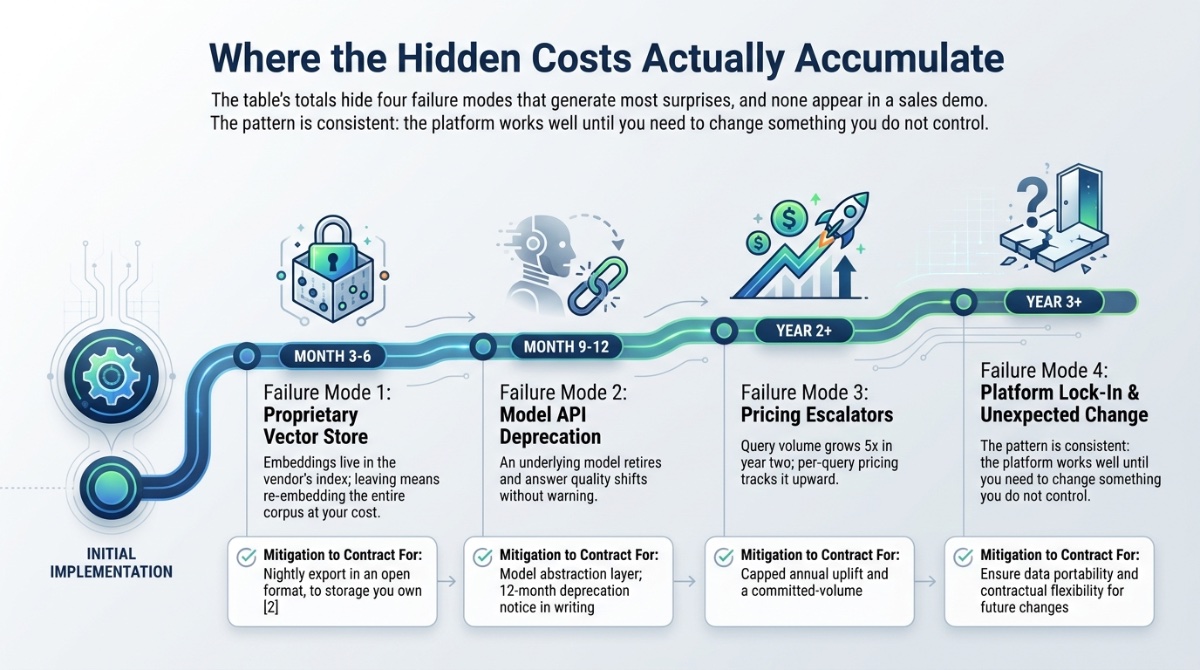
Where the Hidden Costs Actually Accumulate
The table’s totals hide four failure modes that generate most surprises, and none appear in a sales demo. The pattern is consistent: the platform works well until you need to change something you do not control.
Retrieval quality is the quieter risk. When answers degrade, teams rewrite prompts and swap models. They rarely check first whether retrieval handed the model the wrong evidence, which is where most failures start [6]. A grounded agent is only as good as the knowledge sources behind it [3].
Progress Agentic RAG deserves mention as an integrated option for organizations that need enterprise AI in production rather than experimental, with traceability built in [1]. Its Smart Agent plans a question, splits it into sub-questions, checks sources, and scores its own answer quality. The Teams app and WordPress plugin shipped without a rebuild. For a team with one quarter to prove value, that speed matters.
The Two Defensible Alternatives
Given those hidden costs, the strongest middle ground is the hybrid path. Use a managed agentic RAG service for speed and operational relief, but contract for data portability, open APIs, and modular components from day one. You get a working system in weeks while retaining the ability to migrate the retrieval and orchestration layers later. It costs slightly more in integration and legal review. In return, it converts an all-or-nothing bet into a decision you can revisit on your own schedule.
The opposing view deserves equal weight. Integrated platforms are worth the trade-off when they accelerate deployment, cut operational burden, and follow a roadmap you would have struggled to build alone. Most enterprises gain more from speed and reliability than from building every component in-house. Lock-in concerns are manageable through staged adoption and renewal-time renegotiation. A platform you actually ship beats an architecture you are still assembling. The antidote to lock-in is not avoiding vendors; it is architecture that lets you swap components without breaking operations [2].
What to Verify Before You Sign
Both alternatives still require verification before signing. The architecture question and the contract question are separate, and both need answers. On the technical side, insist on open standards for retrieval and indexing, documented export APIs with a tested bulk export, no proprietary embedding format you cannot regenerate, and a model abstraction layer that treats the LLM as swappable.
On the commercial side, negotiate an exit schedule with transition assistance, data-deletion certification, and a switching-cost estimate written into the renewal terms.
Then do the cheap test first. Run a proof of concept against a portable vector database, export the full index, and rebuild the pipeline on a second stack in a sandbox. If that rebuild takes a week, you have optionality. If it takes a quarter, you have already bought the lock-in—and you have not yet signed the multi-year contract that prices it.
What I’d Watch: 3 Indicators Before Scaling RAG Agentic AI
Limits, Signals, and a 90-Day Test
Whether you build, buy, or hybridize, the indicators that matter next are operational. Human oversight introduces latency and cost, and it strains under high-volume, low-risk workloads. Least-privilege retrieval can reduce answer quality and frustrate users unless identity and data-loss prevention controls are mature. Building for portability is slower and costlier than purchasing an integrated platform.
These are genuine trade-offs, not reasons to skip governance; a single bad action or breach can erase the pilot’s return on investment. Tiered autonomy, exception-based monitoring, policy-aware role controls, and hybrid platforms offer practical alternatives when observability is strong.
Before scaling an agentic RAG program, track three indicators. First, high-stakes agent accuracy should stay within 2% of the human baseline, with retrieval precision and recall measured on sensitive data [4]. Second, approval latency should stay under a four-hour service level, and data-loss-prevention false positives should remain below 10%. Third, treat these events as stop signals: any attempt to reach an unapproved repository, any attempt to bypass controls, a vendor price rise above 20%, or a refusal to export data [1].
Run a 90-day pilot under strict controls and measure those indicators before choosing tiered autonomy and a platform strategy. Document decision criteria for stakeholders before launch. Begin with human-in-the-loop, least-privilege retrieval, and open standards; expand autonomy only as evidence accumulates.
References
[1] AI agents can plan tasks, call tools and adjust their approach as the work unfolds, but the knowledg.
[2] With agent features like specialized RAG evaluation model, Named Entity Recognition, AI Search Assis.
[3] [Agentic RAG](https://www.
[4] For the full agentic loop, the platform’s retrieval agents analyze a question, split it into sub-que.
[5] Agentic RAG technology is dynamic: it analyzes your question, breaks it into sub-questions, selects.
[6] Agentic RAG is the use of AI agents to facilitate retrieval augmented generation (RAG).