

Zapier Notion Integration is a practical topic shaped by Most e-commerce teams waste over $1,000 a month on broken Notion-Zapier integrations without realizing a unified CRM could save them $18,720 over three years, so the best answer depends on your goals, constraints, and timing.
The Tinkering Tax Dilemma for E-Commerce Ops
The Strategy Brief
- Relying on a Zapier and Notion integration for e-commerce operations often results in a ‘tinkering tax’ where teams lose significant time and money troubleshooting fragile automated workflows.
- Mid-sized brands typically spend an average of 12 hours per month on manual fixes and data reconciliation, which can cost upwards of $1,000 monthly in lost operational productivity.
- Transitioning to a centralized CRM can save a growing business more than $18,000 over three years by replacing high-maintenance middleware with native, real-time data synchronization.
- Organizations should prioritize upgrading their infrastructure once maintenance time exceeds six hours per month or when monthly order volumes consistently surpass 100 transactions.
The Hidden Tax on Your E-Commerce Operations
I have spent years watching digital brands navigate the delicate balance between agility and stability. In my experience, the primary objective in the early stages of a brand’s lifecycle is speed, leading many operations managers to rely on a zapier notion integration to build their initial infrastructure. We often see this setup used to synchronize customer data and order histories without the need for a dedicated technical team.
The core appeal of a zapier notion integration is the “no-code” promise. It allows our non-technical teams to build complex workflows and automate repetitive tasks by simply connecting different applications. In theory, this democratizes software development, allowing a brand to scale its operations without hiring a dedicated engineering department.
However, as the volume of transactions increases, I have observed that the limitations of this patchwork approach become painfully apparent. When a customer updates their shipping address or modifies an order, a zapier notion integration may fail to propagate that change across all systems. This creates data silos and forces manual intervention, which effectively acts as a “hidden tax” on the company’s growth.
The Real Cost of Tinkering
While these tools are excellent for prototyping, they often struggle with the high-frequency data demands of a scaling e-commerce business. The reliance on third-party “bridges” introduces latency and potential points of failure that can disrupt the customer experience. For many brands I work with, the very tools that enabled their initial growth eventually become the primary obstacles to their expansion.

When evaluating operational efficiency, many businesses overlook the long-term benefits of a centralized CRM. Decision-making is often skewed by a narrow focus on monthly subscription fees. A patchwork of low-cost tools might appear cheaper on a balance sheet, but this perspective fails to account for the labor costs associated with maintaining those connections.
A centralized CRM, such as HubSpot or Salesforce, serves as a unified repository for all customer-facing data. By consolidating sales, marketing, and service data into a single environment, these platforms eliminate the need for fragile “bridge” automations. I believe that moving toward these professional systems is a requirement for any brand serious about long-term scalability.
How the Notion + Zapier Integration Works (and Where It Fails)
The Evolution of the Digital Workspace
The transformation of Notion from a simple note-taking tool into a powerhouse of relational databases has redefined how modern teams organize their digital lives. What began as a minimalist workspace has evolved into a customizable platform where users build complex systems for client management and operational tracking. Today, Notion serves as the central nervous system for thousands of startups.
Despite its flexibility, Notion often suffers from a lack of native connectivity. It excels at housing data but struggles to communicate with the sprawling ecosystem of external software that businesses rely on daily. Without a bridge to other tools, Notion remains a high-functioning silo, requiring manual updates that drain productivity.
Middleware as a Digital Translator
To bridge this gap, organizations are turning to Zapier, a middleware leader that automates data movement between disparate applications. By linking Notion to the broader SaaS world, Zapier allows teams to create a unified workflow. This integration ensures that information flows freely across the tech stack, turning a static repository into a dynamic engine.
The rise of the “no-code” movement has further accelerated this adoption. Non-technical staff can now design complex logic that previously required a dedicated engineering team. This democratization has allowed departments to move faster, testing new processes without waiting for IT approval cycles or budget for custom builds.
The Silo Effect and Operational Lag
Modern enterprises still face a persistent “silo effect,” where vital information is trapped within specific platforms. While Notion’s architecture is inherently flexible, it does not include built-in connectors for specialized tools used in finance or support. This fragmentation forces employees to spend hours on “work about work”—the act of moving data from one place to another.
Zapier solves this by utilizing Notion’s API to synchronize data in real-time. By setting up “Zaps”—automated sequences triggered by specific events—users can ensure that an update in a CRM is immediately reflected in Notion. This connectivity is essential for teams striving to maintain a “single source of truth.”

The No-Code Workaround Terminator Calculator: Your Decision-Intelligence Tool
Analyzing the Economics of Efficiency
The “no-code” movement has changed how teams build custom workflows, allowing non technical staff to use platforms like Notion for database management. These tools offer immediate flexibility and low entry costs, but they frequently hide significant long-term operational risks.
Giniloh’s “No-Code Workaround Terminator Calculator” functions as a decision-intelligence tool designed to quantify these hidden burdens. It provides a data-driven framework for organizations to evaluate the transition from fragmented workarounds to unified enterprise platforms. By moving beyond surface-level costs, the tool exposes the true price of technical debt .
Case Study: The E-Commerce Ops Sync Trap (Notion + Zapier vs. Centralized CRM)
Every growing digital brand eventually hits the “franken-stack” ceiling. It usually starts innocently: a Notion database to track customers, a few Zapier zaps to pull in e-commerce orders, and another automated workflow to trigger sales emails. For a while, it works. But as order volume scales, the cracks show up as broken integrations, duplicated customer profiles, and critical sync timeouts.
The dilemma is classic: Do you keep patching the fragile no-code plumbing, or do you bite the bullet and upgrade to a unified platform like HubSpot?
The Framework: Tinkering Tax vs. Unified Platform Premium
To solve this, we use a decision-intelligence rule called the Tinkering Tax vs. Unified Platform Premium. It strips the emotion out of the software debate by pitting the hidden cost of human maintenance against the explicit cost of a higher software subscription.
Here is how the numbers break down in this specific use case over a standard three-year operational horizon:

The Hidden Drag: While a $500 monthly subscription increase can trigger immediate budget anxiety, it pale in comparison to losing $1,020 worth of high-value engineering or ops time to routine maintenance every single month.
Overcoming the Sunk Cost Fallacy
The shift to professional infrastructure is often delayed by the “sunk cost fallacy.” Teams invest hundreds of hours into building complex Notion dashboards, making it psychologically difficult to abandon them. However, the calculator forces a cold, financial look at whether these systems are assets or liabilities in the current market environment.
In a journalistic context, this tool represents a shift toward “operational transparency.” It allows leaders to move away from anecdotal complaints about “broken zaps” and toward a rigorous financial model. The goal is to determine exactly when a custom-built workaround starts being a drain on the company’s bottom line.
Quantifying the Tinkering Tax: A Real-World E-Commerce Example
The Fragility of “Franken-stacks”
Digital commerce has entered an era defined by modularity. For many emerging brands, the promise of a “custom” tech stack built on low-code tools is nearly irresistible. Organizations frequently lean on Notion to act as a makeshift command center, handling everything from customer databases to order logs.
To bridge the gap, businesses deploy a zapier notion integration—a web of automated triggers designed to sync Shopify sales in real time. While these “Franken-stacks” often perform well initially, operational data reveals a looming technical friction. Maintaining these connections requires constant human oversight to prevent data silos from forming.
The 12-Hour Maintenance Trap
The most significant hurdle in managing custom automation layers is the cumulative time required for technical upkeep. Industry audits suggest these integration layers are rarely “set it and forget it” solutions. Instead, they demand a steady stream of manual fixes to address systemic failures.
On average, a mid-sized digital brand loses roughly 12 hours per month to troubleshooting activities alone . Operations managers find themselves resolving broken multi-step Zaps and deduplicating records that were accidentally tripled during a sync error. These timeouts are particularly common when the Notion API faces high demand.
The Unified CRM Premium: What You Get for $500 per Month
The Operational Realities of Custom Chains
Many brands utilize a zapier notion integration to bridge the functional gap between storefronts and internal databases.
While these custom-built chains offer initial flexibility, they quickly introduce severe operational overhead.

As transaction volumes scale, relying on middleware to sync critical customer data inevitably exposes three main structural flaws:
-
Fragile Data Pipelines: Notion isn’t a relational database at scale; API updates, sudden changes to page properties, or Zapier multi-step timeouts frequently result in silent data drops.
-
The “Zapier Tax”: As data volume increases, task usage multiplies exponentially. Brands often find themselves paying hundreds of dollars just to maintain the pipes, with no added feature value.
-
Lack of Native State Management: Notion lacks native tooling for real-time sales pipelines, automated communication triggers, and deep interaction histories, forcing teams to manually clean data across systems.
By centralizing these operations into a dedicated, unified CRM, you swap unpredictable infrastructure maintenance for a stable, high-performance ecosystem designed to scale.
Quantifying the “Tinkering Tax”
The hidden cost of maintaining custom integrations is often referred to as a “tinkering tax.” This metric represents the cumulative value of time spent by high-level staff on troubleshooting and correcting data entry errors. For a mid-sized brand, the financial implications are substantial and often underestimated.
Data indicates that businesses relying on complex Zapier-driven architectures lose an average of 12 hours per month to maintenance . When calculated using a standard loaded rate of $85 per hour for an operations manager, the direct labor cost reaches $1,020 per month. This far exceeds the cost of most premium CRM platforms.
3-Year Cost Comparison: Workaround vs. Upgrade
The Long-Term Economic Impact
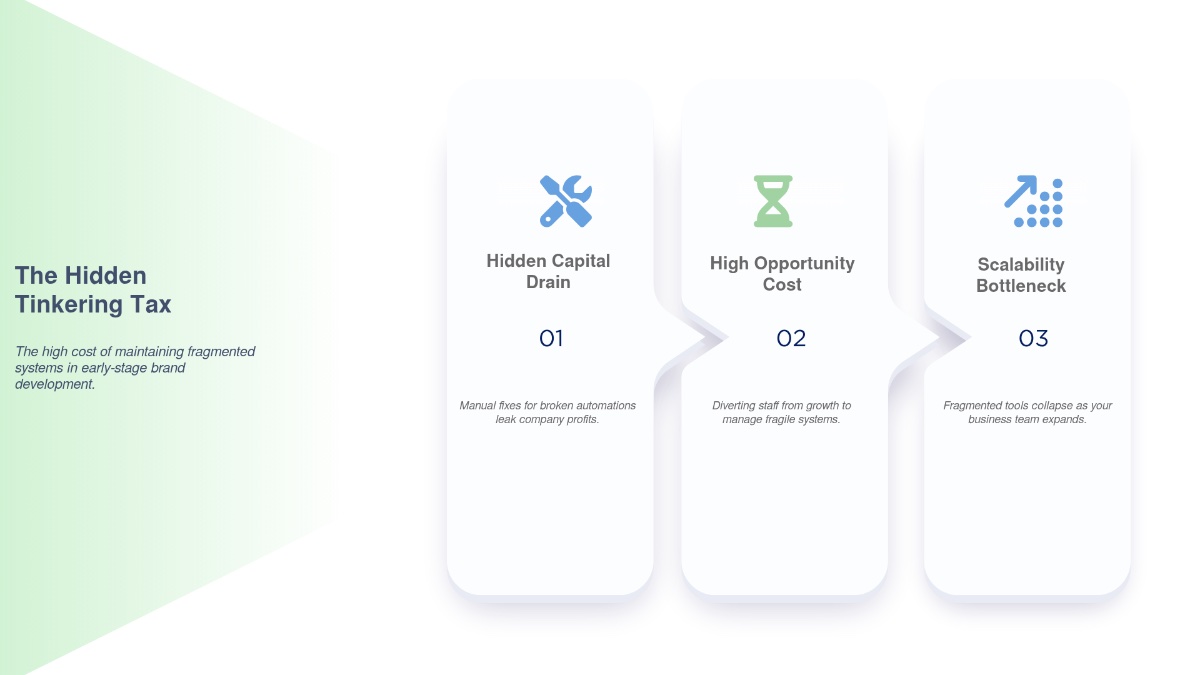
In the high-stakes environment of early-stage brand development, founders often face a difficult choice between speed and structure. Many emerging enterprises adopt a fragmented “no-code” architecture, relying on a patchwork of tools. While marketed as a frugal alternative, industry experts warn of a hidden liability that compounds over time.
The “Tinkering Tax” is not merely a metaphor for lost time; it is a measurable drain on capital. What begins as a quick, ten-minute fix for a broken automation can quickly evolve into a weekly ritual of manual data reconciliation. For brands operating on thin margins, these hours represent a leak in the balance sheet that leadership rarely accounts for.
The Opportunity Cost of Maintenance
The responsibility for managing these fragile integrations typically falls on an operations manager. When these professionals are diverted from strategic growth initiatives to address routine synchronization failures, the organization incurs a direct loss in productivity. This diversion also creates an indirect loss in opportunity costs.
As the business grows, the fragility of these systems becomes a significant bottleneck. A system that worked for a team of five often collapses under the weight of fifty users. This paradox forces many founders to eventually rebuild their entire infrastructure under duress, often at a much higher cost than an early upgrade would have required.
The Verdict: When to Pull the Trigger on a CRM Upgrade
The Math Is Brutally Simple
Let’s cut through the marketing fluff. The decision to upgrade from a cobbled-together zapier notion integration workflow to a centralized CRM comes down to one question: does your monthly tinkering tax cost more than the premium platform? In our example, the numbers tell a stark story.
If your operations team is spending more than 6 hours a month fixing “Zaps” or cleaning up Notion databases, you are already paying for a CRM—you just don’t have one yet. The transition should occur before the system reaches a breaking point, ensuring that your data remains clean and your team remains focused on growth rather than maintenance.
FAQ
What is the ‘tinkering tax’ associated with Notion and Zapier integrations?
The tinkering tax refers to the hidden labor costs spent troubleshooting and fixing broken automated workflows. For many mid-sized brands, this results in roughly 12 hours of manual maintenance each month, costing upwards of $1,000 in lost productivity.
When should a business transition from a Notion-Zapier setup to a centralized CRM?
An upgrade is recommended when maintenance exceeds six hours per month or when the team grows beyond five members. Additionally, processing more than 100 orders monthly often necessitates the stability of a professional CRM over a patchwork system.
Why do these automated workflows become less reliable as a business scales?
As data volume increases, third-party bridges often face latency issues and API limitations that lead to synchronization errors. What works for a small team often collapses under the complexity of high-frequency data demands and multi-step automation paths.
How does a centralized CRM save money compared to low-cost no-code tools?
While a CRM has higher monthly subscription fees, it drastically reduces the labor costs associated with system maintenance. Over three years, a unified platform can save a brand more than $18,000 by eliminating the need for constant manual fixes and data reconciliation.
What are the main operational risks of using a ‘Franken-stack’ architecture?
The primary risks include data silos, duplicate records, and failed triggers that can persist undetected for days. These failures often result in poor customer experiences and force operations managers to focus on technical debt rather than strategic growth.
Does a unified CRM provide better data integrity than a custom Notion database?
Yes, a unified CRM acts as a single source of truth with native, real-time synchronization. This eliminates the ‘glue-code’ failures common in third-party integrations and ensures that sales, marketing, and service data remain consistent across the organization.
What specific maintenance tasks contribute to the monthly time loss in DIY setups?
Common tasks include troubleshooting broken multi-step sequences, deduplicating records caused by sync errors, and updating API schemas. These manual interventions are necessary to prevent system downtime and maintain data accuracy in a fragmented environment.
References
[1] Zapier allows you to connect Notion with 8,000+ apps to automate your work.
[2] Notion integration page for the complete list of triggers and actions.
[3] Connect Notion and Zapier to sync data between apps and create powerful automated workflows.
[4] A CRM can serve as one centralized location to see all communication with a client, from when they f.