
Key Takeaways
- Evaluate the entire financial package, including equity, bonuses, and benefits, rather than focusing solely on the base salary to avoid leaving significant v
- Account for external factors such as regional cost-of-living differences and the tax implications of various compensation types to determine the true take-home value of an offer.
- Secure a formal written offer before initiating negotiations and frame counteroffers as collaborative discussions to maintain rapport while leveraging data to justify requests.
Why Total Compensation Trumps Base Salary in Negotiations
The Evolution of Total Compensation in Modern Employment
When I first sat down to negotiate a job offer early in my career, I was laser-focused on one number: the base salary. I believed that a higher starting pay was the ultimate sign of success, ignoring the complex web of benefits and equity that actually build long-term wealth. I soon realized that by ignoring the “whole envelope,” I was leaving thousands of dollars on the table.
The traditional focus on base salary is increasingly viewed as an incomplete metric for evaluating professional opportunities. While the base salary remains the most visible component, it represents only a single segment of a comprehensive financial package. It serves as the primary source of liquidity for immediate expenses, but it rarely tells the full story of a role’s value.
Total compensation is a term encompassing the aggregate value of all cash and non-cash rewards provided to an employee and it is the core of the GiniLoh Total Compensation Visualizer. Total compensation includes base pay, annual performance bonuses, equity or stock options, and retirement contributions. It also accounts for health insurance premiums, paid time off, and various fringe benefits.
Understanding the Financial Impact of Non-Cash Rewards
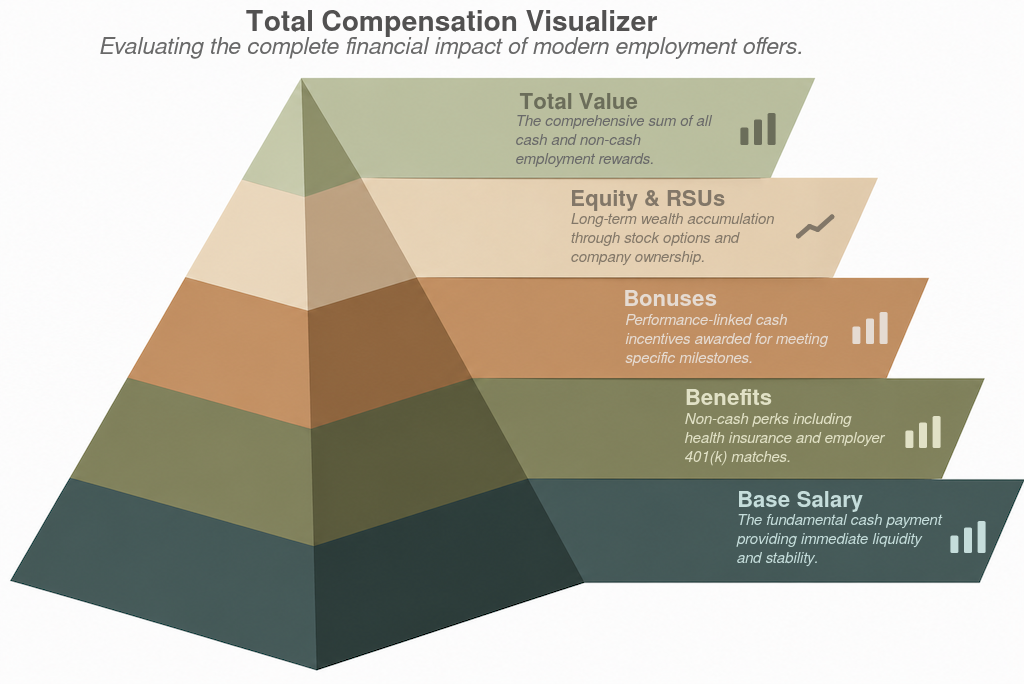
Failure to account for these additional variables can result in a significant undervaluation of an offer. Candidates often overlook thousands of dollars in annual value by focusing solely on the monthly paycheck. This oversight is particularly common among early-career professionals who may not yet appreciate the long-term impact of employer-sponsored benefits.
The complexity of modern compensation structures reflects a shift in how corporations attract and retain talent. Beyond the standard paycheck, employers utilize diverse financial instruments to align employee interests with company performance. This alignment is designed to foster a sense of ownership and long-term commitment among the workforce.
Data from a recent NerdWallet survey suggests that ancillary benefits can augment an individual’s real earnings by 30% or more. These benefits include employer-sponsored 401(k) matches and performance-based bonuses that trigger upon meeting specific milestones. Such figures highlight why a lower-salary offer with high benefits can often outperform a high-salary offer with no perks.
The Role of Analytical Tools in Offer Evaluation
Comparing competing job offers has historically been fraught with ambiguity. This is particularly true when comparing roles across different industries or geographic regions with varying costs of living. The introduction of the job offer calculator has transformed this subjective exercise into a data-driven discipline.
Digital tools, such as Giniloh’s Total Compensation Visualizer, allow candidates to input specific variables to generate a side-by-side comparison. These variables include base salary, the fair market value of equity grants, target bonus percentages, and the estimated cash value of health benefits.
Utilizing a job offer comparison tool also facilitates a clearer understanding of the trade-offs inherent in different corporate structures. For instance, early-stage startups frequently lack the capital to compete with established multinational corporations on base salary. They compensate by providing generous equity packages that carry the potential for significant financial upside.
Visualizing the “Shape” of Your Wealth
Established firms may offer lower equity upside but provide greater stability and more robust immediate benefits. These might include higher 401(k) matches or fully subsidized premium health insurance plans. By visualizing these numbers, you, as a candidate can move away from intuitive decision-making and toward an objective analysis.

The GiniLoh Total Compensation Visualizer also accounts for the “tax-drag” on different types of compensation. While a bonus is taxed as supplemental income, certain health benefits are provided tax-free. Understanding these distinctions allows a candidate to calculate their true “take-home” value.
Data-driven evaluation also helps in identifying “hidden” costs associated with a new role. A calculator might reveal that a longer commute or a higher-cost insurance plan effectively cancels out a 5% raise. This level of detail empowers professionals to make moves that actually improve their financial standing.
Step-by-Step: Input Your Numbers and See the Real-Time Impact
Analyzing the Job Offer: A Comprehensive Approach
Receiving a formal job offer is a defining moment, yet the evaluation process is often surprisingly flawed. Many focus narrowly on immediate liquidity, viewing the base salary as the primary measure of success.
The headline salary is merely one component of a complex financial contract that requires deeper inspection. To accurately judge an offer, you must move beyond a cursory glance at the monthly paycheck. A rigorous analysis of Total Compensation Value (TCV) is necessary to understand the long-term trajectory.
Failing to account for the full spectrum of benefits can lead to a significant undervaluation of professional worth. This oversight often results in missed opportunities for wealth accumulation. Industry research suggests that a comprehensive understanding of compensation structures is the most effective way to secure a fair agreement.
Step 1: Systematic Inventory of Compensation Components
The first stage in evaluating a professional offer is identifying every financial element in the contract. A common mistake is underestimate benefits that do not appear in the monthly deposit but impact net worth. To build an accurate TCV model, you must categorize and quantify several distinct streams of value.

A systematic inventory requires a meticulous review of the offer letter, the benefits summary, and the equity plan documents. Often, the most valuable details are buried in the fine print of an appendix. Candidates should approach this task with the mindset of an auditor, ensuring no potential revenue stream is omitted.
Base Salary: The Foundation of Recurring Income
The base salary serves as the floor for an employee’s financial security. It is the guaranteed portion of the contract, unaffected by market volatility or company performance. For many, this figure dictates their ability to secure mortgages and manage daily expenses.
Items such as 401(k) matches and life insurance coverage are frequently calculated as a percentage of this base. When evaluating the base, it is essential to consider the local cost of living. A $150,000 salary in San Francisco may offer less purchasing power than $110,000 in a mid-sized city.
Simulating Negotiation Scenarios: Salary vs. Equity vs. Bonuses
The Strategic Calculus of Tech Compensation
The initial phone call from a recruiter often centers on a single, enticing number: the base salary. In the high-stakes world of technology, however, that figure is rarely the full story. Industry analysts point out that the most lucrative deals are often hidden in the fine print of equity grants and multipliers.
Evaluating an offer requires a fundamental shift in perspective. It is no longer about the monthly paycheck alone. Instead, candidates are increasingly adopting a multi-year financial lens to decode what a role is actually worth over the long haul .
Market data from the past three years shows a clear and consistent trend. For mid-to-senior level roles at firms like Meta or Google, non-salary components frequently make up 30% to 60% of the total value. In some executive tiers, the base salary is merely a fraction of the realized wealth.
Quantifying the Trade-Offs You Can’t See Yet
Most professionals enter a negotiation with an “anchor” number in mind based on what they earned previously. However, focusing on this single data point can lead to poor long-term financial decisions
Consider a $120,000 base salary offer. On the surface, it looks superior to a $110,000 offer. But if the latter includes a $20,000 signing bonus and a $100,000 equity grant vesting over four years, the math changes instantly. The second offer is worth significantly more in “effective” annual income.
Mastering Negotiation Tactics with Giniloh Total Compensation Visualizer (TCV)
The Total Compensation Visualizer (TCV) converts abstract equity and benefits packages into clear, year-by-year cash flows and wealth engines. By modeling your current role as Offer A and your new offer as Offer B, you gain the exact data needed to drive a highly strategic, numbers-backed negotiation. Here is your step-by-step playbook to maximize your leverage:
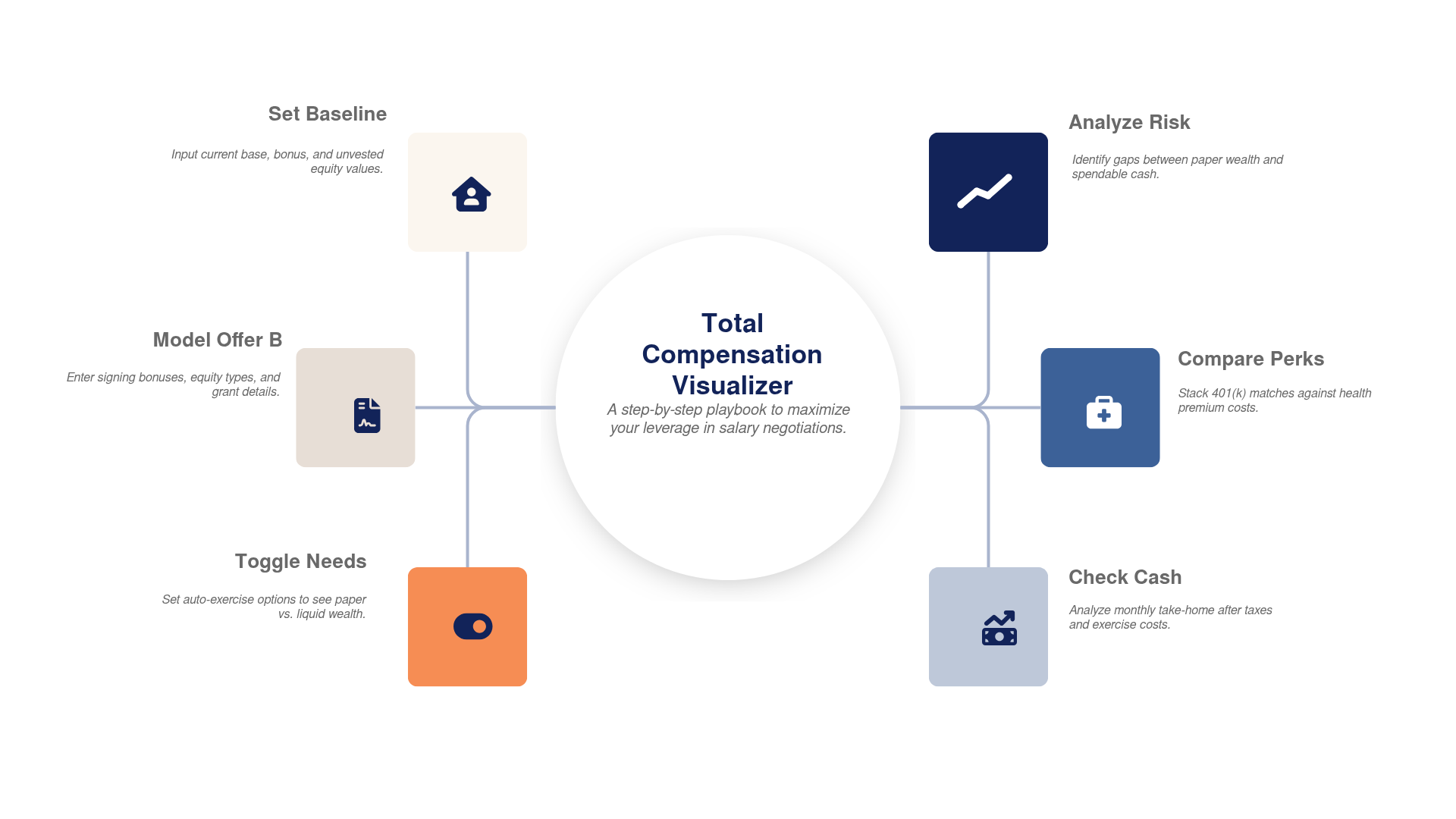
Step 1: Establish the Baseline (Current Job as Offer A)
First, you enter your current compensation structure to establish a realistic baseline.
-
Cash: Input current base salary and target bonus.
-
Long-Term Incentives (LTIP): Input only the remaining unvested stock units or options you expect to vest over the next 4 years. (Already-vested equity belongs in your personal net worth, not in a forward-looking comp comparison).
-
Perks: Input your current 401(k) matching, ESPP yield, average unused PTO days, and health premium deductions.
Step 2: Model the New Offer (as Offer B)
Next, you input the competing offer details.
-
Upfront Incentives: Input signing bonuses or relocation allowances.
-
Equity Details: Choose the correct equity type (e.g., Public Stock Unit vs. ISO Options), inputting the grant price and current value.
-
Global Toggles: Ensure Auto-Exercise Options is toggled ON if you intend to exercise options as you vest, or OFF to see how much paper wealth you accumulate without cash drain.
Step 3: Analyze the Gaps
With both columns filled, you review the charts and metrics cards to uncover the real trade-offs:
-
The Net Spendable Cash Flow Line: Does the new offer actually put more cash in your bank account each month, or does tax drag and option exercise cost erode the paper raise?
-
The Perks Deficit: A higher base salary can be quietly canceled out by worse benefits. The TCV Perks Value positive stack and Out-of-Pocket Drag negative stack will show if premium healthcare costs or lack of ESPP are dragging down your earnings.
-
The Illiquidity Risk: If the new offer is option-heavy, the Total Paper Wealth card will show high numbers, but the 4-Yr Spendable Cash will show a massive gap compared to your current job.
Step 4: Negotiate with Data-Driven Leverage
Instead of asking for a generic “Can you do 10% more on the base?”, you can use specific mathematical findings from the TCV to negotiate from a position of authority:

1. Bridging the Benefits & Vacation Gap (Perks Deficit)
The Script: “At my current company, I receive a 6% 401(k) match and 25 days of paid vacation. Looking at your current benefits package, the difference in retirement match and PTO time adds up to a gap of about $12,000 per year. To help bridge that gap and make the transition seamless, would you be open to increasing the annual stock grant by $15,000?”
-
Why this works: It replaces dense HR terminology like perks deficit or match cap with straightforward concepts like retirement match and vacation difference. By assigning a concrete dollar value to these missing perks, you ground the request in math rather than emotion, making it easy for the recruiter to justify a higher equity grant to leadership.
2. Offsetting the Cost to Buy Stock Options (Option Exercise Drag)
The Script: “Because the stock options in this offer aren’t liquid cash and require an out-of-pocket cost to exercise as they vest, it will cost me roughly $20,000 over the next four years to buy them. To help offset that upfront cash commitment, would it be possible to add a $25,000 sign-on bonus?”
-
Why this works: Instead of using complex financial terms like illiquid assets or capital drag, this explanation frames the reality plainly: stock options are a future opportunity, but they require a cash layout today. Proposing a sign-on bonus is a highly effective counter because it addresses your immediate cash-flow needs without altering the company’s long-term salary structure.
3. Offsetting the Stock Grant Tax Bill (RSU Tax Shortfall)
The Script: “Because public company stock grants are automatically withheld at a flat supplemental tax rate of 22%, my actual tax bracket means I’ll be facing an additional tax bill of about $6,500 every year when I file. To help ensure my predictable monthly take-home cash stays steady, could we look at raising the base salary by $10,000?”
-
Why this works: It translates technical tax jargon like sell-to-cover withholding rates and underwithholding shortfalls into a practical, real-world scenario. It clearly demonstrates that while the total compensation looks high on paper, the automatic withholding structure creates a cash-flow dip. Anchoring this gap to your base salary solves the problem permanently rather than with a one-time fix.
Pro-Tips for Delivering These Scripts:
-
The “Buffer” Rule: Notice that in every script, the ask is slightly higher than the actual gap ($15k ask for a $12k gap; $25k ask for a $20k gap). This leaves you room to compromise while still covering your baseline.
-
Tone is Everything: Deliver these with a collaborative, “help me solve this puzzle” energy rather than a demanding one. Recruiters love solving clear, numerical problems.
Conclusion: Your Next Steps to Secure the Best Offer
So, here’s the thing about learning how to negotiate a job offer: generic advice gets you nowhere. “Just ask for more,” they say. But more of what? Base salary? Equity? A signing bonus? The Giniloh Total Compensation Visualizer (TCV) changes all of that by providing the data you need to make an informed decision.
FAQ
Why is total compensation more important than base salary alone?
Total compensation includes the aggregate value of salary, bonuses, equity, and benefits, which can account for 30% or more of your real earnings. Focusing only on base salary ignores long-term wealth accumulation and the significant financial impact of non-cash rewards.
How does a compensation visualizer assist in the negotiation process?
A visualizer allows you to compare different offers side-by-side using objective data rather than intuition. It helps you see the true value of an offer by accounting for variables like tax-drag, vesting schedules, and the cash value of health benefits.
Should I negotiate before or after receiving a written offer?
You should always wait for a formal written offer before initiating detailed compensation discussions. A written document provides the fixed parameters and legal weight necessary to evaluate complex components like equity and vesting schedules accurately.
How do equity grants impact the long-term value of a job offer?
Equity grants, such as RSUs or stock options, can significantly increase your effective annual income over several years. While they carry more risk than cash, they offer long-term wealth potential that often outweighs a slightly higher base salary.
Can a lower salary offer actually be more valuable than a higher one?
Yes, an offer with a lower base salary can be superior if it includes robust benefits like full health insurance coverage, high 401(k) matching, or significant signing bonuses. These benefits reduce out-of-pocket costs and increase your overall net worth.
What role does the cost of living play in evaluating an offer?
The cost of living is a critical multiplier that determines your actual purchasing power. A high nominal salary in an expensive city may result in less real value than a lower salary in a more affordable region.
How can I maintain a positive relationship with a recruiter while negotiating?
Frame the negotiation as a collaborative problem-solving exercise rather than a series of aggressive demands. Leading with genuine enthusiasm for the role builds the social capital needed to justify your counteroffer.
What are common hidden costs to look for in a new job offer?
Hidden costs include factors like longer commutes, higher insurance premiums, or lower retirement matches that can cancel out a salary increase. Identifying these through a data-driven evaluation ensures your move actually improves your financial standing.
References
[1] # France Salary Comparison Calculator – Daily Income 2026 This Daily Salary Comparison Calculator.
[2] ## Evaluating Salary Packages Using Hourly Take-Home Pay Job offers in France often include differ.
[3] # Washington Annual Salary Comparison Calculator 2026 The Annual Salary Comparison Calculator prov.