

At a glance
- Rapid Enterprise Adoption: Agentic AI deployment among billion-dollar companies surged from 27% to 40% in just one year, marking a critical transition from simple experimentation to scalable operational reality.
- Defining Autonomous Impact: Unlike rigid automation or generative content tools, agentic AI systems autonomously perceive environments, make decisions, and execute complex, multi-step workflows with minimal human intervention.
- Strategic Imperative for CIOs: IT leaders must move past a wait-and-see approach, deploying robust governance, security protocols, and human-in-the-loop frameworks to capture measurable ROI before laggards fall irrecoverably behind.
The catch: While the potential benefits of agentic ai adoption are substantial, execution often introduces hidden friction, compliance demands, or unexpected costs that require careful planning.
Forty percent of billion-dollar companies now report widespread agentic AI adoption, yet the number of businesses seeing real financial returns has stalled at 37 percent.
The big picture: Enterprise AI is shifting from passive chatbots to autonomous agents capable of multi-step execution, but a persistent “value gap” means usage is outstripping earnings impact. While 88% of organizations use AI in at least one business area, only 6% are “high performers” seeing a profit boost of 5% or more.
Why it matters: For CIOs, the stakes involve a fundamental “build-versus-buy” flip—32% of companies now decline software to build in-house—and the risk of “pilot purgatory” where 40% of projects are forecast for cancellation by 2027 due to escalating costs and lack of ROI.
By the numbers:
The reality check: Faster individual workers do not automatically translate to higher company earnings; without fundamental workflow redesign, automation merely accelerates existing inefficiencies and increases token-based operating costs.
Go deeper: Below is the strategic analysis of the agentic transition and the roadmap for IT leaders to bridge the gap between deployment and measurable ROI.
Go Deeper
Agentic AI Adoption Hits an Inflection Point
Billion-dollar enterprises are moving autonomous AI agents out of experimental labs and into daily operations. This transition marks a departure from the cautious pilot programs that defined the previous year. According to the Mayfield CXO Network survey of 266 IT and innovation leaders within the Fortune 2000, 40 percent of these large-scale companies now report the widespread use of AI agents across various departments .
This adoption rate reflects a significant jump from the 27 percent recorded just twelve months ago. The data suggests that the world’s largest organizations are no longer merely curious about agentic systems; they are actively integrating them into the machinery of their business. This acceleration is driven by a desire for operational efficiency that goes beyond simple text generation.
The current trend is less about general interest in artificial intelligence and more about a fundamental change in how corporate software is built. Earlier versions of generative AI were often restricted to “sandboxes”—isolated environments where developers could test tools without risking core business data. Today, those barriers are coming down as agents find homes in critical workflows.

Agentic AI vs. Generative AI vs. Traditional Automation
For the P&L owner, the distinction between these technologies is critical for budget allocation. Traditional automation relies on hard-coded logic with no room for judgment. Generative AI acts as a digital assistant, primarily focused on content creation and summarization. Agentic AI, however, functions more like a digital employee capable of proactive action.
The 40% Tipping Point: A Strategic Pivot
The adoption of agentic artificial intelligence has transitioned from a period of experimental curiosity into a foundational operational strategy. Recent industry data reveals that 40% of companies with valuations exceeding $1 billion have now deployed AI agents extensively across their internal teams . This shift marks a departure from the static use of large language models toward more dynamic, autonomous systems.
Crossing the 40% threshold signals a critical tipping point in the global competitive landscape. When two out of every five major industry players integrate autonomous agents into production workflows, the strategic focus for the remaining market shifts. The conversation among leadership teams is moving from theoretical exploration to the urgency of practical implementation.
For boards of directors and executive leadership, the primary concern is no longer whether the technology is viable. Instead, the focus has shifted to the speed at which an organization can establish necessary governance frameworks. Integration layers and data readiness are now viewed as essential prerequisites for remaining competitive in an increasingly automated market.
From Pilot to P&L: The Financial Disconnect
Despite the rapid pace of technological development, financial returns on early AI investments remain elusive for most organizations. Data indicates that approximately 95% of enterprise generative-AI pilots have failed to deliver a measurable impact on P&L statements. This is particularly concerning given an estimated collective expenditure of $30–40 billion on these initiatives .
The “pilot purgatory” phenomenon is a significant risk for corporate leadership. Many projects stall after the initial proof-of-concept phase because the costs of scaling—including data integration and continuous monitoring—far exceed the initial budget. For a project to survive, it must move beyond novelty and prove that it can either save money or generate revenue in a way that is clearly visible on the balance sheet.
To navigate this period of uncertainty, companies are increasingly focusing on “hard” metrics rather than speculative productivity gains. The era of “AI for the sake of AI” is ending, replaced by a more disciplined approach to project selection. Executives are now demanding detailed business cases that account for the long-term costs of maintaining autonomous systems in a production environment.
The 30-60-90 Day Agentic AI Adoption Roadmap
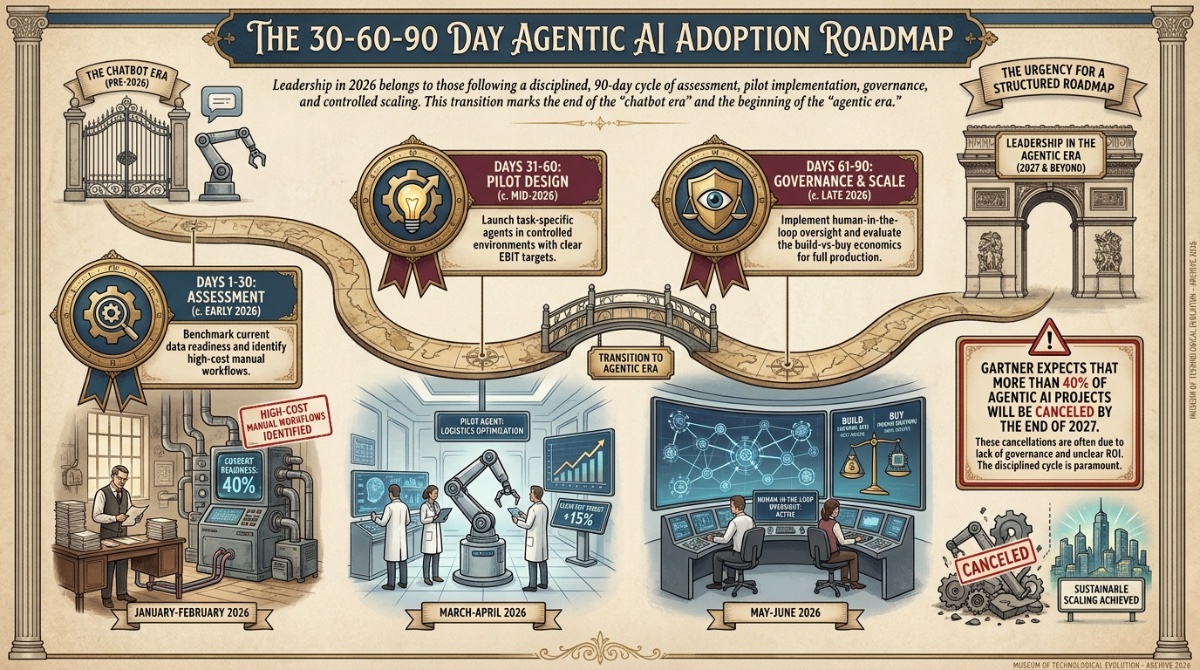
Leadership in 2026 belongs to those following a disciplined, 90-day cycle of assessment, pilot implementation, governance, and controlled scaling. This transition marks the end of the “chatbot era” and the beginning of the “agentic era.”
-
Days 1-30: Assessment. Benchmark current data readiness and identify high-cost manual workflows.
-
Days 31-60: Pilot Design. Launch task-specific agents in controlled environments with clear EBIT targets.
-
Days 61-90: Governance & Scale. Implement human-in-the-loop oversight and evaluate the build-vs-buy economics for full production.
The urgency for a structured roadmap is underscored by recent market projections. Gartner expects that more than 40% of agentic AI projects will be canceled by the end of 2027. These cancellations are primarily attributed to escalating operational costs and a failure to demonstrate clear business value .
Human-in-the-Loop: Designing Trust and Governance
The tension between the pressure for rapid deployment and the need for operational stability has become a primary concern for technology leadership. Organizations are finding that while it is easy to build a prototype, it is difficult to maintain a system that can reliably handle the edge cases of a live business environment.
Approximately 66 percent of Chief Information Officers (CIOs) report that their staff lacks the training required to use AI responsibly . An identical 66 percent of these leaders admit they are not fully confident that their current governance models can keep up with the pace of implementation . This gap between technical capability and oversight suggests a period of potential instability for firms that fail to prioritize safety.
Industry experts warn that the current “move fast and fix things later” mentality may not be sustainable in highly regulated sectors. The technical debt associated with hasty deployments is beginning to surface. As companies rush to integrate agents into legacy systems, they often overlook the long-term maintenance requirements, leading to increased vulnerabilities.
Frequently Asked Questions
What is the primary difference between Generative AI and Agentic AI?
Generative AI focuses on creating content or answering prompts based on existing data, acting as a passive assistant. Agentic AI is proactive and autonomous, capable of planning and executing multi-step tasks across different software platforms with minimal human intervention.
Why are so many agentic AI projects failing to show ROI?
Most failures stem from a “value gap” where companies deploy tools without redesigning the underlying workflows. High operating costs, such as token fees and technical debt, often offset the productivity gains if the tool is not tied to a specific cost-saving or revenue-generating task.
How does the “build-versus-buy” shift affect software procurement?
With automated coding tools, 32% of companies are choosing to build custom internal solutions rather than renewing vendor contracts. This forces CIOs to weigh the lower upfront cost of building against the long-term burdens of security, maintenance, and updates that a vendor typically handles.
What are the biggest risks of rapid agentic AI deployment?
The primary risks include a “governance vacuum” where agents interact with sensitive data without oversight, and escalating technical debt. Additionally, 66% of CIOs report that their staff lacks the necessary skills to manage these autonomous systems safely.
References
McKinsey & Company, “The state of AI in 2026: On the road to ROI” (Aug 25, 2026).
KPMG US, “The ROI Horizon: Navigating the Transition from AI Deployment to Enterprise Value” (Global AI Pulse, 2026).
Mayfield CXO Network, “Fortune 2000 Agentic AI Survey” (2026).
Gartner, “Predicts 2026: The Rise of Agentic AI” (2025).
Logicalis, “CIO Report 2026: Governance in the Age of Autonomy.”
MIT Sloan Management Review, “The P&L Impact of Generative AI Pilots” (2026).
Industry Analysis, “The $40 Billion AI Expenditure Gap” (2026).
Gartner, “Strategic Technology Trends 2027.”
IBM Case Study, “AskHR: Scaling Specialized Agents.”
McKinsey & Company, “High Performers in the AI Economy.”