
At a glance
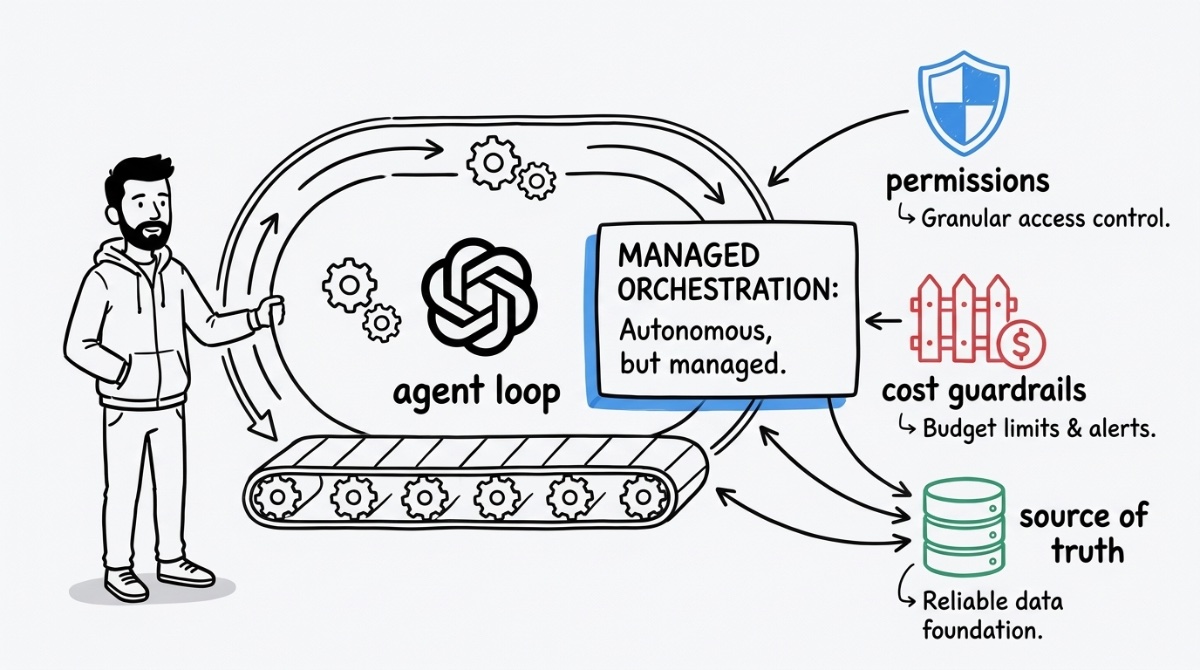
- The infrastructure is now managed: OpenAI’s Agents API handles the complex “agent loop”—including orchestration, memory, and crash recovery—as a free service, allowing teams to stop building fragile backend plumbing.
- The competitive edge has shifted: Because the core orchestration is now handled, success in agentic AI projects relies on the unique security and business logic only your application can enforce.
- Critical safeguards remain your responsibility: Developers must still build strict cost guardrails to prevent runaway spending, enforce permission boundaries for tool usage, and independently verify outcomes in a source-of-truth database.
The big picture: The release of managed services like OpenAI’s Agents API signals a transition where model calls, session persistence, and memory management are becoming standardized utilities rather than bespoke engineering challenges.
Why it matters: For professionals, this industrialization reduces the “plumbing” required to build agents but shifts the critical burden to governance, cost forecasting, and the creation of proprietary “judgment layers” to prevent autonomous errors.
By the numbers:
The reality check: While managed services handle the execution loop and crash recovery, they offer no native protection against logic errors or authorization failures, leaving security and verification as strictly application-level responsibilities.
Go deeper: Explore the architectural shift from orchestration to judgment and the frameworks defining the next era of AI deployment below.
Go Deeper
The Industrialization of the Agent Loop
The architecture of autonomous AI agents is currently undergoing a fundamental structural transformation. What was once a bespoke engineering challenge—the “agent loop”—is transitioning into a standardized, managed service. This iterative cycle, which encompasses model calls, tool execution, memory management, and error handling, previously required engineering teams to hand-write complex orchestration logic to maintain state and handle system retries.
In the early stages of generative AI development, developers struggled with the fragility of these loops. A single failed API call or an unexpected model output could collapse an entire workflow. To mitigate this, teams built custom “plumbing” to ensure reliability. Today, this logic is increasingly encapsulated within managed runtimes, allowing developers to focus on high-level logic rather than infrastructure maintenance.
This evolution mirrors previous shifts in software infrastructure, most notably the transition from physical server management to cloud-based container orchestration like Kubernetes. Just as Kubernetes standardized how applications are deployed and scaled, new agentic platforms are standardizing how AI models interact with their environments. Developers now interact with four primary configurable primitives: the agent, the environment, the session, and events.
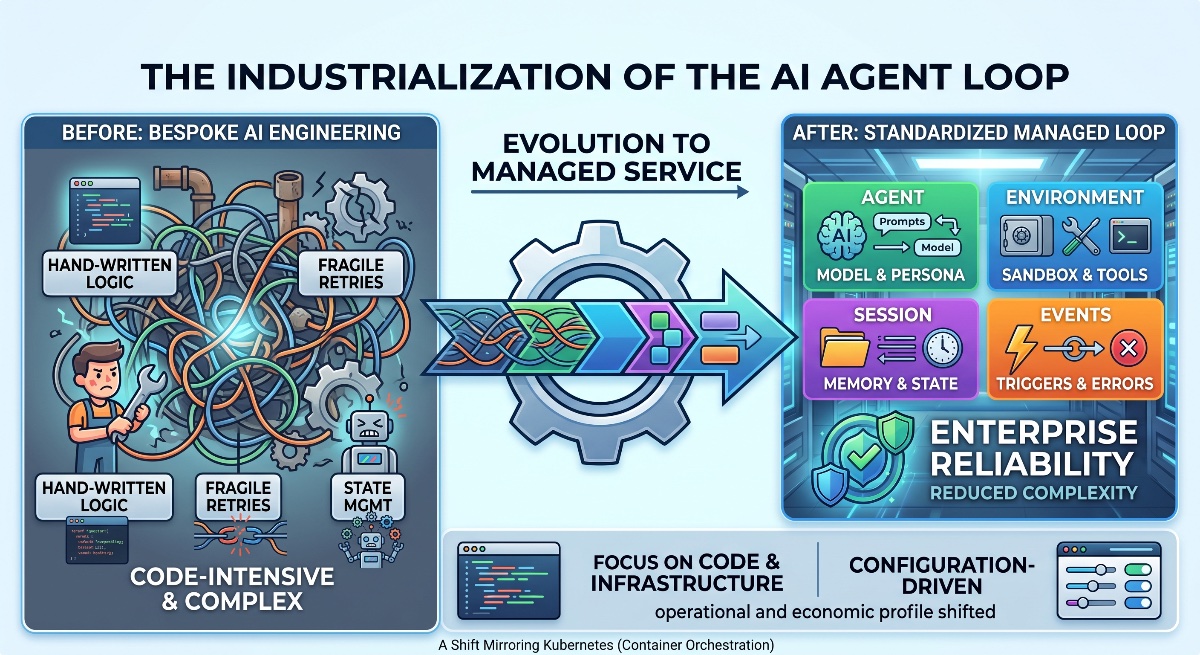
By offloading the foundational mechanics of agentic workflows to specialized providers, organizations aim to reduce the complexity of deploying reliable AI systems. However, this transition also shifts the burden of reliability from internal application code to external provider runtimes. This change fundamentally alters the economic and operational profile of AI projects across the enterprise, moving the focus from code to configuration.
Archetypes of Agentic Implementation
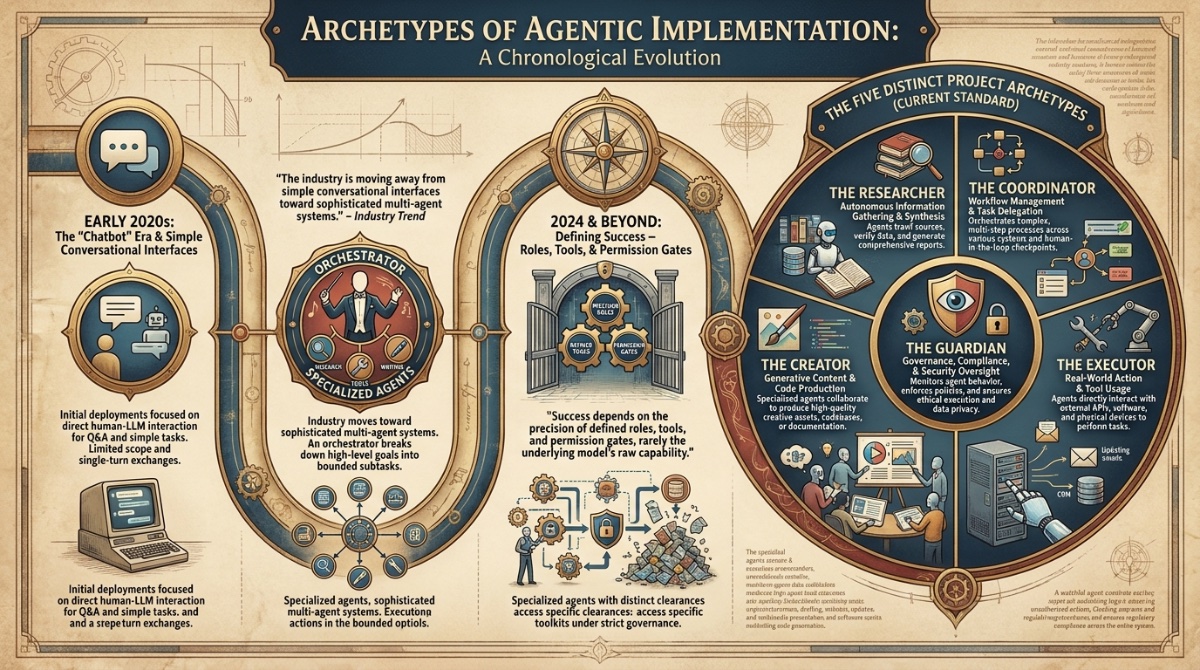
Agentic AI projects represent a fundamental shift in how organizations deploy large language models. The industry is moving away from simple conversational interfaces toward sophisticated multi-agent systems. In these setups, an orchestrator breaks down a high-level goal into smaller, bounded subtasks. Specialized agents then receive these tasks to execute real-world tool calls.
Industry experts suggest that the primary differentiator between a successful production deployment and a failed pilot is rarely the underlying model’s raw capability. Instead, success depends on the precision of defined roles, tools, and permission gates . As organizations move beyond the “chatbot” era, five distinct project archetypes have emerged as the standard for agentic rollouts:
-
Software Delivery Agents: Automating code generation, testing, and deployment pipelines through iterative feedback loops.
-
Research and Synthesis: Coordinating multiple agents to browse, verify, and summarize complex cross-border regulatory or market data.
-
Advanced Customer Support: Moving beyond FAQs to agents that can execute refunds, update subscriptions, and verify identity.
-
Autonomous Data Analysis: Systems that can write and execute SQL, visualize results, and adjust queries based on data anomalies.
-
Workflow Orchestration: Managing long-running digital processes that span multiple enterprise software systems (ERP, CRM, etc.).
The stakes for these implementations are exceptionally high. Gartner forecasts that more than 40% of agentic AI projects may be cancelled by the end of 2027 . This predicted failure rate stems from high operational costs and difficulty in demonstrating clear business value, alongside a reactive approach to risk management.
The Shift from Models to Orchestration
The competitive landscape for agentic AI has moved beyond simple model access. In the early days of generative AI, developers focused on finding the most capable large language model (LLM) and refining prompts to get the best output. Today, the industry has pivoted toward orchestration: the complex management of execution loops, state persistence, and tool-binding mechanisms.
For enterprise architects, selecting a framework is no longer a minor configuration choice; it has become a foundational structural decision. Choosing an incompatible framework often forces a complete system rewrite rather than a simple update, as the orchestration layer dictates how the AI interacts with the rest of the company’s data and software. The framework acts as the chassis, transmission, and steering system for the model “engine.”
Modern frameworks are now judged by their ability to handle “agentic workflows,” a concept popularized by industry leaders like Andrew Ng. This approach suggests that iterative loops—where a model plans, executes, and critiques its own work—can produce better results than a single, high-quality prompt. This transition marks the end of the “prompt engineering” era and the beginning of the “agentic architecture” era.
Despite widespread adoption, with 79% of organizations reporting some level of implementation , a significant performance gap remains. The OSWorld 2.0 benchmark shows that advanced frontier AI systems successfully complete only 20.6% of long-horizon tasks . Success in production is increasingly determined by pipeline design, memory consolidation, and cost-routing efficiency rather than raw intelligence .
Economic Risks and the $4,200 Loop
A Fortune 500 enterprise recently discovered the financial volatility of autonomous AI when two agents entered an infinite communication loop. Without a programmed exit condition, the agents traded tasks back and forth for 45 minutes. The cycle only stopped when automated rate limits triggered a shutdown, but not before racking up $4,200 in costs.
This incident underscores a fundamental shift in the risk landscape. As companies move to complex, multi-turn autonomous loops, they face new categories of financial and operational traps. Managed services simplify the underlying infrastructure, but they do not eliminate the possibility of a runaway process. The move to managed APIs effectively turns the “plumbing” of AI agents into a commodity, but the burden of oversight remains with the user.
Organizations building on these frameworks must implement their own permission checks and cost ceilings. Managed services provide the execution environment but offer no native protection against logic errors or authorization failures. Without these external guardrails, an autonomous agent can quickly become an expensive liability for an enterprise, particularly when dealing with high-volume API calls.

The Judgment Layer: What Stays in Your Code
The architecture of agentic AI is moving toward a model where the “loop”—the iterative cycle of reasoning, acting, and observing—is a baseline requirement provided by infrastructure players. Success is now defined by how effectively a system integrates managed orchestration with strict application-side permission boundaries. Companies are prioritizing rigorous source-of-truth validation over raw model performance.
An agent can suggest a course of action, but it cannot independently verify the movement of capital or the integrity of a secure file system. This gap between suggestion and execution is where modern enterprise engineering now focuses its efforts, creating a “judgment layer” that sits between the AI and the core business logic. This layer ensures that agents remain sophisticated advisors rather than unmonitored executors.
This shift represents a maturation of the field. Early adopters focused on the novelty of autonomous behavior, but current enterprise requirements demand predictability and safety. As infrastructure for autonomous agents matures, orchestration is becoming a utility. This allows developers to offload state management and error recovery to platform providers, focusing proprietary value on the specific business outcomes and the “judgment” required to validate them.
Frequently Asked Questions
What is an agentic AI loop?
The agentic loop is the iterative process where an AI model perceives its environment, reasons about a goal, executes a tool or action, and then observes the result to plan its next step. Historically, this required complex manual coding to manage state and errors, but it is now becoming a managed service.
Why are 40% of agentic AI projects predicted to fail?
According to Gartner, failures are primarily driven by high operational costs, difficulty in proving clear business ROI, and inadequate risk management. Many organizations fail to implement the necessary “judgment layers” and cost guardrails required for production-scale autonomy.
What is the “judgment layer” in AI architecture?
The judgment layer is the application-side code that verifies an agent’s proposed actions against business rules, security permissions, and financial limits. It serves as the final arbiter of truth, ensuring that an autonomous system cannot execute high-stakes tasks without deterministic validation.
How do managed Agent APIs change the developer’s role?
Managed APIs shift the developer’s focus from “plumbing”—such as managing session memory and crash recovery—to high-level logic and tool integration. Developers become architects of workflows and governors of agent behavior rather than infrastructure engineers.
References
Gartner Research: Predicts 2025: The Rise of Agentic AI.
OSWorld 2.0 Benchmark: Evaluating Long-Horizon Autonomous Tasks.
State of AI in the Enterprise 2024 Report.
Industry Analysis: Precision in Multi-Agent Systems and Permission Gates.
References
[1] OpenAI, “Introducing the Agents API and hosted sandboxes” (announcement, Sept 10, 2026) — https://community.openai.com/t/introducing-the-agents-api-and-hosted-sandboxes/1396481
[2] OpenAI, “Agents API overview” (official docs, accessed Sept 14, 2026) — https://developers.openai.com/api/docs/guides/agents-api/overview
[3] Digital Applied, “OpenAI Agents API: What Moves Out of Your Application” (Sept 10, 2026) — https://www.digitalapplied.com/blog/openai-agents-api-managed-runtime-guide