

At a glance
- Adoption hit a record: 40% of billion-dollar companies use AI agents widely (up from 27%), yet EBIT impact remains flat at 37% and only 6% are “high performers”.
- The build-versus-buy line flipped: 32% of companies recently declined to buy software they can now build in-house using automated coding tools.
- The fix requires workflow redesign and a clear starting cost, not better models — and claiming “some profit impact” masks a lack of real financial returns.
Forty percent of billion-dollar companies now report widespread agentic AI adoption across their teams. That is a steep climb from 27 percent just one year ago . Yet the number of businesses making real money from these systems refused to budge. That figure sits at 37 percent, exactly where it stalled last year . At the same time, nearly one in three companies recently refused to buy software because they can now build it themselves .
Usage races ahead of financial returns as enterprise adoption hits new milestones. McKinsey’s 2026 State of AI survey polled 1,719 leaders across 97 countries. It found that 88 percent of groups use the technology in at least one business area . Forty-four percent say they use it across the whole company, up from 38 percent last year . But only 37 percent tie any operating profit—measured as Earnings Before Interest and Taxes (EBIT)—to these tools . Just 6 percent count as “high performers” who credit the tools with at least a 5 percent profit boost. Both of those financial numbers stayed flat over the past year .
The biggest threat to software sellers hides in the choice to build or buy. Thirty-two percent of groups decided not to buy a software product because smart coding tools let them build it themselves . A third of the market now defaults to building. This shifts how engineering teams spend their budgets, and it happened in just one year.
Rising costs also hurt the buyers during this wave of enterprise adoption. Roughly 20 percent of leaders say daily operating costs limit their use . This includes token costs, the tiny fees charged every time a user asks a language model a question. Data from Klynveld Peat Marwick Goerdeler (KPMG) fills out the daily picture. Sixty-five percent of groups struggle to expand these automated tasks, nearly double the previous quarter . Another 62 percent say a lack of staff skills blocks them from showing a Return on Investment (ROI) . The roadblock is no longer the model itself. The friction lives in the human work around it.
The 6 percent of companies actually making money share a simple playbook. McKinsey’s high performers chase growth alongside efficiency, rather than just cutting costs . They redesign the daily work that holds the new tool, instead of forcing a new tool into an old routine.
Engineering leaders can turn this into two clear moves. First, stop measuring success by how many people use the tool. Pick a single task with a clear starting cost—like customer service routing or back-office checks—and track the dollars from day one. Companies stuck at zero financial impact usually gave a chatbot to ten thousand workers without defining a single goal.
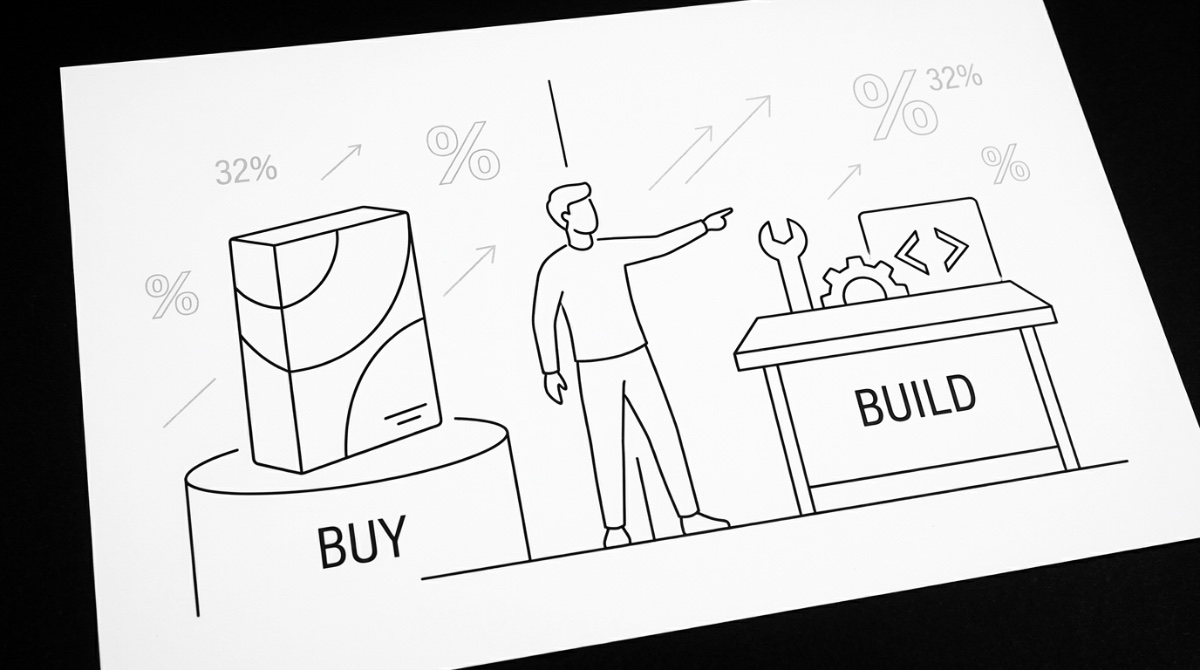
Second, treat the build-versus-buy choice as a daily question rather than a yearly review. Before you renew a vendor contract, ask if an internal team can build a basic version cheaply using an automated coding assistant. Just do not confuse a rough early version with a finished product. The 32 percent of companies refusing to buy software still have to pay for security, daily fixes, and long-term upkeep. A vendor usually handles those heavy burdens.
Read that 37 percent figure closely. The phrase claiming “at least some” profit impact carries a lot of weight in McKinsey’s report . Only 6 percent of leaders credit the technology with 5 percent or more of their EBIT . While 80 percent of workers say automation improved their personal speed, faster workers do not automatically equal higher company earnings .
This gap points to a tracking problem just as much as a failure to do the work. Faster work that never lowers a cost line on a financial statement is easy to claim but impossible to defend to a board. McKinsey titled the report “On the road to ROI”—a nod to the ongoing search for real value. Roads describe a journey, not an end point. The technology still fails to clear the earnings bar for most companies. The data gives boards plenty of reasons to ask the exact same questions they asked last year. The only difference is who has to answer them. Engineering leaders now need to bring hard numbers to the table.
References
[1] McKinsey & Company, “The state of AI in 2026: On the road to ROI” (Aug 25, 2026).