

At a glance
- For mid-career expats considering a move from the U.S. to destinations such as Costa Rica or Germany, relocating for a job is worth it only when a dual-country analysis proves that lower living costs and lifestyle gains outweigh reduced base pay, cross-border taxation for expats, and hidden relocation costs—making a structured decision framework essential.
- For mid-career professionals, moving abroad is no longer a simple salary comparison. Expats must weigh a U.S. $200K tech salary against a €130K European offer, then factor in lower healthcare, education, and daily costs alongside dual-country taxation expats face, visa rules, and hidden relocation expenses. This guide cuts through the noise with a practical framework for expats Costa Rica, expats Germany, and other markets, helping you answer the critical question: is relocating for a job worth it? You will learn how to calculate true net cash flow, anticipate cross-border tax liabilities, and score cities on livability, career momentum, partner employment, schools, and community. The Expat Financial & International Tax Evaluator turns guesswork into a clear, personalized decision. Before you accept the offer, run the numbers, test the lifestyle trade-offs, and protect your long-term wealth. Your next move deserves evidence, not hope.
- A $200,000 U.S. salary often shrinks to €130,000 in Europe, but for expats the bigger decision isn’t the pay cut—it’s whether the tax, lifestyle, and long-term wealth math makes the move worth it.
The reality check: A lower nominal salary in a social democracy often yields higher “net-net” wealth accumulation because the state covers infrastructure, education, and personal liability risks that are privatized in the U.S.
Go deeper: Understanding the hidden economic ecosystem of your destination is the only way to ensure a move supports your long-term financial goals.
Go Deeper
The Two- to Three-Year Net-Income Test
Relocating for a professional role is a strategic decision that requires a clear financial baseline. A move is generally considered successful when your net income remains equal to or higher than your current baseline over a multi-year period.
The three-year window: This timeframe is vital because it allows you to spread out high upfront costs. Initial expenses like shipping, temporary housing, and legal fees often create a financial deficit in the first twelve months. A move that appears unprofitable in the first year may show a significant surplus by the end of the third year as these costs are absorbed.
Stabilizing habits: During the first year, you are likely to spend more on local services as you learn the market. By years two and three, your spending habits typically stabilize, providing a more accurate picture of your long-term financial trajectory in the new country.
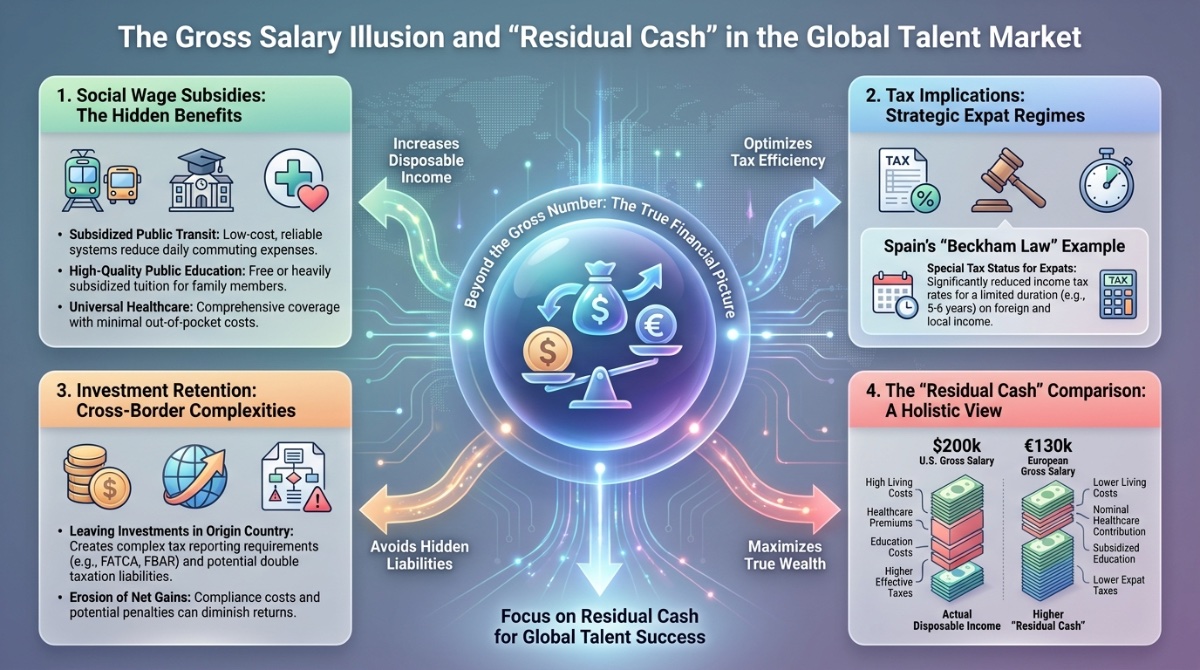
The Gross Salary Illusion and “Residual Cash”
In the global talent market, a $200,000 U.S. salary rarely translates directly to a European equivalent. While a €130,000 offer looks like a pay cut, the comparison is incomplete without looking at “residual cash.”
-
Social wage subsidies: In many European countries, the “social wage” acts as a hidden subsidy. This includes benefits like subsidized public transit, high-quality public education, and universal healthcare.
-
Tax implications: Mid-career professionals must understand specific tax laws, such as Spain’s “Beckham Law,” which can significantly benefit expats for a limited duration.
-
Investment retention: Leaving investments in your country of origin can create complex tax reporting requirements and potential liabilities that erode net gains.
Urban Fundamentals Over Cultural Amenities
A truly great city for expats is defined by its ability to reliably deliver fundamental civic outcomes. While cultural prestige and festivals are visible, they are structurally secondary to economic stability.
The economic engine: Success is measured by a city’s resilience during economic downturns. A city with a diversified economy and a disciplined municipal budget can sustain its services when tax revenues dip. For the global professional, the primary driver of relocation is the career opportunity; everything else is built upon that baseline.
Career insurance: A deep labor market acts as a form of insurance. In cities like London or New York, losing a job is a setback rather than a catastrophe because of the density of alternative employers. In smaller markets, a single layoff can force a family to relocate again, regardless of the local “vibe.”
The Hidden Ledger: Partner Employment and Childcare
Standard cost-of-living calculators often track the price of groceries but ignore the complex variables of a mid-career household. A move is a structural reorganization of your social capital.
-
Partner career equity: The loss of a secondary household income is a major factor frequently overlooked. If a trailing spouse cannot secure a visa or a comparable role, the household’s total net worth may decline despite a higher primary salary.
-
International schooling: For professionals with children, the cost of international schools can be a massive “leakage” point. These costs must be factored into the “net-net” calculation before signing a contract.
-
Healthcare gaps: Medicare does not cover care outside the US, except in minimal border emergencies . This makes private health insurance or access to high-quality public systems a critical variable for growing families.
A Practical Scoring Rubric for Global Markets
A practical expat scoring rubric converts quality-of-life and financial variables into a single, comparable score. This strips away the emotional allure of a new city to focus on economic reality.
Market comparisons: Roughly 8.7 million U.S. citizens live abroad, with Germany, Mexico, and Costa Rica as top destinations . However, nearly half of U.S. expats report earning less than they did at home . This highlights why the rubric is essential to avoid “optimism bias.”
Case Studies: The Mid-Career Reassessment
Expats who move mid-career rarely judge the decision on salary alone. Those who reassess after two years tend to measure success based on partner employment and “career optionality”—the ability to find the next role without leaving the new region.
The portfolio view: A job-driven move abroad works when net income improves over three years, career options rise, and the lifestyle costs absorbed are ones the family can genuinely sustain. It is a long-term investment in professional and personal capital, not just a temporary assignment.
Frequently Asked Questions
How does the “Beckham Law” affect expats in Spain?
The Beckham Law is a special tax regime that allows foreign workers to be taxed as non-residents, applying a flat tax rate (currently 24%) on Spanish income up to a certain threshold for up to six years. This can significantly increase net take-home pay compared to standard progressive tax rates.
What happens to my U.S. investments if I move abroad?
You generally retain ownership, but you may face complex reporting requirements like the FBAR or FATCA. Additionally, some foreign countries may tax the capital gains or dividends from those investments, potentially leading to double taxation if a tax treaty is not properly applied.
Is international school tuition usually covered by employers?
While executive-level “gold-plated” relocation packages often include tuition, many modern “local-plus” contracts do not. Mid-career professionals must negotiate this explicitly, as private international schooling can cost between €15,000 and €30,000 per child annually in major European hubs.
How do I calculate “residual cash” accurately?
Start with your gross offer, subtract local income tax and social security, then deduct fixed costs like rent, private health insurance, and schooling. Finally, factor in the difference in daily consumer costs (groceries, utilities) using purchasing power parity indices to find your true discretionary income.
References
[1] ### Key Takeaways – Nearly half of professionals who relocated for work (47%) say the move improve.
[2] ## What Are the Real Pros of Relocating for a Job? ### Does relocating for work actually lead to a.
[3] Foreign rental income, capital gains, or dividends from the US remain tax-free in Costa Rica.
Gini Loh
•Financial Systems Engineer
Gini Loh builds interactive decision engines and analytical frameworks to help professionals optimize compensation, evaluate assets, and automate investments.