
The Strategy Brief
- The Giniloh Strategic Decision-Intelligence Engine can help you evaluate buying decisions like a commuting eBike.
- Evaluating e-bike costs through a cost-per-use framework reveals that a $2,500 investment results in a daily round-trip cost of approximately $7.90, which is significantly lower than the average daily parking fee of $15.00.
- Transitioning to an e-bike for daily commuting can save a rider nearly $3,000 over three years by eliminating recurring expenses like parking, fuel, and rideshare fees.
- The ongoing energy costs for an e-bike are remarkably low, with a typical 10-mile daily commute costing less than $3.00 in electricity for an entire year.
- While the upfront sticker price may be high, the total cost of ownership includes manageable annual maintenance fees and battery reserves that are far outweighed by the reduction in car-related expenses.
Introduction: Why Understanding E-Bike Costs Can Save You Thousands
The Giniloh Strategic Decision-Intelligence Engine can help you evaluate buying decisions like this within its Cost-Per-Use tab.
I have a friend at work who lives in a different city (Rockville, MA) and uses a combination of an electric scooter and the metro. It works wonderfully for him to avoid traffic stress and get to work in Rosslyn (Arlington, VA). Watching him arrive at the office refreshed instead of frazzled really got me thinking about my own commute and the potential of eBike costs to change my life.
I’ve been staring at e-bike price tags lately, and I’ll be totally honest with you: my first thought was probably the exact same as yours. I looked at the screen, blinked a few times, and thought, “That is a whole lot of money for a commuter bicycle.” It’s hard not to feel a bit of sticker shock when you see a bike costing as much as a decent used car.
But then, I sat down with my favorite mug of coffee and started doing some real thinking about what I’m already spending just to get around every day. I started looking at my bank statements and realized how much those “little” things add up. Between the parking fees and the gas prices that swing wildly, I was bleeding money.
I also thought about those times I’m running late or just too tired to deal with the afternoon traffic, so I end up grabbing a rideshare. Those $20 trips here and there really start to hurt after a while. I realized I might be asking the wrong question entirely. Instead of asking how much the bike costs, I should have been asking how much my life costs right now.
The Real Question Nobody’s Asking
The real question isn’t just whether e-bikes are expensive. It’s whether they actually cost less than your current commute over the long run. That is a totally different conversation, and it’s the one I really want to have with you today.
It’s so easy to look at a $2,000 or $3,000 price tag and immediately say “no way,” but it’s a lot harder to ignore the hundreds of dollars leaking out of your bank account every month. I remember looking at my monthly budget and seeing a giant chunk of change going toward a car that mostly just sat in traffic. It felt like I was paying a “stress tax” every single day.
To get a clear picture, I’ve been using the Giniloh Strategic Decision-Intelligence Engine . It’s just a way for us to compare costs using something called Cost-Per-Use (CPU). Instead of looking at the big number on the price tag, we look at how much each individual trip actually costs you.
What You’ll Walk Away With
By the time we’re done chatting, you’re going to have a complete, honest breakdown of ebike costs compared to what you’re spending right now. I’m going to dig deep into the total cost of owning one of these things, including those sneaky hidden costs. I want you to have all the facts so you can make a choice that feels good for your wallet.
I’ve also got a great story to share about a friend of mine, Sarah, who actually ran these numbers for herself. She ended up saving nearly $3,000 over three years just by switching some of her trips to an e-bike. Let’s look at how the different tiers of bikes stack up against each other.
Breaking Down E-Bike Costs: From Sticker Prices to Hidden Expenses
The Price Tag That Caught Me Off Guard
I’ll remember the time when I thought that I’d just drop a few hundred bucks on an e-bike and be off to the races.
Then I saw the actual numbers and realized very quickly that a good e-bike isn’t just a bike with a battery. It’s a sophisticated piece of machinery that feels more like a tiny electric car. The sticker shock was real, and it took me a few days to wrap my head around why these things cost what they do.
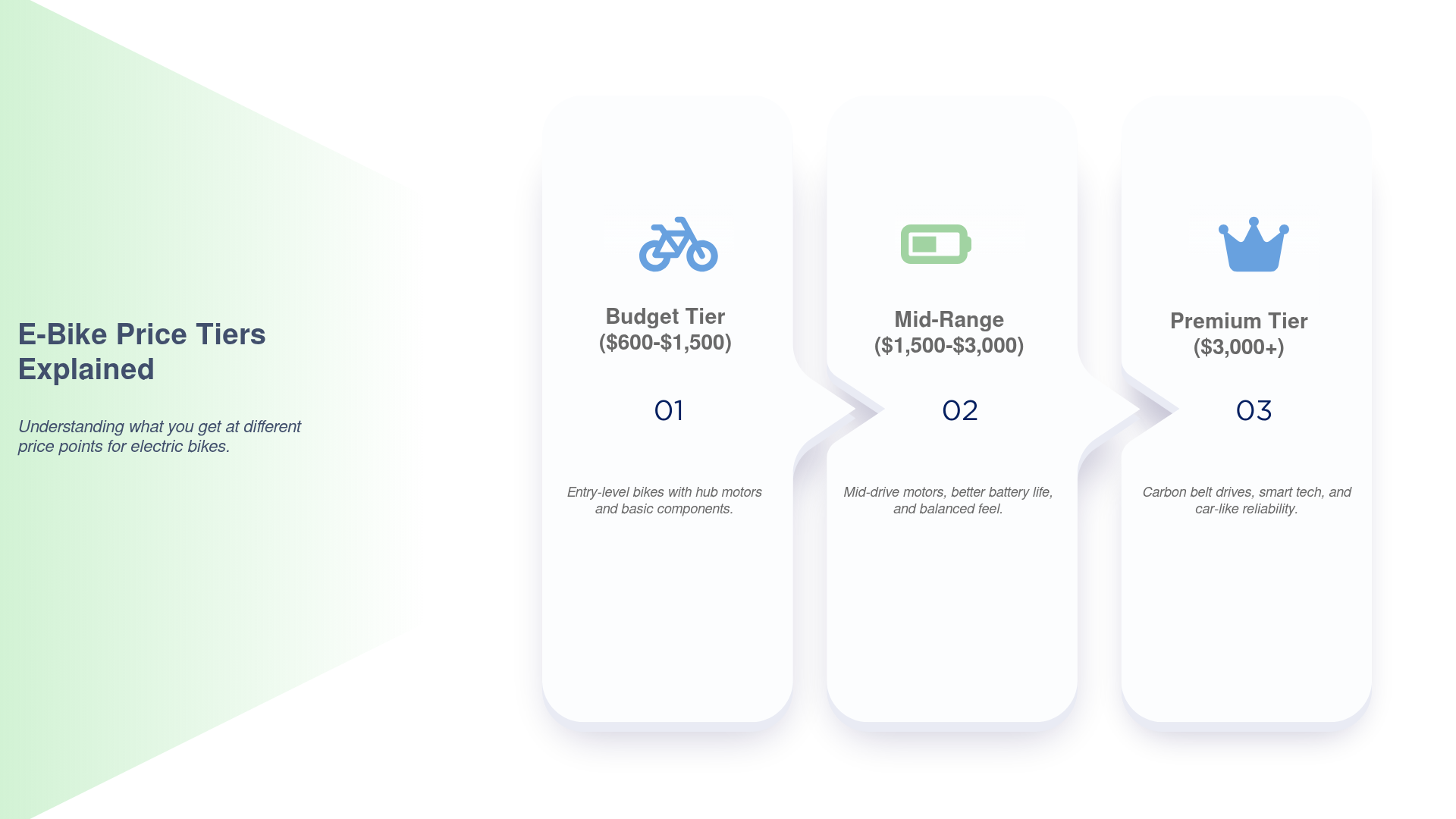
Understanding the Budget Tier ($600 – $1,500)
These are your entry-level options, and honestly, they’re where a lot of people start our journey. When I tried one of these, I noticed right away that the manufacturers had to cut some corners to keep the price down. They use basic parts that you might find on a standard department store bike.
On these budget models, you’re usually looking at mechanical disc brakes instead of hydraulic ones. This means you have to squeeze the levers a bit harder to come to a stop. The motors are almost always “hub motors” located in the center of the back wheel, which feels like a gentle push from behind.
These bikes usually have smaller batteries, giving you maybe 20 to 30 miles of range. They’re perfect if you’re just dipping your toe in the water or riding on flat, paved roads for a few miles at a time . My neighbor, Mike, uses a budget cruiser for trips to the library, and for him, it’s perfect.
The Mid-Range Sweet Spot ($1,500 – $3,000)
This is the sweet spot where I think most people end up finding their “forever bike.” In this price bracket, you start seeing a massive jump in quality. You’re getting reliable motors from brands you’ve actually heard of, like Bosch, Yamaha, or Shimano.
In this range, the batteries can handle more charge cycles, meaning they’ll last for years before they start to lose their punch. Many of these bikes use “mid-drive” motors, which are located right where the pedals are. This makes the bike feel much more natural and balanced during your ride.
The Premium Tier
This premium tier is where e-bikes turn into true car replacements. Between $3,000 and $9,000+, you are leaving budget parts behind for ultra-smooth mid-drive motors (like Bosch) and smart tech like built-in GPS tracking.
Top-tier commuter and cargo brands like Riese & Müller or Specialized swap out messy chains for clean carbon belt drives and internal gears that rarely need maintenance. Whether it is an indestructible cargo bike carrying the kids or a high-end electric mountain bike, this segment is all about ultimate reliability, massive battery range, and automotive-grade engineering built to last for years.
The Real Price Tag: Total Cost of Ownership for Your Commute
Why Sticker Price Is a Trap
When evaluating ebike costs, most of us fall into the same trap I did. We just look at that big upfront number and compare it to things that aren’t really comparable. I used to think a $2,500 e-bike was expensive compared to calling a rideshare a few times a week.
However, the electric bike cost you’re worried about upfront starts looking a lot more reasonable once you stack it against car expenses. You have to consider the “all-in” cost, including maintenance, insurance, and the daily fees associated with driving.
Real-World Case Study: A $2,500 E-Bike vs. Parking Fees Alone
My E-Bike Paid for Itself in 18 Months
I’ll be honest with you—I was really skeptical at first. The idea of dropping $2,500 on a bicycle felt like something my wallet would immediately regret. I mean, that’s a lot of money for something that doesn’t even have a roof, right?
But my parking situation at work was getting completely ridiculous. Every single month, that parking pass ate $450 from my bank account. When I sat down and thought about it, that’s basically a car payment for a spot of concrete where my car sat while I wasn’t even driving it .
I’d spend ten minutes just circling for a spot, getting more and more annoyed before my day even started. By the time I walked into the office, I was already stressed out and frustrated. That’s when I decided I needed to see if there was a better way to do this.
Crunching the Numbers
I pulled out a calculator and started crunching the numbers to see if an e-bike was a smart move or just an expensive toy. I wanted to be as realistic as possible about what I was getting into. Here is how the daily costs actually break down when compared to other methods.
The e-bike came out to $7.90 per trip. That is literally half the price of just the parking fee at my local garage! Furthermore, I discovered it costs only $2.89 in electricity for the entire year to charge the bike .
Your Personal Decision Maker: Use the Giniloh Strategic Decision-Intelligence Engine
The Real Math Behind Buying an E-Bike
I spent a fair ammount of time hemming and hawing before I finally pulled the trigger on my first e-bike. I was stuck in a loop of doubt, worrying that I wouldn’t actually ride the thing. I had this vision of it sitting in my garage, gathering dust.
But you don’t need a fancy degree to figure this out. You just need three basic numbers and a little bit of honesty about your daily habits. It’s much less scary when you break it down into bite-sized pieces and look at the “Cost-Per-Use.”
The Giniloh Strategic Decision-Intelligence Engine Explained
Think of the Giniloh Strategic Decision-Intelligence Engine as a friendly reality check for your wallet. It is a simple way to stack up the true cost of owning and riding an e-bike against what you are already spending just to get around town. Think of it as a head-to-head battle between a shiny new ride and your current daily commute!
To test the app, you can head right over to the Cost-Per-Use tab and plug in your own numbers to see how they stack up.
To show you how it works, let’s look at a quick example:
The Dilemma: Is it worth dropping $2,500 on an electric commuter bike, or is it better to stick with city parking fees, gas, and rideshares? For a professional in California—where gorgeous, year-round weather means you never have to worry about a winter break from riding—the math gets really interesting. Let’s break it down step-by-step.
To find the true day-to-day cost of ownership, the framework needs the Upkeep / Internal Cost (Per Use) that in this case is calculated as $1.73 per-use upkeep rate by amortizing all hidden secondary expenses across the e-bike’s entire lifecycle. Over a three-year span, keeping the bike safe, running smoothly, and powered requires an estimated $700 investment, which covers $180 in essential gear (like a premium lock, helmet, and safety lights), $300 for annual professional tune-ups, a $200 reserve fund for a future replacement battery, and roughly $20 in electricity for charging. By taking this combined $700 upkeep pool and dividing it by the 405 total roundtrips generated from a three-day hybrid schedule across 45 working weeks per year, the framework reveals that your actual maintenance footprint boils down to just $1.73 every time you make the trip.
How to Enter in the App:
- Select the Cost-Per-Use tab at the top.
- In the Sticker Price (Upfront Cost) field, type
2500(or adjust the slider). - In Weekly Usage Frequency (hybrid commute trips per week), type
3(or adjust the slider). - In Outsourced / Alternative Cost (daily parking fee), type
15.00(or adjust the slider). - In Upkeep / Internal Cost (Per Use) (electricity, gear, tune-ups amortized per trip), type
1.73(or adjust the slider). - Set the Target Lifespan Horizon (Years) stepper to
3 years.
To run this simulation, the framework evaluates five core parameters based on a 3-day weekly hybrid work schedule over a 3-year lifespan horizon (totaling 405 roundtrips). The baseline investment starts with a $2,500 upfront sticker price for the premium e-bike, paired with an internal upkeep cost of $1.73 per roundtrip to account for gear, locks, tune-ups, and battery reserves. This ownership model is weighed against an alternative outsource price of $15.00 per roundtrip, which reflects daily city parking fees alone while strictly excluding additional fuel or rideshare expenses.
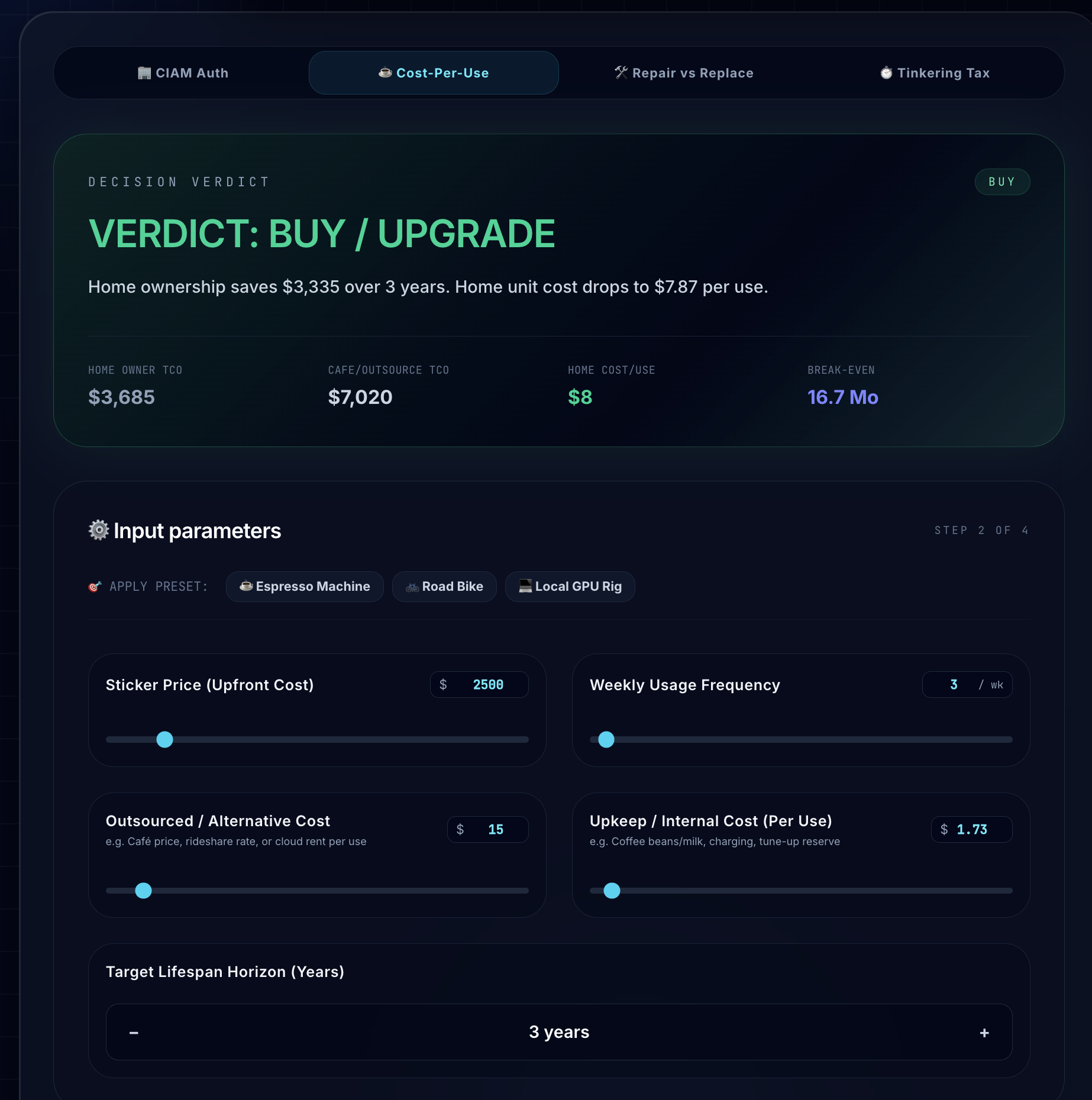
By choosing the e-bike, you instantly flip the script on your daily expenses, pocketing $3,335 in lifetime savings over three years compared to paying for city parking alone. Instead of watching your hard-earned money slowly disappear into a parking garage meter, your total cost of ownership (TCO) for commuting drops to just $3,685 over that entire three-year stretch. When you look at the micro-math, your real day-to-day cost drops to an incredibly efficient $7.87 per roundtrip—nearly cutting your old $15.00 alternative parking rate in half.
Think of it like comparing a home-cooked meal to ordering takeout every night. One has a bigger cost upfront because you have to buy the groceries and the pots and pans. The other feels cheaper in the moment, but those small bills add up fast over a month.
Conclusion: Is an E-Bike Right for Your Commute?
The Numbers Don’t Lie
When I first sat down to run the numbers, I was more than a little skeptical. I honestly thought there’d be some kind of hidden catch. How could spending $2,500 on a new bike really be better for my bank account than just paying for my daily parking spot?
But once I actually plugged my own stats into the framework, the math was impossible to argue with. I realized I was handing over thousands of dollars a year just for a tiny patch of concrete. I wanted something that didn’t just save me money, but actually made my morning feel like less of a chore.
Choosing the e-bike pockets you a massive $3,335 in savings over three years compared to parking alone. Instead of feeding city meters, your total cost of ownership (TCO) drops to just $3,685 for that entire three-year stretch. When you look at the micro-math, your daily expense plummets to an efficient $7.87 per roundtrip—nearly cutting your old $15.00 alternative rate in half.
E-bike costs almost always beat out the cost of parking, and they absolutely crush the combination of gas plus those sneaky rideshare fees . Charging a typical e-bike for a 10-mile commute actually costs less than $3 per year . That $7.90 per trip for the e-bike is an investment in a machine you actually own, rather than money that just disappears into a parking garage.
FAQ
How long does it typically take for an e-bike to pay for itself?
Based on the case study, an e-bike can pay for itself in approximately 18 months when replacing high daily expenses like parking fees. This timeline may be even shorter if you are also factoring in the elimination of fuel costs and occasional rideshare fees.
What are the primary differences between a budget and a mid-range e-bike?
Budget models usually feature hub motors and mechanical brakes, which are suitable for flat, short trips. Mid-range bikes offer more natural-feeling mid-drive motors, hydraulic brakes for better stopping power, and higher-quality batteries that can handle more charge cycles.
How much does it actually cost to charge an e-bike battery?
Charging an e-bike is remarkably inexpensive, typically costing less than $3.00 in electricity for an entire year of commuting. This makes the daily energy cost negligible compared to the price of gasoline or public transit fares.
Do I need to factor in the cost of a replacement battery?
Yes, it is wise to budget roughly $100 to $150 annually into a reserve fund for an eventual battery replacement. While high-quality batteries last for several years, planning for this expense ensures the long-term sustainability of your commute.
What kind of annual maintenance should I expect to pay for?
You should expect to spend between $150 and $250 per year on routine maintenance, including professional tune-ups and new tires. Regular servicing helps prevent more expensive mechanical failures and ensures the bike remains safe for daily use.
Is an e-bike still cost-effective if I have a cheap public transit option?
While public transit is affordable, an e-bike often provides a faster door-to-door commute by eliminating wait times and transfers. When using the cost-per-use framework, the e-bike remains highly competitive while offering the added value of personal flexibility and health benefits.
Should I invest in specialized insurance for my e-bike?
Optional insurance typically costs between $100 and $200 per year and provides protection against theft or accidental damage. For commuters investing in mid-range or premium models, this coverage is often recommended to protect the significant upfront investment.
References
[1] Compared to cars or even public transportation, the true cost of owning an ebike is dramatically low.
[2] Discover 2025 e-bike costs, from $600 budget models to $8,000 premium rides.
[3] The chart below shows how these expenses add up over three years for different electric bike price r.
[4] Quick Answer: Electric bike cost typically ranges from $800 to over $5,000, but most first-time buye.
[5] The price for ebike starts from $1,200 to $3,000+ for city use.