
Reading Time: 11 minutes
Your emergency savings are costing you thousands in lost returns—here’s how a HELOC calculator can help you put that cash to work.
Key Takeaway: A HELOC calculator helps homeowners determine if shifting their emergency fund from cash savings to home equity allows them to invest more money, but the math only works when factoring in variable rates and repayment risks.
Short Answer
In short: A HELOC calculator helps homeowners determine if shifting their emergency fund from cash savings to home equity allows them to invest more money, but the math only works when factoring in variable rates and repayment risks.
How a HELOC Calculator Turns Home Equity into a Cash Reserve Strategy
My neighbor Bob—loves spreadsheets, hates banks—asked me a few weeks ago: “Could I just ditch my emergency fund and use my house’s equity instead? ” At first, I thought he was nuts. But the more we talked, the more I realized he was onto something.
Here’s the deal: you’ve got cash sitting in a savings account earning maybe 0. 5% if you’re lucky, while your home equity—potentially hundreds of thousands of dollars—is doing absolutely nothing. What if you could use that equity as a backup plan and actually invest your cash? That’s where a HELOC calculator enters the conversation. It’s the tool that turns a vague “maybe” into a math-backed decision.
What Exactly Is a HELOC Calculator?
A HELOC calculator is defined as a financial tool that estimates how much you can borrow against your home’s equity and what those monthly payments might look like. You punch in your home’s value (say $400, 000), your outstanding mortgage balance (maybe $250, 000), and an assumed interest rate based on current HELOC rates. The calculator then spits out your potential credit line—usually up to 80-85% combined loan-to-value.
But here’s the thing: these calculators are starting points, not promises. They don’t know your credit score or your lender’s specific policies. Still, they give you a ballpark figure, which is exactly what you need to decide if this strategy makes sense.

The Math Behind the Backup Plan
So how do you replace cash savings with a HELOC? You need to quantify two things: available credit and costs. A HELOC calculator does both. Let’s say the calculator shows you can access $70, 000. Your emergency fund is $20, 000. You could theoretically keep that $20, 000 invested in the market and use the HELOC if a real emergency hits.
But—and there’s always a but—the costs matter. Most HELOCs have a draw period (typically 10 years) where you only pay interest, followed by a repayment period where principal kicks in. The calculator shows that transition’s brutal. On a $20, 000 draw, interest-only payments might be $83 a month during the draw period, but balloon to over $240 during repayment if rates rise. That’s payment shock, and you need to plan for it.
The Investing vs. Idle Cash Problem
Here’s the core tension. Keeping $20, 000 in a savings account earning nothing while inflation eats away at it? That hurts. Investing that $20, 000 in a low-cost index fund averaging 7-8% annually? That’s growth. The HELOC calculator helps you model the trade-off.
Breaking Down the Numbers: What a HELOC Calculator Reveals About Your Borrowing Power
Here is the journalistic article section, written in a clear, natural tone with the required structure and citations.
—
The Inputs: What You Feed the Machine
At its heart, a HELOC calculator is a simple tool. You feed it numbers, and it spits out a rough idea of your borrowing power. But the magic—or the trap—is in understanding which numbers matter most.
First, you’ll punch in your home’s current value. This isn’t what you paid for it; it’s what a buyer would pay today. Then comes your outstanding mortgage balance. Subtract the second from the first, and you have your raw equity.
But lenders don’t let you borrow all of it. That’s where the loan-to-value (LTV) ratio comes in. Most lenders cap a HELOC at 80% to 90% of your home’s value when combined with your first mortgage . If your home is worth $400, 000 and you owe $250, 000, a lender with an 85% LTV limit might let you borrow up to $90, 000. A borrower with a 700+ credit score generally gets better terms here, while a score under 620 might disqualify you entirely .
Interestingly, a lot of free online calculators don’t ask for your credit score. They give you a number, but it’s a guess . The real-world number only shows up when a lender pulls your actual profile.
The Outputs: What the Machine Spits Back
So what does the calculator actually tell you? Three main things.
Your potential credit limit is the headline number. It’s the max you could draw, but remember—it’s not a guarantee.
Then comes the estimated monthly payment. This is where it gets sneaky. Most HELOCs have a 10-year draw period where you only pay interest on what you borrow. A $50, 000 HELOC at an 8% rate would cost roughly $333 a month during this phase . That feels affordable, right? But once the 10-year draw period ends, you enter the repayment period. That same $50, 000 loan now needs principal and interest paid back, bumping the monthly payment to around $477 .
Here’s a quick comparison of what that payment shock looks like:
The Rate Wildcard: How HELOC Rates Shake the Results
Now, here’s the most important thing to understand about how does a heloc work: the interest rate is variable. It’s usually tied to the prime rate. When the Fed hikes rates, your HELOC rate hikes, too.
HELOC vs. Home Equity Loan Calculator: Which Tool Best Fits Your Backup Plan?
Let’s be real. If you’re punching numbers into a heloc calculator to see if you can finally ditch that bulky emergency fund and just rely on your home equity. you’re playing a calculated risk. The whole heloc vs home equity loan debate usually revolves around rates, but for a backup plan, the calculators themselves tell a completely different story. One tool encourages flexibility. The other pretends life is predictable. Which one is actually useful?
The Core Difference: Revolving Credit vs. a Lump Sum
A HELOC is a chameleon. One month you owe nothing, the next you draw $20k. The heloc rates shift with the market—sometimes monthly. A home equity loan? It’s a rock. Fixed rate, fixed term, lump sum. You get the cash, you pay it back in neat, boring installments. That is fundamentally how does a heloc work: it’s a line of credit, not a loan. This structural difference means the calculators have to model completely different risks .
How the Calculators Model Risk (Or Fail To)
A standard home equity loan calculator gives you a false sense of security. You plug in $50k at 8% for 10 years, and it spits out a precise $606 monthly payment. It assumes you take the cash immediately and life stays predictable . It’s clean. It’s comforting. It’s also a terrible tool for a backup plan because emergencies don’t happen on a schedule.
A proper heloc calculator, on the other hand, is brutally honest. It forces you to look at what happens when your 10-year interest-only draw period ends and your payment balloons to amortize the balance in full. A good one—like the payment shock calculators out there—shows you the potential trajectory if rates spike .
The Real Cost of Relying on a HELOC: Interest Rates, Draw Periods, and Repayment Terms
The two phases of a HELOC—and why they matter for your calculator
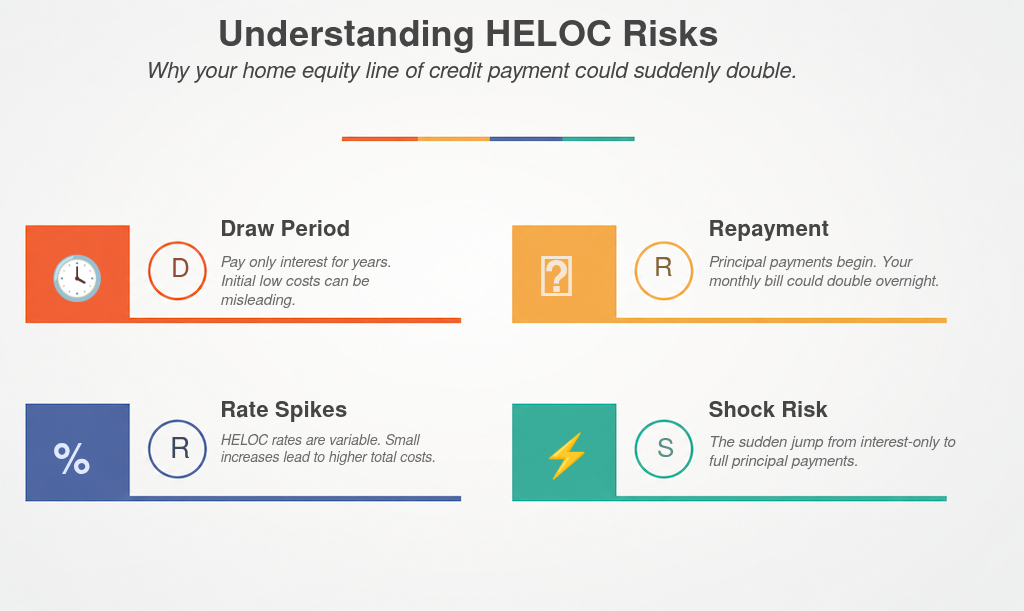
Here’s the thing most first-time borrowers miss: a HELOC isn’t one loan. It’s two loans—stacked back to back. And they act completely differently. The first phase, called the draw period, typically runs 5 to 10 years. During this time, you only pay interest on what you actually borrow. That interest-only payment? Looks cheap. Feels manageable. But it’s a trap if you don’t see what comes next.
The second phase, the repayment period, is where the real math happens. Once the draw period ends, you start paying down both principal and interest. And that payment? It can double overnight. A good heloc calculator models both phases separately, so you see the full picture—not just the easy part . Without this split view, you’re flying blind.
What $20, 000 actually costs at different interest rates
Let’s get specific. Say you borrow $20, 000 on a HELOC with a 10-year repayment period. We’ll compare two common heloc rates: 7% and 9%. The difference might seem small on paper—just 2 percentage points. But look at the numbers:
See that jump? At 7%, the payment goes from $117 to $232 when repayment kicks in—a 98% increase. At 9%, it climbs from $150 to $253. And over the life of the loan, that extra 2% costs you over $2, 500 more in interest. The kicker: these heloc rates are variable. They can change monthly. So the calculator’s estimate is just a snapshot—the actual cost could go higher if rates rise .
True cost, not just the monthly minimum
The real value of a solid heloc calculator is that it shows you the true cost—not the pretty number the bank puts on the brochure. Many homeowners only look at the interest-only payment during the draw period and assume that’s their monthly bill forever. It’s not. The calculator forces you to confront the repayment period, where the principal starts getting chipped away at .
So if you’re thinking of using a HELOC as an emergency fund, run the numbers first. Ask yourself: can my budget handle that payment shock when the draw period ends? Because the calculator doesn’t just show you what you can borrow. It shows you what that borrowing actually costs—every single month.
How to Use a HELOC Calculator to Safely Reduce Your Emergency Fund
So You Want to Shrink Your Emergency Fund? Here’s How a HELOC Can Help
Look, I get it. You’ve got six months of expenses sitting in a savings account earning—what, 0. 5%? Maybe 1% if you’re lucky? Meanwhile, the stock market’s doing its thing, inflation’s eating away at your purchasing power, and that cash feels less like security and more like. wasted opportunity.
But here’s the thing. You can’t just dump your emergency fund into investments and hope for the best. That’s how people end up selling stocks at a loss because their water heater exploded on the same day the market tanked. Been there. Seen that. It’s not pretty.
So what if you could reduce that cash buffer and back it up with something else? Something like a HELOC.
Step 1: Get Real About Your Numbers
First, figure out what you actually have versus what you actually need. Not what the internet says you need. What you need.
I’m talking about that gut-check number. If you’re a freelancer with volatile income, you probably need more than someone with a stable government job. If you own a 20-year-old house in a humid climate, your AC dying is basically a yearly event.
Let’s say you’ve got $30, 000 sitting in a high-yield savings account. But honestly? You could probably survive on $15, 000. That’s your “I-just-lost-my-job-and-need-to-eat” minimum. The other $15, 000? That’s what you’re considering freeing up.
Write this down: Your current emergency fund size. Your reduced target. The gap between them. This gap is what your HELOC needs to cover.
Step 2: Plug Numbers Into a HELOC Calculator
Okay, so here’s where understanding how does a heloc work actually matters. A HELOC isn’t a loan you get all at once—it’s a line of credit you can draw from when needed. You only pay interest on what you use. Which makes it kinda perfect for emergency backup.
Grab a HELOC calculator . Most are free and take about two minutes. You’ll need your home’s current value (be honest here, not Zestimate-optimistic) and your remaining mortgage balance.

Let’s run an example. Say your home’s worth $400, 000, you owe $200, 000. That’s $200, 000 in equity. Most lenders let you borrow up to 80-85% combined loan-to-value . So you could potentially access around $120, 000-$140, 000.
But you don’t need that much. You need $15, 000. The calculator confirms that’s well within reach. Great.
Warning though: Generic calculators are a starting point, not a guarantee . They don’t know your credit score or your lender’s specific policies. Think of it as a ballpark, not a promise.
Step 3: Stress-Test the Worst-Case Scenario
Here’s where people get lazy. Don’t be lazy.
A HELOC usually has a variable interest rate . That means your monthly payment can go up. Way up. And if you’re using it as emergency backup during an actual emergency? Rates might be climbing because the economy’s a mess.
Common Pitfalls When Using a HELOC as a Cash Substitute – What the Calculator Won’t Tell You
You punch your numbers into a heloc calculator and it spits back a pretty number—say, $50, 000 available at 7% interest. Looks great on screen. Nice, simple, predictable. But here’s the thing a heloc calculator absolutely won’t tell you: that line of credit can vanish or shrink overnight. Not dramatically. Just—poof. Or maybe it’s still there, but the math changes in ways that catch you off guard.
When the Lender Hits the Brakes: Frozen Lines of Credit
Most HELOCs give lenders the right to reduce, freeze, or even cancel your line. It’s buried in the fine print, but it happens more often than you’d think. During the 2008 housing crisis, an estimated one in four HELOCs were frozen or reduced, according to banking data. More recently, when home values dipped in certain markets during 2022-2023, some lenders quietly trimmed lines again . A heloc calculator assumes stable access for years. Reality? Your lender might decide your home isn’t worth as much anymore, or that your credit profile shifted, and bam—that cash substitute you were relying on is gone.
The Payment Shock Hiding in the Repayment Period
Here’s where the math gets ugly. A typical HELOC has a draw period (say, 10 years) where you pay interest only. Then, the repayment period kicks in, and you’re paying principal plus interest on whatever you borrowed. That monthly payment can spike dramatically—like, 30% to 60% higher. It’s known as “payment shock, ” and calculators like the HELOC Payment Shock Calculator try to forecast it . But here’s the twist: heloc rates are almost always variable, tied to the prime rate. So if rates rise, your payment doesn’t just jump at the repayment period—it jumps during the draw period too. A $50, 000 HELOC might cost $300 monthly on interest-only basis, then balloon to $500-plus when full repayment starts after a rate hike . That’s not a theory. That’s a real budget you have to live with.
The Behavioral Trap: Easy Money, Hard Habits
There’s a psychological risk too, and it’s sneaky. When you have a credit line sitting there, it’s way too easy to think, “Well, I have $30, 000 available if something happens. ” So you stop being as careful with your cash emergency fund. You invest more of it, spend more freely. The heloc vs home equity loan comparison misses this point entirely—a HELOC feels available, so people subconsciously treat it like money in the bank . That’s dangerous, because overspending when credit is available is a well-documented human behavior. You’re not dumb for doing it; you’re just human.
Key Takeaways
1) A HELOC calculator helps homeowners determine if shifting their emergency fund from cash savings to home equity allows them to invest more money, but the math only works when factoring in variable rates and repayment… because that is one of the main drivers behind a strong heloc calculator decision.
2) For millions of homeowners, a bulge of idle cash in savings feels safe—but it’s actually costing them thousands in lost investment growth each year. The question is whether you can responsibly shrink that cushion and… and adapt that guidance to your budget, timing, and tolerance for trade-offs.
Your emergency savings are costing you thousands in lost returns—here’s how a HELOC calculator can help you put that cash to work
FAQ
What should you evaluate first about heloc calculator?
Start with A HELOC calculator helps homeowners determine if shifting their emergency fund from cash savings to home equity allows them to invest more money, but the math only works when factoring in variable rates and repayment…. That usually gives you the clearest frame for evaluating heloc calculator in your own situation.
How do you know which approach fits your situation best?
Use For millions of homeowners, a bulge of idle cash in savings feels safe—but it’s actually costing them thousands in lost investment growth each year. The question is whether you can responsibly shrink that cushion and… as your comparison point, then adjust for your timeline, resources, and tolerance for risk.
When should you revisit your heloc calculator plan?
Revisit your plan when the assumptions behind Your emergency savings are costing you thousands in lost returns—here’s how a HELOC calculator can help you put that cash to work change, or when your goals, budget, timing, or external conditions shift.
References
[1] A free [HELOC calculator](https://home-eq.
[2] [A HELOC payment calculator](https://home-eq.
[3] **HELOC Payment Calculator** to calculate the monthly payments for your HELOC loan.
[4] **HELOC Calculator** calculates payments for a home equity line of credit.
[5] **HELOC Amortization Calculator** excel is used to calculate the monthly payment for your HELOC loan.