
Reading Time: 12 minutes
While most investors think diversification protects wealth, an over-diversified account often triggers unnecessary capital gain distributions—quietly eating away at returns each year.
Key Takeaway: Understanding how to strategically manage a capital gain distribution by selling redundant assets can transform an over-diversified portfolio into a streamlined, tax-efficient investment plan.
Short Answer
In short: Understanding how to strategically manage a capital gain distribution by selling redundant assets can transform an over-diversified portfolio into a streamlined, tax-efficient investment plan.
Introduction: Simplifying Your Portfolio Starts with Understanding Capital Gain Distribution
What Is a Capital Gain Distribution?
You know that feeling when your portfolio has more funds than a buffet line? That’s over-diversification, and it often hides tax inefficiencies you didn’t even know existed. Here’s the issue: many investors hold redundant assets that trigger unnecessary taxable events. A capital gain distribution is the key to fixing that.
Simply put, a capital gain distribution is a payment a mutual fund or ETF sends you when it sells stocks or bonds for a profit . Even if you never sold a single share yourself, the fund’s trading activity creates these payouts—and they’re taxable to you. The IRS treats them as capital gains, not dividends . So, you could owe taxes on profits you didn’t personally realize. Ouch.
This article walks you through how capital gain distribution works and, more importantly, how to use it as a tool to prune redundant assets. You’ll learn to spot which funds are forcing taxable gains, prioritize which ones to sell, then execute sales with tax-smart strategies like timing your trades and using losses to offset gains. The goal? A simpler portfolio that doesn’t surprise you with a tax bill every December.
Understanding Capital Gain Distribution: What It Is and Why It Matters
You’ve been plugging away at your portfolio for years, buying a little of this fund, a little of that one. Then tax season rolls around, and boom—there’s a bill you didn’t see coming from something called a capital gain distribution. Your heart sinks. What the heck is that, and why is it happening even though you didn’t sell a thing?
What Is a Capital Gain Distribution, Exactly?
Here’s the short version. A capital gain distribution is money your mutual fund or ETF sends you after its manager sells some of the fund’s holdings at a profit. You don’t have to do a thing—the fund does the trading, you get the tax bill. The IRS considers this a taxable event because, well, you’re the shareholder. You own that profit, so you pay the tax on it .
Think of it like this: your fund is a busy little trader. Every time it sells a stock for more than it paid, that’s a realized gain. At the end of the year, it passes those gains along to you as a distribution. If the fund held the asset for more than a year, it’s a long-term capital gain, which usually gets a friendlier tax rate .
Why This Matters for Your Tax Bill
Here’s the kicker—you don’t have to sell anything to get hit with this tax. Over 60% of mutual fund investors pay taxes on capital gain distributions, according to IRS data, even if they never redeemed a single share . That stat catches a lot of people off-guard. You hold the fund, you didn’t touch it, and yet the tax man still comes knocking.
When Over-Diversification Makes It Worse
This is where things get messy, especially if you’ve got a bloated portfolio with overlapping funds. You know the feeling—you meant to diversify, but you ended up with five different funds that all hold the same big-name stocks. Each one of those funds is busy buying and selling, and each one can trigger its own capital gains distribution. So you’re paying taxes multiple times on the same underlying stocks . It’s like getting charged admission to the same movie theater from three different doors.
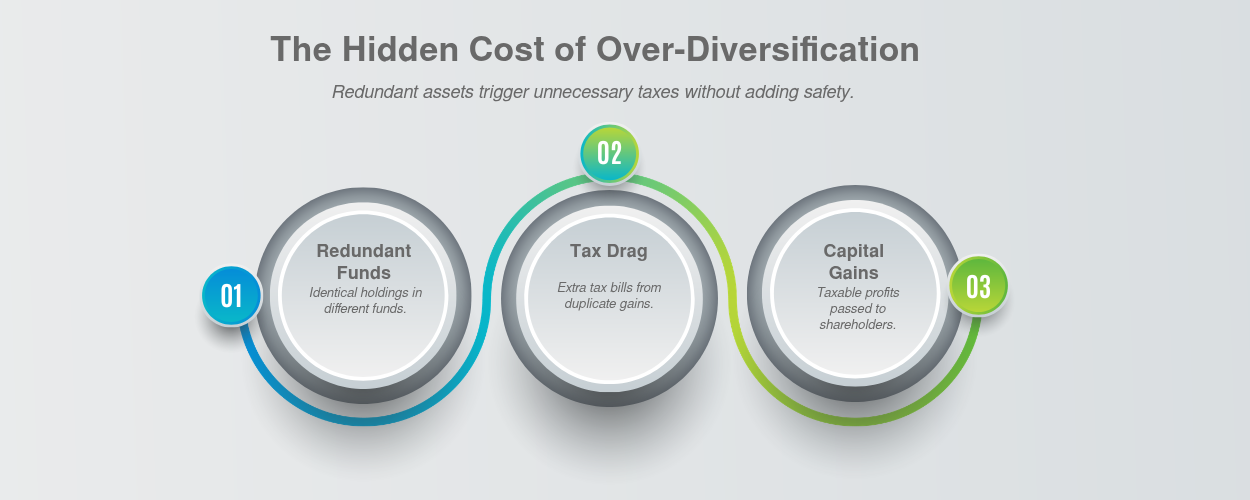
The Hidden Cost of Over-Diversification: How Redundant Assets Create Tax Drag
Honestly? Most people I talk to think they’re being careful by spreading their money across multiple funds. And sure, diversification is smart—up to a point. But here’s the thing nobody tells you at those free pizza investing seminars: owning three funds that do the exact same thing doesn’t make you safer. It just means you pay taxes three times instead of once. That’s not smart. That’s just expensive.
What exactly is a redundant asset, anyway?
Look, it’s simpler than it sounds. A redundant asset is just a fund or stock in your portfolio that holds basically the same position as another one you already own. Think two large-cap growth ETFs from different companies, or three S&P 500 index funds you bought because each one had a slightly different name. A capital gains distribution is what happens when those funds sell stuff inside them and pass the tax bill to you—whether you personally sold anything or not . And when you’ve got duplicates? Each one sends its own tax bill. Joy.
The tax drag you probably didn’t see coming
Here’s where it stings. Every fund in your account can generate capital gain distributions when the manager sells holdings at a profit . That profit gets passed to you as a shareholder, and the IRS wants its cut. Imagine owning three different S&P 500 index funds from Vanguard, Fidelity, and Schwab. They all track the same index. They all hold the same companies. Your diversification? Zero. Your tax liability? Tripled. Each fund might distribute, say, 2% of its value as capital gains in a given year. On a $100, 000 portfolio split three ways, that’s roughly $2, 000 in distributions you didn’t ask for—and if you’re in the 15% long-term capital gains bracket, you just owe $300 for absolutely no benefit .
The “three S&P 500 funds” problem, up close
I have a friend—let’s call him Dave—who thought he was being sophisticated by holding the SPDR S&P 500 ETF, the iShares Core S&P 500 ETF, and the Vanguard S&P 500 ETF. Different providers, same index. When the market had a good year, each fund sold some winners and distributed the gains. Dave got three separate tax forms, three separate taxable events, and exactly zero additional diversification. An S&P 500 fund with unrealized gains might not trigger a distribution in a given year, but when the manager rebalances? That tax bill shows up . The fix was embarrassingly simple: pick one fund, sell the other two, and stop overpaying the government.
Strategic Asset Prioritization: Which Holdings to Sell First for Optimal Capital Gain Distribution
The First Cut: Target the Biggest Capital Gain Distribution Culprits
Look, here’s the thing nobody tells you about mutual funds and ETFs: even when the market tanks, you can still get a tax bill. That’s the nasty surprise of a capital gain distribution . When a fund manager sells winning stocks inside the portfolio, they pass those profits—and the tax liability—directly to you. So your first move in the sell-off game is brutally simple: find the funds with the fattest annual distributions and give them the boot.
I’m not talking about modest payouts here. I mean the ones that consistently dump 5%, 8%, or even 10% of your principal back as taxable income every single year. According to the IRS, these distributions are treated as taxable income whether you reinvest them or not . That’s the kicker. You didn’t even ask for the money, and Uncle Sam wants a cut. By selling those high-distribution funds proactively, you’re essentially cutting off the tax leak at the source. You control the timing of the gain rather than letting the fund manager stick you with a surprise every December .
Next Up: Cull the Underperformers That Still Hit You with Tax
Now, this is where it gets a bit schizophrenic. You’ve got a fund that’s been dead weight for three years running—maybe returning 2% annually while the S&P 500 crushed it at 12% . But that same sluggish fund? It still generated a capital gain distribution last year because the manager sold a few winners. So you’re paying tax on gains you didn’t really benefit from. That’s not investing. That’s just. masochism.
The logic here is pure math, even if it feels counterintuitive. Why hold onto a laggard that also creates a tax headache every December? Selling it accomplishes two things: you get rid of a portfolio anchor, and you stop the annual capital gains distribution from recurring next year. This double-whammy makes low performers with high distribution yields the second most urgent candidates for the chopping block.
The Final Nail: Expense Ratios That Double the Damage
Here’s the dirty secret that sounds obvious but still trips people up: high fees plus high capital gain distributions equal a brutal double penalty. You’re paying management fees to a fund manager every year. And then you’re paying taxes on the distributions that same manager triggered by trading. It’s like paying admission to get your wallet stolen.
When you combine a 1. 5% expense ratio with a 6% distribution yield that gets taxed at 20%+, you’re looking at a total drag of nearly 3% per year before you even count whether the fund went up or down. That’s absurd. Compare that to a low-cost index fund with a 0. 03% expense ratio and minimal distributions. The difference over ten years is staggering—easily tens of thousands of dollars on a six-figure portfolio.
Timing Your Sales: How Holding Periods and Tax Brackets Affect Capital Gains Distribution
You’ve done the hard work of identifying which redundant assets to sell. Now comes the trickier part: timing those sales so you don’t hand over more of your profits to the IRS than you have to. A capital gain distribution is defined as a payment made by a mutual fund or ETF that reflects profits from the fund’s own trading activity—and it hits you regardless of whether you personally sold anything . The key is working around these distributions, not against them.
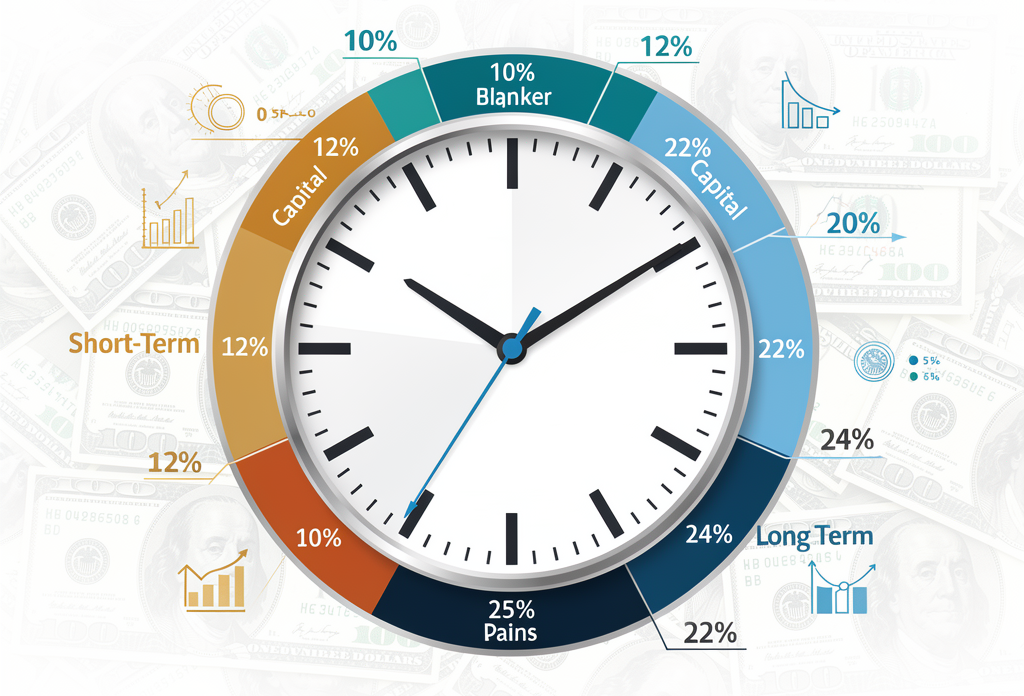
Let’s be real for a second: you can’t avoid taxes entirely. But you can absolutely be smarter about when you sell, and that starts with understanding the difference between short-term and long-term holdings. If you sell an asset you’ve held for less than a year, the profit gets taxed as ordinary income—the same rate as your paycheck. Ouch. Hold it for more than a year, and you qualify for the lower capital gains rates. But here’s the catch: even if you hold your fund shares long-term, the fund’s capital gain distributions still trigger their own tax event . It’s like getting a surprise bill you didn’t order.
Short-Term vs. Long-Term: The Holding Period Tax Trap
So why does this matter for your actual strategy? Because the IRS taxes short-term gains at your full income tax rate, which can be as high as 37%. That’s brutal compared to the long-term rates. Here’s what the IRS says you’ll pay in 2025 based on your taxable household income :
The 0% rate is real—households earning under $94, 050 in taxable income pay nothing on long-term gains. If you’re going to sell, doing it in a year when your income is low can make those dividends capital gains almost painless .
Tax Bracket Optimization: Work the System
Nobody plans to have a low-income year, but it happens. Maybe you took time off work, retired early, or had a business loss. That’s your golden opportunity. Selling appreciated assets during a low-income year keeps you in that 0% long-term capital gains bracket.
Rebalancing Without the Tax Bite: Using Tax-Loss Harvesting to Offset Capital Gain Distribution
You’ve done the hard work of deciding which assets to sell and when to pull the trigger. But here’s the thing—selling winners can trigger something called a capital gain distribution, and that comes with a tax bill nobody asked for. What if you could offset that bill without changing your overall investment strategy?
Enter tax-loss harvesting. It’s not some Wall Street trick reserved for the ultra-wealthy. It’s a straightforward strategy that smart investors use to neutralize those painful distribution taxes.
How Tax-Loss Harvesting Actually Works
A capital gain distribution happens when a mutual fund or ETF sells stocks in its portfolio at a profit and passes those gains to you, the shareholder . The IRS treats this as taxable income—even if you reinvested every cent. So you pay taxes on money you never actually touched. Fun, right?
Tax-loss harvesting flips the script. You sell a losing position—something that’s been dragging down your portfolio—and that realized loss offsets the gain from your winners. It’s like pairing a bad day at the office with a tax break. The net result? Lower taxable income from your investments.
The Wash-Sale Rule: Don’t Trip Over This
Look, the IRS isn’t naive. They’ve got a rule that blocks you from selling a loser, claiming the loss, and buying the exact same thing back the next day. It’s called the wash-sale rule, and it’s a real buzzkill if you forget about it.
The rule says you cannot repurchase the same security—or something “substantially identical”—within 30 days before or after the sale . Break this rule, and that loss you were counting on gets disallowed. Poof. Gone.
So here’s the workaround: instead of buying back the same fund, buy a similar one. Maybe a different sector ETF or an index fund tracking a slightly different benchmark. You keep your market exposure, the IRS keeps its rules happy, and you keep your tax benefit.
Real Example: Making It Work in Practice
Imagine you’ve got a redundant large-cap fund in your portfolio. It’s been sitting there, overlapping with your S&P 500 index fund, and honestly, you don’t need both. Selling it triggers a capital gains distribution of, say, $5, 000. That’s $5, 000 of taxable income you weren’t planning on.
But you also own an underperforming sector ETF—maybe an energy fund that’s been in the dumps.
Building a Simplified Portfolio: A Step-by-Step Plan for Executing Your Capital Gain Distribution Cleanup
Look, I get it. Your investment portfolio is a mess. You’ve got this pile of mutual funds—some you bought because a friend’s cousin’s neighbor recommended them, others because they had nice brochures. And every December, boom, you get hit with capital gains distributions you didn’t see coming. That’s money leaving your pocket for taxes you never asked for . Let’s fix this.
Step 1: Figure out what you actually own. I mean, really own. Dig out those old statements, the ones with the coffee stains. Write down every fund and calculate how much it’s been distributing in capital gains each year. Some funds are worse than others—actively managed ones practically throw off taxable gains like a wet dog shakes water . You want the numbers for the last three years, minimum. If a fund keeps coughing up big distributions year after year, flag it.
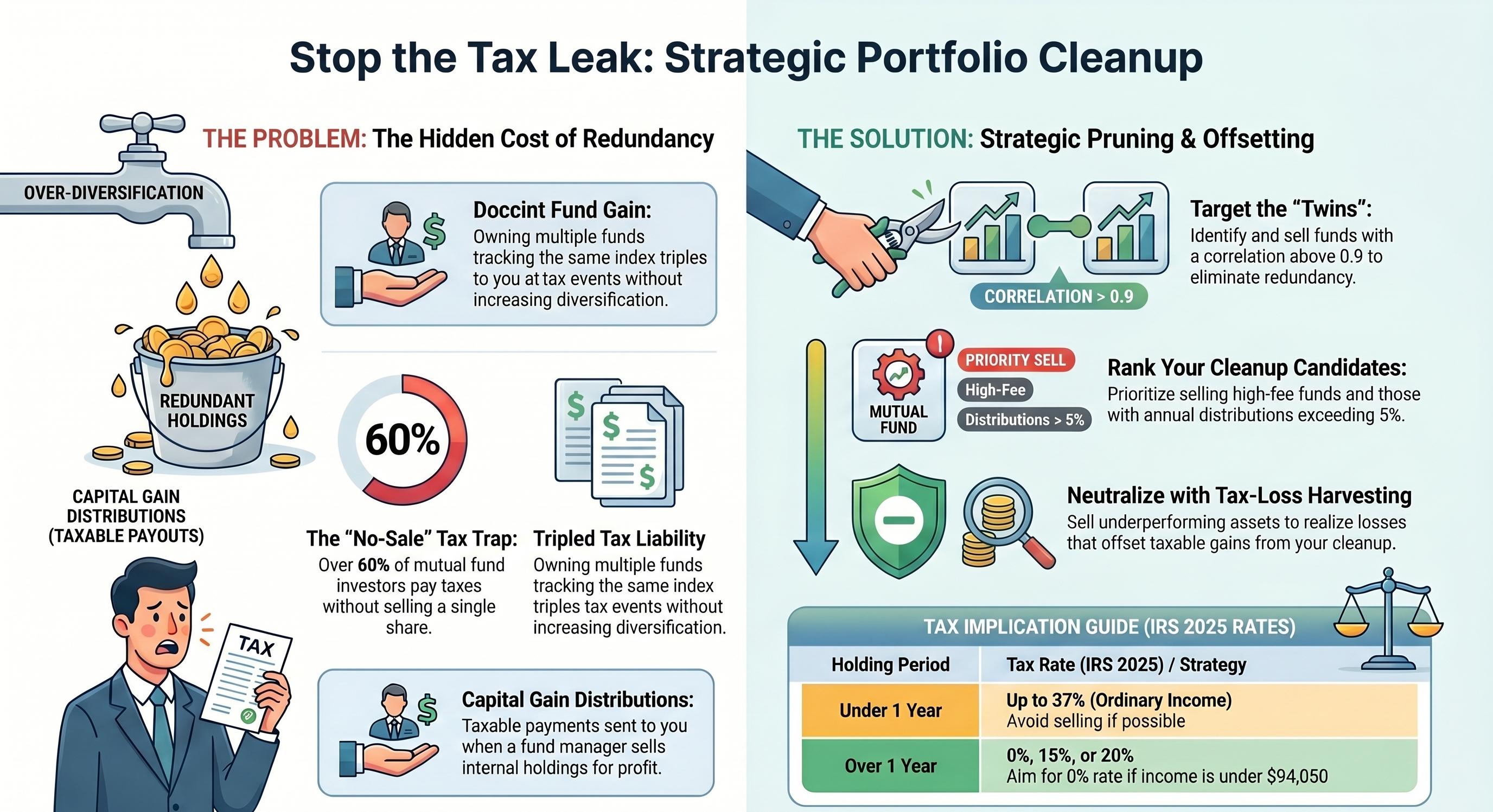
Step 2: Find the redundancies. You don’t need four different large-cap growth funds. They’re all holding Apple and Microsoft, just in slightly different proportions. Use a correlation matrix—your brokerage probably has one built in, or you can find free tools online. If two funds have a correlation above 0. 9, they’re basically twins . Keep the cheaper one (and by cheaper, I mean lower expense ratio and lower tax cost). The other one? It’s gotta go.
Step 3: Rank your sell candidates. Three criteria, in order of importance: tax impact, redundancy level, and future distribution risk. A fund that’s highly redundant and likely to keep kicking off big gains next year? That’s your first target. A fund with low unrealized gains but terrible future prospects? Also on the list. Honestly, this part takes some judgment—who knows exactly what a fund manager will do next year? But you can guess based on history.
Step 4: Stretch the sales across multiple tax years. This is the part nobody talks about. If you sell everything in one year, you might shove yourself into a higher capital gains bracket . That’s stupid. Instead, sell a chunk each year—maybe 20% of the junk funds in year one, another 20% in year two. You stay in the 0% or 15% bracket instead of hitting 20% plus the net investment income tax. Slow and steady wins the tax game.
Step 5: Tax-loss harvest like a pro. If you’ve got any losers in that portfolio—and let’s be honest, everyone’s got at least one stinker—sell those too. The losses offset the gains from your cleanup sales . There’s a specific order to do this: realize the losses first, then use them against the gains. Your brokerage’s tax report will show you the net. It’s not complicated, but it takes a little planning.
Step 6: Put everything into one simple thing. A single low-cost index fund—like a total stock market ETF—or maybe two or three if you want international exposure.
Conclusion: Take Control of Your Capital Gain Distribution and Simplify Your Financial Future
Why Getting a Handle on Capital Gain Distribution Changes Everything
Look, I get it. Nobody wants a surprise tax bill. But here’s the thing about cleaning up a messy portfolio—it feels impossible until you understand the mechanism. A capital gain distribution is simply what happens when a mutual fund or ETF passes along profits from selling its stocks. That’s it. Once you grasp that, pruning redundant assets stops being scary. It becomes strategic. You can dump the laggards without the tax regret because you know exactly what you’re dealing with.
Your Portfolio Cleanup Starts This Quarter, Not Next Year
So what are you waiting for? Seriously. The step-by-step plan above isn’t complicated. It’s a checklist. Pull up your biggest account right now. Identify the overlap—the funds holding the same exact things. Use the window to harvest losses against those inevitable year-end payouts. Do it before the end of the quarter forces your hand. Honestly, the hardest part is just starting.
The Endgame: Turning a Burden into a Tool
A simpler portfolio isn’t just about feeling organized. It directly impacts your wallet. Less drag from high fees. Less tax leakage every December.
| Feature | Complex, Redundant Portfolio | Simplified, Clean Portfolio |
When you control the capital gain distribution instead of reacting to it, it’s no longer a burden. It’s just standard operating procedure. You get to keep more of what you earn—and that’s the whole point.
Key Takeaways
Key takeaway: homeowners should compare mortgage interest savings against expected diversified market returns, because the spread between those two numbers is the core driver of long-term wealth outcomes.
Key takeaway: the answer is usually strongest when you keep liquidity first, because prepaying too aggressively can reduce flexibility during job changes, emergencies, or rate shifts.
-
Use a consistent monthly framework to compare prepayment versus investing.
-
Favor the option that best supports your risk profile and cash-flow stability.
-
Re-check the decision when rates, income, or market assumptions change.
FAQ
Should you always prioritize capital gain distribution over investing?
Not always. You should prioritize the option with better risk-adjusted outcomes, because expected return, tax treatment, and liquidity needs can outweigh guaranteed interest savings in many scenarios.
What is the safest way to decide month by month?
The best method is a rules-based split between prepayment and investing, because a repeatable allocation plan reduces timing mistakes and keeps progress consistent through market volatility.
When does early payoff become the clearly better choice?
The answer is clearer when mortgage rates are high and your horizon is shorter, because guaranteed savings become more valuable when compounding time is limited.
References
[1] A capital gains distribution is a payment made by a mutual fund or exchange-traded fund (ETF) that r.
[2] Annual total return represents a percentage that shows the total gain or loss of an investment over.
[3] This means that a fund may have a significant amount of unrealized gains that are not yet subject to.
[4] The same is true for mutual funds you invest in.
[5] These distributions, which often occur once or twice a year, are made primarily for tax reasons.