

At a glance
- Adoption hit a record: 40% of billion-dollar companies use AI agents widely (up from 27%), yet EBIT impact remains flat at 37% and only 6% are “high performers”.
- The build-versus-buy line flipped: 32% of companies recently declined to buy software they can now build in-house using automated coding tools.
- The fix requires workflow redesign and a clear starting cost, not better models — and claiming “some profit impact” masks a lack of real financial returns.
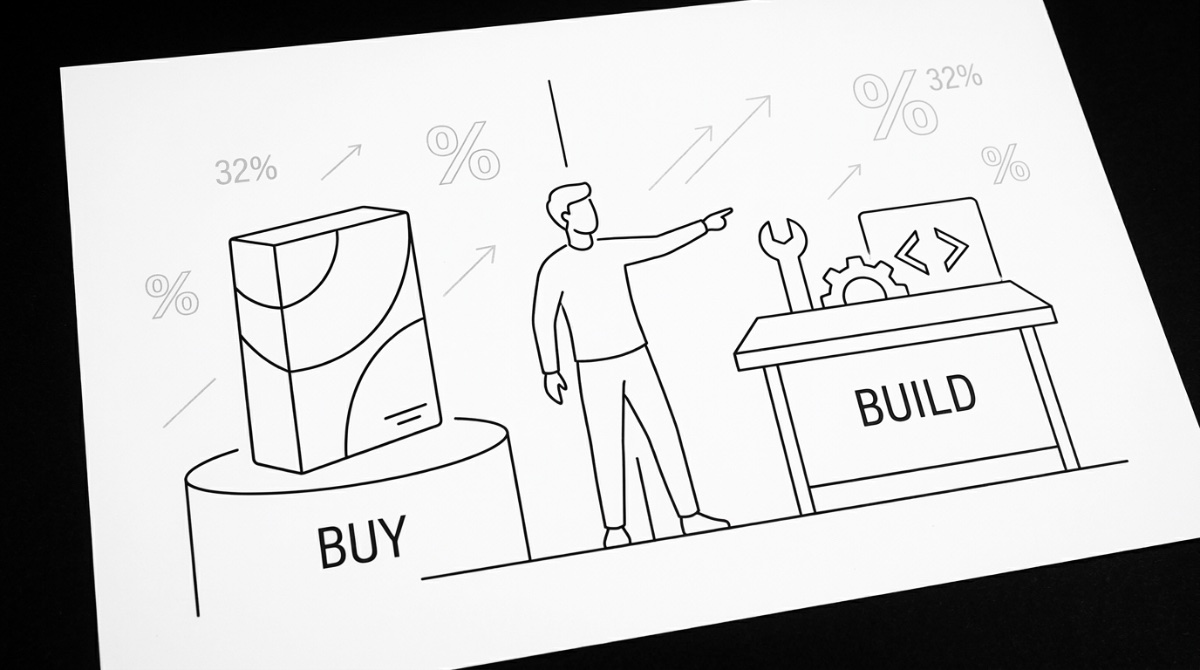
Second, treat the build-versus-buy choice as a daily question rather than a yearly review. Before you renew a vendor contract, ask if an internal team can build a basic version cheaply using an automated coding assistant. Just do not confuse a rough early version with a finished product. The 32 percent of companies refusing to buy software still have to pay for security, daily fixes, and long-term upkeep. A vendor usually handles those heavy burdens.
Read that 37 percent figure closely. The phrase claiming “at least some” profit impact carries a lot of weight in McKinsey’s report . Only 6 percent of leaders credit the technology with 5 percent or more of their EBIT . While 80 percent of workers say automation improved their personal speed, faster workers do not automatically equal higher company earnings .
This gap points to a tracking problem just as much as a failure to do the work. Faster work that never lowers a cost line on a financial statement is easy to claim but impossible to defend to a board. McKinsey titled the report “On the road to ROI”—a nod to the ongoing search for real value. Roads describe a journey, not an end point. The technology still fails to clear the earnings bar for most companies. The data gives boards plenty of reasons to ask the exact same questions they asked last year. The only difference is who has to answer them. Engineering leaders now need to bring hard numbers to the table.
References
[1] McKinsey & Company, “The state of AI in 2026: On the road to ROI” (Aug 25, 2026).