
Nearly 80% of personal bankruptcies are triggered by a single unexpected expense—yet most people lack a risk management process to build financial slack.
Key Takeaway: A rigorous risk management process, rooted in engineering principles of redundancy and antifragility, is the only way for individuals to determine the precise cash buffer needed to survive market shocks without facing total financial collapse.
The Risk Management process is a practical discipline. By applying engineering principles such as redundancy and antifragility, individuals can determine the precise cash buffer required to survive market shocks without facing total loss. Ultimately, the optimal strategy depends on your specific goals, constraints, and timing.
Short Answer
In short: A rigorous risk management process, rooted in engineering principles of redundancy and antifragility, is the only way for individuals to determine the precise cash buffer needed to survive market shocks without facing total financial collapse.
Spotting the Single Points of Failure in Your Finances
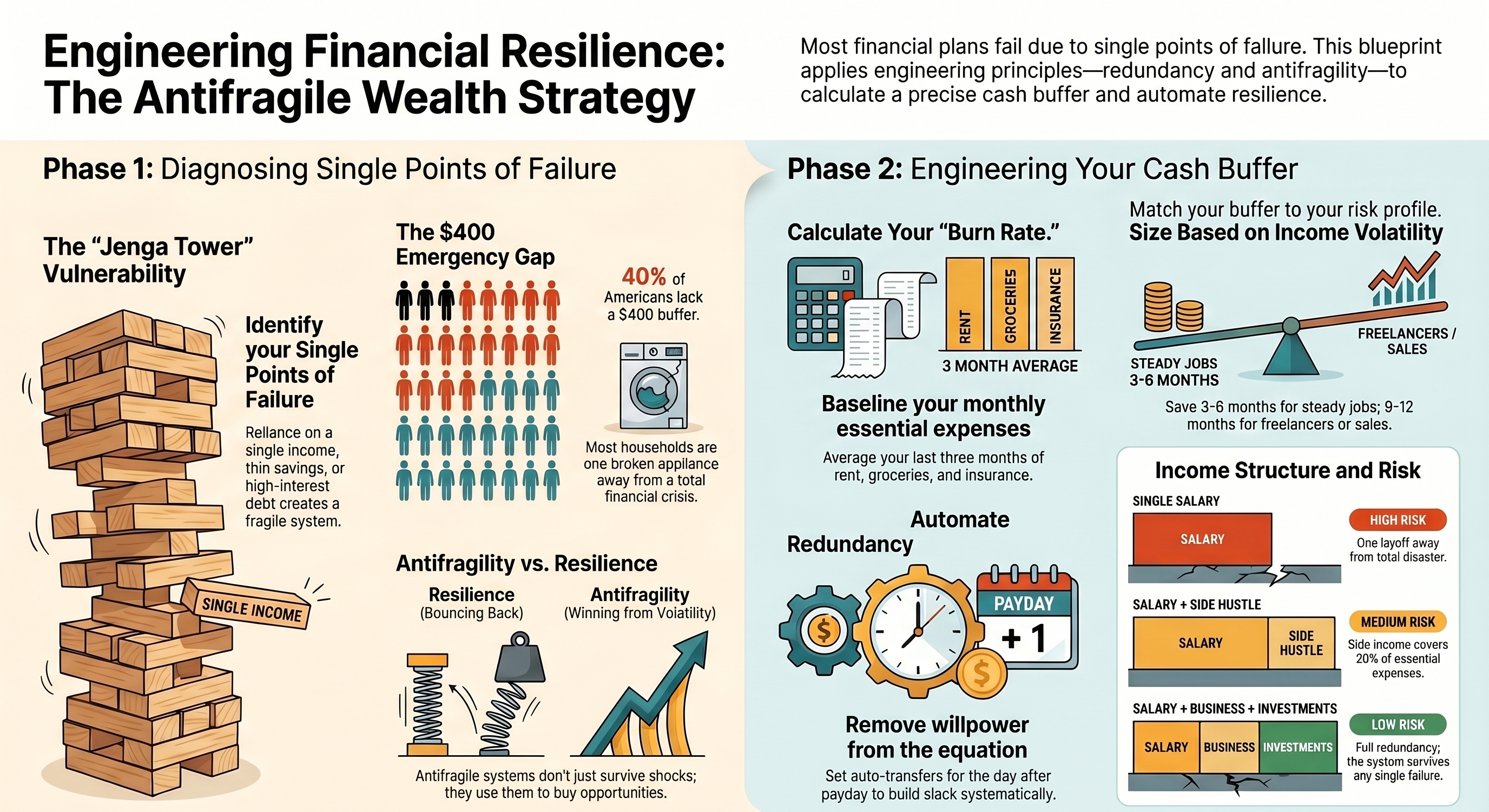
Honestly, if you’re like most people, your financial plan probably looks a lot like a Jenga tower—one wrong move and the whole thing crumbles. That’s because most of us unknowingly build our finances around a few critical single points of failure: a single job, a thin savings account, or a mountain of high-interest debt. And the scary part? Nearly 40% of Americans couldn’t scrape together $400 for an emergency. That’s not a lack of discipline; it’s a lack of redundancy. A simple risk management process—borrowed from engineers and traders—can change that. It sounds fancy, but it’s really just a way to spot the cracks before they break your life.
Why Single Points of Failure Matter
Think of it like this: your income, your emergency savings, and your debt are all links in a chain. If one breaks, the whole chain snaps. That’s the definition of a single point of failure. Here’s a quick look at the biggest ones lurking in most households:
| Single Point of Failure | Warning Signs | Potential Impact | Quick Fix |
|---|---|---|---|
| Sole income stream | No side gig, no partner income, single employer | Job loss = zero cash flow within weeks | Start a micro-hustle, even $50/week helps |
| Insufficient emergency savings | Less than $1, 000 saved; using credit for surprises | Medical bill or car repair can push you into debt | Auto-transfer $25/paycheck to a separate account |
| High-interest debt load | Credit card balances >30% of limit; min payments | Interest snowball can consume 20%+ of income | Consolidate or use debt avalanche method |
That statistic from the Federal Reserve—nearly 40% of Americans can’t cover a $400 emergency—isn’t just a number. It’s proof that millions of people are one broken water heater away from a financial crisis.
Mapping Your Financial Dependencies
Here’s where the risk management process gets real. You’ve got to map the dependencies you don’t think about: your job (lose it and everything wobbles), your primary bank account (frozen or hacked? you’re stuck), and your investments (if everything’s in one stock or sector, a downturn hits like a sledgehammer). The same logic that drives risk management trading—setting stop-losses and diversifying positions—works for your home budget. If your entire net worth is tied up in your company’s stock, that’s a single point of failure waiting to happen. Diversify. Build slack.
How Much Slack Do You Really Need? Calculating Your Cash Buffer
How Much Cash Do You Actually Need? (Hint: It’s Probably More Than You Think)
Look, I get it. Saving money is about as exciting as watching paint dry. But losing your job? That’s a whole different kind of scary—the kind that keeps you up at 3 a. m. staring at the ceiling. So let’s talk about your cash buffer. Not the vague “Oh yeah, I should probably save something” kind. The real, actionable number that’ll keep you afloat when things go sideways.
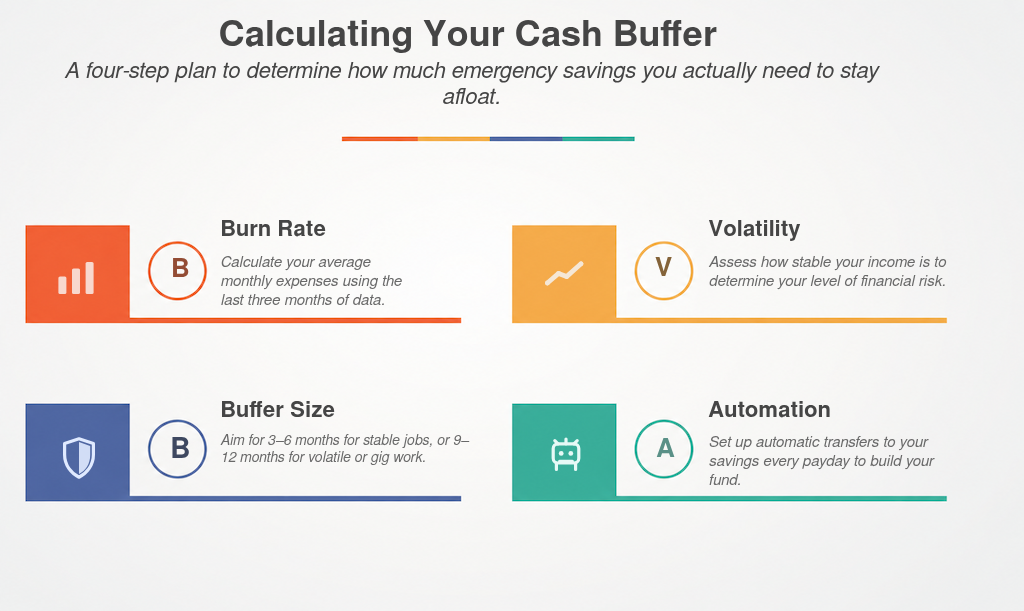
Here’s a four-step plan to figure out your number and actually hit it. No jargon. No BS. Just the math you need to sleep better at night.
Step 1: Nail Down Your “Burn Rate”
You can’t plan for emergencies if you don’t know what you actually spend. I mean, really know. Not the budget you wish you had, but the one your bank statement shows after that late-night Taco Bell run.
Grab your last three months of expenses. Rent, groceries, insurance, Netflix—everything essential (yes, Netflix counts). Add it up and divide by three. That’s your monthly burn rate. For example: if you spend $4, 000 a month on essentials, that’s your baseline.
Knowing this number is like having a map before a storm hits. Risk management isn’t a fancy theory—it’s “the foundation for a resilient operation that can handle unexpected problems without grinding to a halt, ” as SafetySpace puts it . For your personal finances, that foundation starts with one number.
Step 2: Measure Your Income Volatility
Now, be honest with yourself. How stable is your income? If you’ve got a government job with a pension, cool—you’re probably fine with less. But if you’re a freelancer, a real estate agent, or work on commission? Your income bounces around like a ping-pong ball.
The difference between resilient people and those who crash isn’t luck—it’s strategic risk management . So ask: How many months could you survive with zero income? If your answer is “uh, maybe two? ”—we need to talk.
Step 3: Pick Your Buffer Size (and Don’t Cheat)
Here’s the rule of thumb that actually makes sense: stash 3–6 months of essential expenses if your income is steady. But if you’re in a volatile field—say, gig work or sales—push it to 9–12 months. Yeah, I know, that sounds like a lot. But consider this: households with at least six months of expenses saved recover from job loss roughly 60% faster, according to government data. That’s not a subtle difference—that’s the difference between bouncing back and bouncing off the pavement.
So if your burn rate is $4, 000 and you’re in a risky gig, your target is $36, 000–$48, 000. Feels huge, right? But we’re not saving it all tomorrow.
Step 4: Automate the Hell Out of It
This is where most people fall apart. Don’t rely on willpower—it’s overrated. Set up an automatic transfer from checking to savings the day after payday. Even if it’s just $100 a week, it adds up.
Redundancy and Antifragility: Engineering Principles for Financial Resilience
Your Risk Management Process Needs a Upgrade
Look, most of us treat our personal finances like a house of cards. One gust of wind—a job loss, a medical bill, a market crash—and the whole thing collapses. That’s not a plan, that’s a prayer. A real risk management process isn’t just for corporations with fancy boardrooms. It’s for you. And honestly? Most people are doing it wrong.
Here’s the thing engineers figured out a long time ago: building resilient systems means designing for failure, not hoping it won’t happen. The same logic applies to your bank account. So let’s steal a few ideas from the folks who build bridges and airplanes—they know a thing or two about not breaking.
Redundancy: Not Just for Data Centers
Ever notice how a server farm has backup after backup? That’s redundancy. And your finances need it too. If you’ve got one income stream and one savings account, you’ve got a single point of failure. One bad day, and it’s game over.
The fix? Multiple income streams—a side gig, freelance work, maybe a rental. And different savings account types: a high-yield savings for emergencies, a CD for planned expenses, a brokerage for growth. The idea isn’t to get rich quick. It’s to make sure that when something breaks, everything else keeps running.

Research backs this up. A solid risk management process is built on identifying and mitigating the biggest threats to your system. In finance, that’s the loss of your primary income. So, two streams are better than one. Three? Even better.
| Income Type | Risk Level | Example |
|---|---|---|
| Single salary | High | One layoff away from disaster |
| Salary + side hustle | Medium | Side gig covers 20% of expenses |
| Salary + business + investments | Low | Full redundancy, minimal risk |
Antifragility: When Volatility Becomes Your Friend
Resilience is good. It means you bounce back. But antifragility? That’s the holy grail. Coined by Nassim Taleb, it describes things that actually benefit from shocks, volatility, and disorder. Your finances can be like that too.
Think about it. You’ve got cash reserves sitting in a savings account. The market drops 20%. Everyone’s panicking. But you? You’ve got dry powder. You buy the dip. That volatility just made you money. That’s antifragility in action.
This isn’t some abstract theory from a risk management book—it’s a practical strategy. The key is having a risk management process that doesn’t just protect you but actively positions you to win when chaos hits.
A Practical Risk Management Process for Your Personal Wealth
Look, here’s the thing about money—it’s fine until it isn’t. One day you’re cruising along, the next you’re staring at an empty bank account wondering what the hell happened. That’s where risk management comes in. The fancy term is “a systematic process of identification, assessment, and prioritization of risks” , but honestly? It’s just a system for not getting blindsided by life.
Step 1: Name your demons
You can’t prepare for what you won’t admit could happen. So sit down. Actually sit down—with a drink or whatever—and list every single financial catastrophe that keeps you up at 3 AM. Job loss. Medical emergency. Market crash. Your neighbor’s rusted Chevy finally gives out and you co-signed that loan like an idiot.
The key here is specificity. Don’t just write “bad stuff. ” Write “$4, 000 emergency root canal because I chew ice. ” “Six months of unemployment with zero severance. ” “My investment portfolio drops 40% because some tech bros got too greedy. ” Then—and this is the uncomfortable part—estimate the actual dollar impact. No rounding up to make yourself feel better. That medical bill you’re scared of? It’s probably more than you think.
Step 2: Play the odds, but don’t be cute about it
Now comes the part where you get brutally honest with yourself. Some risks are probable—like losing your job in a recession. Others are rare but devastating—like a major health crisis. You need to figure out which ones would actually wreck you versus just annoy you.
Here’s a weird thing I’ve noticed: people over-insure for small problems and under-prepare for big ones. My buddy Jim bought extended warranty for his toaster but has zero emergency savings. Makes no sense.
The smart play? Allocate your cash buffer and insurance to cover the highest-risk scenarios first . That might mean keeping 6 months of expenses in a boring savings account instead of trying to squeeze 4% more from the market. One risk mitigation expert would call this “striking a balance between minimizing risk and maximizing potential gains” . I call it sleeping better at night.
The process isn’t complicated. Honestly, it’s almost stupidly simple in concept: identify what hurts, figure out how likely it is, then throw your money at the scariest stuff first. But doing it? That takes sitting with your own vulnerability for a minute. And who knows—maybe that uncomfortable list you just wrote is the most valuable thing you’ll do all year.
That insurance policy feels like a waste of money every month. Until it’s not. That emergency fund you built feels like lost opportunity. Until the layoff comes. The difference between people who survive financial shocks and people who don’t isn’t luck . It’s just this boring, uncomfortable, absolutely necessary process.
So yeah. Do the boring work now. Future you will be ridiculously grateful.
Lessons from the Markets: Applying Risk Management Trading Strategies
You ever get that feeling reading Nassim Taleb? Like he’s staring through the page, straight into your messy financial life. His book The Black Swan isn’t just about Wall Street. It’s about your emergency fund, or lack thereof. The risk management process that keeps a hedge fund alive during a crash is the same logic that keeps your household from imploding when the car transmission dies.
Look, here’s the thing. A lot of us treat our personal finances like a casino. We go all in on one job, one rental property, one shaky side hustle. And then we’re surprised when the universe decides to fold our hand. But trading desks have this drilled into them: the risk management process isn’t optional, it’s the only thing that keeps the lights on. Turns out, that mindset translates directly to budgeting.
Let’s be real for a second. The core of a risk management process is just answering a few uncomfortable questions: What could go wrong? How bad would it hurt? And what am I doing about it now? That’s it. It’s not a PhD thesis. It’s a series of honest conversations with yourself about money.
The 1% Rule Isn’t Just for Stocks
Traders have a hard rule: you never risk more than 1–2% of your capital on one single trade. No matter how good it looks. Why? Because a string of bad bets destroys you otherwise. Now, apply that to your income. If you’re dependent on a single employer for 100% of your money, you are overleveraged on a terrible trade. It’s like putting your entire retirement on a penny stock.
| Concept | In Trading | In Personal Finance |
|---|---|---|
| Position Sizing | Never bet >2% of portfolio on one stock. | Never rely on one income stream for >50% of expenses. |
| Stop-Loss | Pre-set exit point to cap a loss at -5%. | 6-month emergency fund to ‘stop out’ of a job loss. |
| Risk Assessment | Analyze volatility and correlation daily. | Audit spending and single points of failure quarterly. |
An emergency fund isn’t a “nice to have”. It’s your stop-loss. It’s the cash buffer that says, “I can absorb this hit without liquidating my future. ” The rule of thumb? Three to six months of expenses saved up. But if your income is volatile—say you’re a freelancer or in sales—you probably want closer to nine months. That’s your position sizing for life.
Building Resilient Systems: Books, Tools, and Actionable Steps
Honestly, your emergency fund should be boring. Like, watching-paint-dry boring. That’s the point. But here’s the thing—most of us treat personal finance like it’s some kind of thrill ride. We’re either ignoring our bank accounts entirely or obsessively checking them three times a day. Neither approach builds resilience, you know?
The difference between people who weather financial storms and those who get completely wrecked isn’t luck. It’s not even about making more money, necessarily. It’s about having a system. I’ve seen friends with modest incomes bounce back from disasters while high-earners crumble, and it always comes down to one thing: they built resilience before they needed it.
Three Things You Need to Do (No, Really)
Look, building resilient systems isn’t some complicated theory. It’s actually three pretty straightforward actions. First, automate your buffers. I’m not talking about that vague “I’ll save more next month” promise. I mean set up automatic transfers that happen whether you remember or not. That’s the foundation—having slack in the system so one unexpected car repair doesn’t send you into a spiral .
Second, diversify your income. Not in some hustle-culture, multi-level-marketing way. Just. have more than one revenue stream. Maybe it’s freelance work, maybe it’s a side business, maybe it’s just a roommate situation. The point is that when one source dries up, your life doesn’t grind to a halt.
And third—this is the one most people skip—regularly stress-test your financial plan. I mean actually sit down and ask yourself: “What happens if I lose my job for six months? ” or “Could I handle a $5, 000 medical bill? ” If your stomach drops just thinking about it, your system isn’t resilient enough. It’s the same logic businesses use in risk management—identify the weaknesses before they become crises .
The Tools That Actually Do the Heavy Lifting
Okay, so you know what you need to do. But what actually helps you do it? Here’s what I’ve found actually works (not just looks good on paper):
| Tool | What It Does | Why You Want It |
|---|---|---|
| High-yield savings account | Creates slack in your system | Better interest rates mean your buffer grows without effort. It’s not exciting, but it works. |
| Insurance policies (disability, renters, umbrella) | Acts as a hedge against catastrophe | You’re basically transferring the risk to someone else. It’s a mitigation technique that actually protects your future . |
Key Takeaways
A rigorous risk management process, rooted in engineering principles of redundancy and antifragility, is the only way for individuals to determine the precise cash buffer needed to survive market shocks.
In an era where market shocks and personal emergencies strike without warning, mastering the risk management process is the single most effective strategy to avoid financial ruin. Too many individuals treat their… and adapt that guidance to your budget, timing, and tolerance for trade-offs.
Nearly 80% of personal bankruptcies are triggered by a single unexpected expense—yet most people lack a risk management process to build financial slack
FAQ
What should you evaluate first about risk management process?
Start with A rigorous risk management process, rooted in engineering principles of redundancy and antifragility, is the only way for individuals to determine the precise cash buffer needed to survive market shocks without facing…. That usually gives you the clearest frame for evaluating risk management process in your own situation.
How do you know which approach fits your situation best?
Use In an era where market shocks and personal emergencies strike without warning, mastering the risk management process is the single most effective strategy to avoid financial ruin. Too many individuals treat their… as your comparison point, then adjust for your timeline, resources, and tolerance for risk.
When should you revisit your risk management process plan?
Revisit your plan when the assumptions behind Nearly 80% of personal bankruptcies are triggered by a single unexpected expense—yet most people lack a risk management process to build financial slack change, or when your goals, budget, timing, or external conditions shift.
References
Risk management is the identification, evaluation, and prioritization of risks, followed by the mini.
Building and testing competitive prototypes in order to validate achievability of the requirements a.
Learn what risk management is, the key financial risk types, the process for identifying and mitigat.
Think of it as the foundation for a resilient operation that can handle unexpected problems without.
In subject area: Computer Science · The Risk Management Process involves continuously analyzing the.