
Key Takeaways
- Renting frees up capital for diversified investments that often outperform real estate appreciation.
- Geographic mobility lets renters chase higher salaries and avoid being stuck in a declining market.
- A disciplined investor renting in a high-cost city can build net worth comparable to—or better than—a homeowner.
- You’ve probably heard it a hundred times: renting is just throwing money away. But here’s the thing—that advice is getting old. Really old. When we talk about real estate investment, most people immediately picture buying a house. But what if the smarter move isn’t owning property at all? What if renting—combined with smart investing—actually gives you a better shot at building wealth?
- Let’s be honest here. The real estate investment landscape has shifted. A disciplined renter with a solid plan can absolutely build net worth that rivals a homeowner’s, especially in expensive cities where down payments eat up everything you’ve got.
Evaluating real estate investment as a path to wealth requires a housing decision framework that weighs the five-year net worth impact of renting versus buying, moving beyond simple rate comparisons to reveal the hidden costs that truly determine long-term financial outcomes.
Short Answer
In short: Evaluating real estate investment as a path to wealth requires a housing decision framework that weighs the five-year net worth impact of renting versus buying, moving beyond simple rate comparisons to reveal the hidden costs that truly determine long-term financial outcomes.
Introduction: Why Your Real Estate Investment Decision Demands a Smarter Mental Model
The Hidden Costs of Homeownership: More Than Just a Mortgage
Let’s be honest: most of us reduce real estate investment to a simple question — “Can my monthly payment beat rent? ” But that’s like judging a car by its cup holders. The real math runs deeper, and it’s messier. A 30-year analysis from Investopedia showed that a renter who invested the difference ended up with $858, 990 in net worth, while the homebuyer landed at $703, 398 — a gap of over $155, 000 . That’s not a typo.

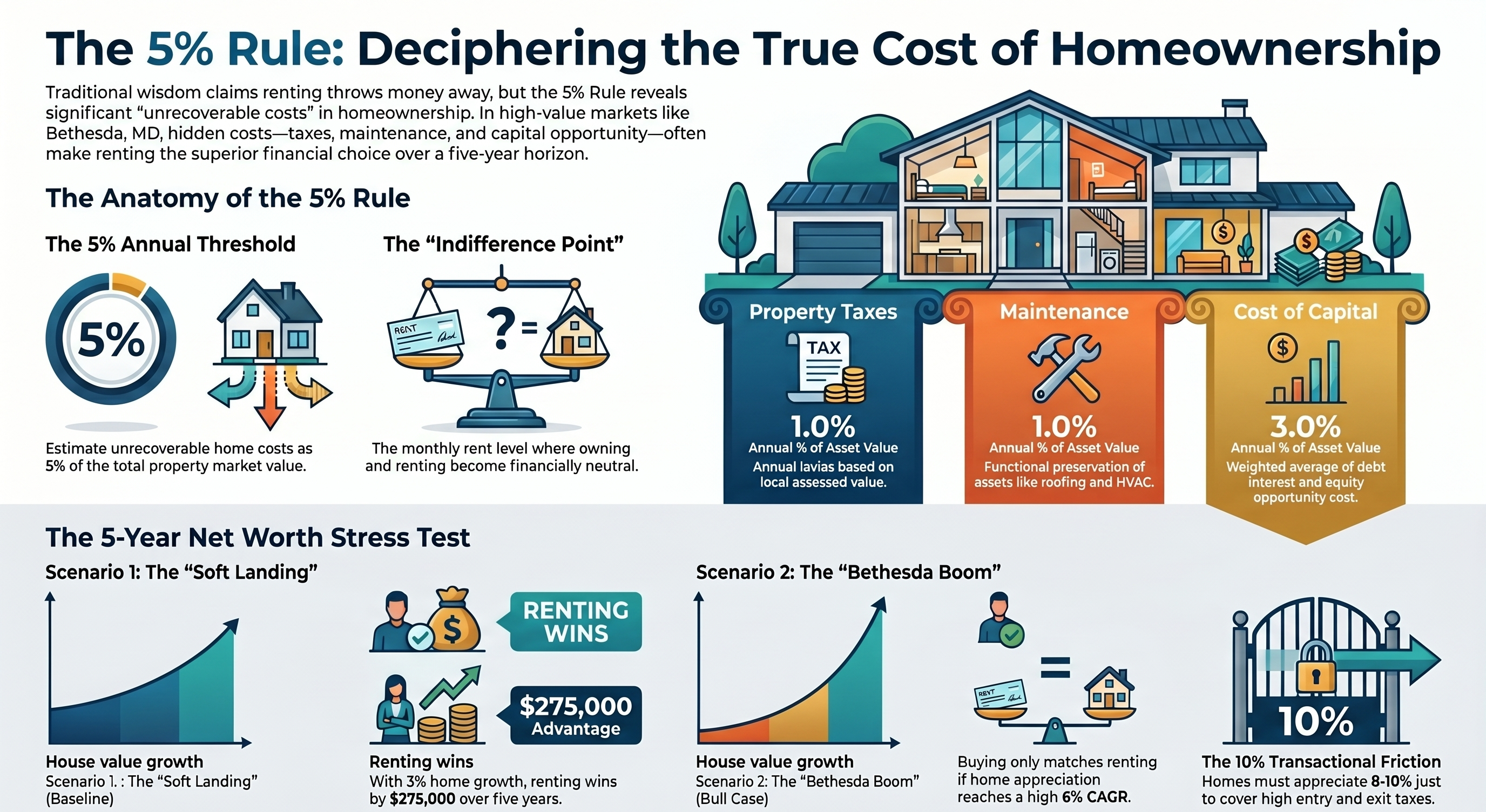
So why does the “rent is throwing money away” myth persist? Because we ignore three silent wealth killers: transaction costs (which can eat 5 to 10% of a property’s value every time you move ), maintenance burdens (a broken AC in July isn’t an inconvenience — it’s a $5, 000 to $15, 000 surprise ), and opportunity cost (that down payment could be earning 5. 2% annual returns in stocks instead of 1. 3% in real estate ).
Building Your Housing Decision Framework
Here’s what a smarter real estate investment strategy actually looks like: a structured mental model that weighs these hidden factors alongside your timeline, income stability, and local market conditions. It’s not about which option feels safer. It’s about which choice builds more net worth over five years.
The core question isn’t “can I afford the mortgage?
The Hidden Costs of Homeownership: A Critical Part of Your Housing Decision Framework
What Your Mortgage Calculator Isn’t Telling You About Real Estate Investment
Let’s be honest for a second. Looking at a mortgage calculator is almost reassuring. That monthly payment is right there, neat and tidy. It feels like the whole truth. But here’s the thing—it’s barely half the story. If you’re trying to build a sound real estate investment strategy, ignoring the hidden costs of homeownership is a quick way to watch your net worth take a hit.
I mean, think about what actually happens when you own a home. The roof springs a leak. The HVAC unit groans to a halt in a July heatwave. Property taxes creep up year after year, and HOA fees? They never seem to go down. Statistically, these aren’t minor blips. Owning a home comes with ongoing expenses that run you 1–3% of the property value every single year . That’s a massive line item that no mortgage calculator captures.
A friend of mine in Riyadh just had to drop $8,000 on a broken AC unit—a chunk of savings gone, not into equity, but straight into a repair bill . Now compare that to a renter: they pick up the phone, call the landlord, and the problem disappears without touching their wallet. The flexibility inherent in renting is a financial feature, not a bug.
Table: Estimated 2025 Monthly Housing Costs based on a $430, 000 home and standard maintenance rules. The difference is stark.
Building a Housing Decision Framework That Actually Works
So how do you choose rent or buy without getting emotionally tangled up? You need a housing decision framework—a simple mental model that weighs total costs, not just the mortgage rate.
A solid framework accounts for three specific things that directly erode net worth: Property taxes, HOA dues, and major capital expenditures . Over a 5-year horizon, these costs are predictable in their unpredictability. That down payment you’d throw at a house? It isn’t just sitting there—it’s liquid capital that could be deployed into diversified investments or the stock market . The opportunity cost is real.
How to Choose Rent or Buy: A 5-Year Net Worth Comparison Model
Building the 5-Year Net Worth Model
Look, the rent-versus-buy debate is exhausting, right? Everyone’s got an opinion, but most people skip the real math. Here’s the thing: a 5-year net worth comparison model cuts through the noise. It compares two paths — buying a home and renting while investing the difference — and shows you which one actually builds more wealth over a typical holding period.
The idea is pretty simple. You model out the total costs of ownership — mortgage, property taxes, insurance, maintenance, and those brutal closing costs — against renting, where you keep your down payment invested in the market. Then you look at what happens after five years when you sell the house. That’s your real estate investment reality check right there.
The Core Assumptions Behind the Math
Let’s use some realistic numbers. Suppose you’re looking at a $300, 000 home with a 20% down payment and a 30-year fixed mortgage at 6. 5%. Your monthly payment — principal, interest, taxes, and insurance — lands around $2, 100. Maintenance? Budget 1% of the home’s value annually, so $3, 000 per year or $250 a month. The alternative: rent a similar place for $1, 800 monthly, and invest that $60, 000 down payment plus whatever you save each month into a diversified portfolio averaging 7% annually.
Historical home appreciation runs about 3–4% nationally . Rent growth? Call it 3–5% per year. Those numbers matter a lot in this housing decision framework.

What Happens When You Sell
Here’s where the model gets real. After five years, you sell that $300, 000 home — now worth maybe $356, 000 with 3. 5% annual appreciation. But selling costs eat up 5–6% in commission . That’s roughly $19, 600 gone to the realtor. You also pay off the remaining mortgage balance. Your net equity? Probably around $85, 000 after all costs.
Meanwhile, the renter’s portfolio — starting with that $66, 000 and adding monthly savings — could be worth over $100, 000 if the market cooperates. The renter also avoids paying thousands in property taxes, insurance, and maintenance over those five years .
Tax rules matter too. If you’ve lived in the home for two of the last five years, you can exclude up to $250, 000 of capital gains (or $500, 000 for married couples). That’s a big advantage for homeowners.
Opportunity Cost: Why Your Down Payment Is a Deal-Breaker in Real Estate Investment Strategy
The Math Behind a “Lost” Down Payment
Here’s the thing about that big check you write when you buy a home—it’s not just a down payment. It’s also a bet. You’re betting that the house will appreciate faster than the stock market would have grown that same cash. And honestly? That’s a tough bet to win historically.
The down payment on a typical home—often 20% of the purchase price—could instead be earning 7% to 10% annual returns in a diversified portfolio of stocks and bonds . Let’s make it concrete. Say you put $50, 000 down on a $250, 000 house. Now imagine you took that same $50, 000 and dropped it into a low-cost index fund instead. After five years, assuming a conservative 7% annual return, that money grows to roughly $70, 000. At 10%, you’re looking at over $80, 000 .
What about the home equity you’d build in those five years? After paying mortgage interest, property taxes, insurance, and maintenance—then factoring in the 5% to 6% you’ll lose to real estate commissions when you sell—you might walk away with just a few thousand dollars of net equity . So the comparison isn’t even close.
Assumes $250, 000 home purchase, 20% down ($50, 000), 6% mortgage rate, 1. 5% annual maintenance/taxes, and 5–6% selling costs. Investment returns based on historical S&P 500 data .

Why Your Real Estate Investment Strategy Needs to Account for Liquidity
This isn’t an argument against ever buying a home. It’s an argument for being honest about what a real estate investment strategy actually looks like when you factor in opportunity cost. A house is not a liquid asset. You can’t sell the bathroom when you need cash for an emergency. The money you put into your down payment is locked up until you sell or refinance—and even then, transaction costs eat into what you get back .
Compare that to a brokerage account. Need cash? Click sell. Money in your bank in two days. That liquidity matters because compounding works best when you leave your investments alone for decades—but life happens. A liquid portfolio gives you options. Home equity gives you a place to live.
Building a Housing Decision Framework That Weighs Opportunity Cost
So how do you make the call? A good housing decision framework isn’t just about comparing monthly mortgage payments to rent. It must account for what that down payment would be doing if it weren’t sitting in drywall and shingles.
The Liquidity Trap: How Selling Costs Reshape Your Rent vs Buy Outcome
The 8–10% Toll: Why Selling Your Home Costs a Fortune
Here’s the part of homeownership nobody likes to talk about. You see that Zestimate go up, you pat yourself on the back, and you think, “Look at that appreciation. ” But the moment you actually sell, reality hits. Selling a home typically costs between 8% and 10% of the sale price in commissions, transfer taxes, and closing fees . On a $400, 000 house, that’s $32, 000 to $40, 000 gone before you pocket a dime.
Think about it. If your property appreciates 4% annually for five years — a solid run — you’d expect to walk away with a nice gain. But that 8–10% exit cost effectively eats your first two years of appreciation. You’re not building wealth. You’re feeding a machine of agents, tax collectors, and title companies.
Real Estate Investment Strategy: The Five-Year Horizon Trap
Most real estate investment advice assumes you’ll hold forever. But life happens. Job changes, divorce, relocation — the average homeowner stays put only about five to seven years. And that’s where the math gets ugly.
Let’s walk through a real scenario:
See the problem? The buyer’s appreciation got gutted. The renter, meanwhile, avoided the “liquidity trap” — the term economists use when all your wealth is locked up in a single, hard-to-move asset . Stock market returns over the last 50 years have averaged about 7. 6% annually, while housing barely beats inflation at 5. 4% . Invest that down payment difference in a low-cost index fund, and you often come out ahead with a five-year horizon.
How to Choose Rent or Buy: The Flexibility Premium
Here’s the part that how to choose rent or buy guides often skip: Renters avoid this trap entirely. They preserve flexibility. If your career takes you to another city, you give 30 days’ notice. You don’t stress about a market that might drop 10% just as you need to sell.
Renting as a Smart Real Estate Investment Strategy: Building Wealth Through Flexibility
The math on renting and investing
So here’s the logic. You rent a place for, say, $1, 800 a month. A comparable mortgage? Probably $2, 500 once you factor in taxes and insurance. That’s $700 a month you’re not spending on housing. Invest that difference in a diversified portfolio—index funds, REITs, maybe some bonds—and you’re not just saving money. You’re building wealth.
According to a study that crunched 50 years of housing data, both renting-and-investing and owning can generate serious long-term wealth. The key difference? Liquidity. Your money isn’t locked in one house in one neighborhood. It’s working for you across the whole market.
Why location flexibility matters more than you think
Here’s something homeowners don’t talk about. When your money is tied up in a house, you’re stuck. Economically speaking, you can’t just pack up and move to a city where your skills earn 20% more. A renter can. That geographic flexibility is a huge deal in a housing decision framework.
Think about it. If your industry is booming in Austin but your house is in Detroit, you’ve got a problem. You either sell (and pay those brutal transaction costs) or keep the house as a rental while you figure out remote work. A renter? They just give notice and go. That ability to chase higher wages can literally make or break your long-term wealth.
When you choose rent buy, you’re really choosing between a single asset and the whole market.
Conclusion: Making the Right Real Estate Investment Decision for Your Future
The Real Decision: Aligning the Numbers with Your Life
There’s no magic formula that tells everyone to rent or buy. Honestly, anyone promising a single right answer is probably selling something. The optimal real estate investment isn’t about following market hype—it’s about aligning your choice with your time horizon, local conditions, and personal priorities. A housing decision framework helps cut through the noise.
Consider this: over a 30-year period starting in 1982, a renter who invested the difference in stocks ended up with roughly $155, 000 more than a buyer, according to an economist’s analysis . But that same economist would buy a house today because he sees the stock market as overvalued. Timing matters that much.
Running the Numbers: Your Personal Financial Test Drive
So how do you actually choose rent or buy without guessing? You use the framework to run your own numbers, factoring in everything. Not just the mortgage payment—the whole picture.
FAQ
What should you evaluate first about real estate investment?
Start with The biggest mistake in real estate investment isn’t buying at the wrong time—it’s failing to apply a five-year net worth framework before making the rent-or-buy decision. That usually gives you the clearest frame for evaluating real estate investment in your own situation.
How do you know which approach fits your situation best?
Use Claim extracted from: – Use structured, scannable sections with clear H2/H3 headings — Generative AI engines prefer conten as your comparison point, then adjust for your timeline, resources, and tolerance for risk.
When should you revisit your real estate investment plan?
Revisit your plan when the assumptions behind real estate investment change, or when your goals, budget, timing, or external conditions shift.
References
[1] If the renter invests the difference for 18 years until they are the same (plus down payment) their.
[2] The crux of Case’s argument is that if you take all the money you would have spent on a down payment.
[3] As a rule of thumb, you’ll want to expect to stay there at least 5 years.
[4] If you can buy another house and not have >75% of your net worth tied up in real estate then do i.
[5] At 5% down you wont be able to take a HELOC or cash out refi for a few years without any major impro.