
Nearly 40% of workers who switch careers at 40 or 50 lose up to 20% in earnings—yet those who strategically evaluate their next move can actually increase their lifetime income without starting from scratch.
Key Takeaway: A career change at 40 or 50 doesn’t have to reset your earnings—by systematically evaluating how your existing skills transfer to a new field, professionals can make a strategic pivot that protects long-term income and builds on experience.
Short Answer
In short: A career change at 40 or 50 doesn’t have to reset your earnings—by systematically evaluating how your existing skills transfer to a new field, professionals can make a strategic pivot that protects long-term income and builds on experience.
Career Change: When a Strategic Pivot Beats Starting Over
Let’s cut through the noise. A career change isn’t just about swapping one job for another—it’s a fundamental decision that rewires your professional trajectory. Unlike a career pivot, which keeps you within your existing industry or function, a career change often means moving into an entirely different field, sometimes from scratch. The real question isn’t whether you should do it, but whether you’re bringing enough of what you already know to make it worth the risk.
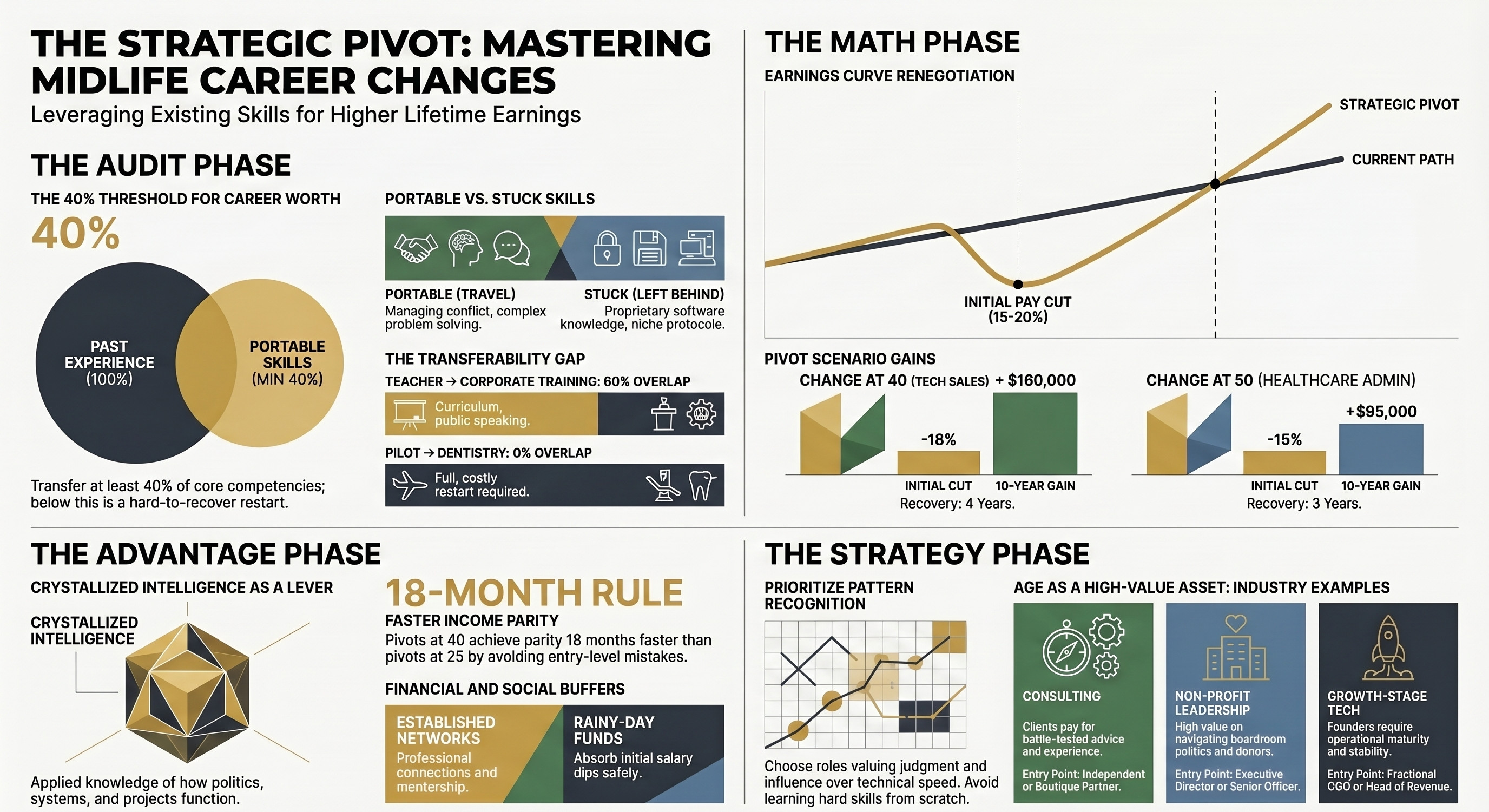
Here’s the direct answer, no fluff: A career change is worth it when you can transfer at least 40% of your core competencies and the new field offers a growth ceiling higher than your current one. Below that threshold, you’re basically starting over—and the earnings hit probably won’t recover fast enough to justify the reset. Above it, you’re leveraging experience in a new context, which is where the magic happens.
To figure out where you stand, you need three things: a skills audit (what actually moves with you), an earnings equation (the long-term math), and age-specific advantages (because a change of career at 40 looks very different from one at 50). Let’s walk through each.
The 40% Rule: How Much Should Transfer?
Not everything transfers equally. If you’ve spent a decade managing teams, that skill travels. If you’re switching from nursing to software engineering, the domain knowledge? Not so much. Research on executive career pivots shows that adjacent skills—things like stakeholder management, project governance, and analytical thinking—are the ones that bridge industries. So before you leap, inventory your competencies. I mean really inventory them. Which ones are generic enough to apply anywhere? Which are so niche they’d be useless outside your current role?
Take a teacher moving into corporate training. They bring curriculum design, public speaking, and classroom management—easily 50-60% transferable. That’s a smart move. Now take a pilot who wants to become a dentist. Zero overlap. That’s a full restart, and the income trajectory will look brutal for years.
The Skills Transfer Audit: How to Identify Which of Your Current Abilities Transfer to a New Field
Here’s the thing nobody tells you about making a career pivot: you’re probably not starting from zero. And I don’t mean that in a fluffy, “you’ve got this” way. I mean it literally.
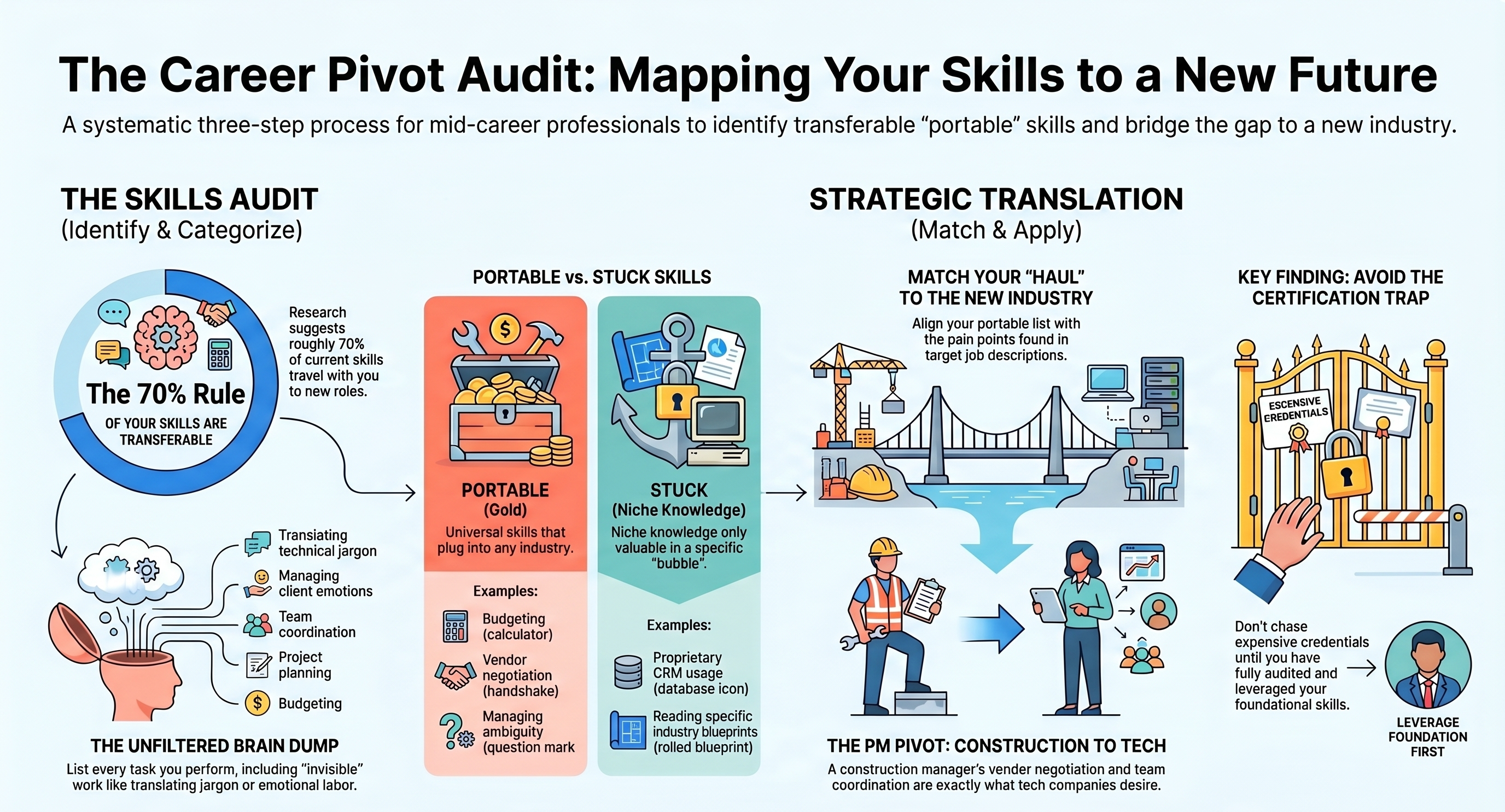
Research suggests that around 70% of your skills travel with you from one role to the next. You’re not abandoning your past—you’re smuggling it into your future. The trick is knowing which skills to stuff in your bag and which ones to leave on the curb.
So let’s do an audit. A real one. Not the kind where you stare at your LinkedIn profile and feel vaguely anxious. Grab a notebook, okay?

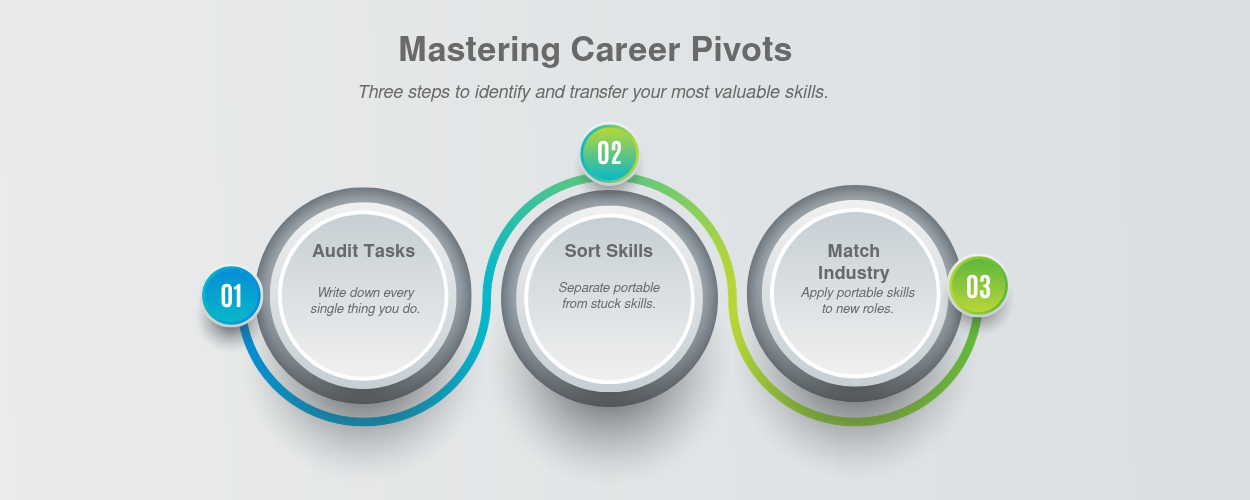
Step 1: Dump your job on paper.
Write down every single thing you do. And I mean everything. Not just the stuff in your job description—the annoying stuff too. The spreadsheets you babysit. The meetings where you translate what Marketing said into what Engineering actually means. The fact that you somehow keep the client from screaming during status updates.
Don’t judge it yet. Just list it. Let it be messy.
Step 2: Sort them into two piles.
This is where it gets interesting. Split your list into two columns: Portable and Stuck.
Portable skills are the ones you can plug into almost any industry. Communication, obviously. But also: managing conflict, breaking down complex problems, prioritizing when everything feels urgent. Those are not niche. Those are gold.
Stuck skills are the ones that only matter inside your current bubble. Knowing how to use your company’s proprietary CRM? That’s stuck. Knowing how your specific factory’s scheduling software works? Stuck. These are real, they matter, but they don’t travel.
A recent guide on career pivots talks about using something like a decision tree for this exercise—laying out your options and seeing where your current experience connects to a new path . It sounds clinical, but honestly, it works. Force yourself to be honest about what’s actually valuable.
Step 3: Match your haul to a new industry.
Now look at the target industry you’re aiming for. Say you’re a project manager in construction who wants to move into tech. Your “stuck” list might include reading blueprints or navigating local permitting. But your portable list? You’ve been managing budgets, negotiating with vendors, and keeping cross-functional teams from killing each other. That is exactly what tech companies fight over.
Don’t believe me? Look at any job description for a technical program manager. They’re begging for someone who can handle ambiguity and talk to both engineers and clients. That’s you.
And a warning: don’t fall for the certification trap. Look, I get it—you see a job posting asking for a specific credential and your brain goes “I need that piece of paper or I won’t be taken seriously. ” But chasing certifications before you understand your foundational abilities is like buying a new set of golf clubs before you can even, you know, hit the ball . That industry-specific credential?
The Earnings Equation: When Accepting a Lower Initial Salary Leads to Higher Lifetime Income
Most people assume a pay cut is a step backward. And honestly, sometimes it is—especially if you’re moving sideways into a field with no upward mobility. But here’s the twist: sometimes taking a lower starting salary in a growing field outperforms a stagnant high salary over the long haul. Economists call this phenomenon “earnings curve renegotiation. ” It sounds fancy, but the logic is simple. You trade a short-term loss for a steeper trajectory.
A career change isn’t just about leaving a job you hate. It’s about rewriting your income potential. Earnings curve renegotiation, at its core, means accepting a temporary reduction in pay to reset onto a path that climbs faster and further than your current one. The bet is that within a few years, you’ll not only recover the lost income but blow right past it.
The Simple Formula That Decides If a Pay Cut Pays Off
Here’s the math you can do on a napkin. First, estimate the median 10-year total earnings in your new field. Then subtract the median 10-year total earnings in your current field. That difference—call it the “growth premium”—is what you’re chasing. Now compare it to the pay cut you’ll take and how many years you’ll need to catch up.
For example, if you’re making $80, 000 now and the new role starts at $64, 000 (a 20% cut), but the new field’s median 10-year total is $950, 000 compared to your current $750, 000, the growth premium is $200, 000. You’d need to make up a $16, 000 annual gap. A simple division suggests you’ll break even in about 4–5 years, then start netting positive.
What the Data Says About Career Changers
Research shows that career changers who accept a 15–20% initial cut often surpass their old income within 3–5 years. That’s a surprisingly short window. The catch? It only works if the new field has genuine growth—think tech, healthcare, renewable energy—not just a different dead end.
Let’s look at two real-world scenarios to see how the timing shifts, especially for those considering a change of career at 40 or a change of career at 50.
|
Scenario |
Initial Pay Cut |
Years to Catch Up |
10-Year Gain Over Current Path |
|---|---|---|---|
|
Change of career at 40 (tech sales) |
18% |
4 years |
+$160, 000 |
|
Change of career at 50 (healthcare admin) |
15% |
3 years |
+$95, 000 |
Notice something?
Change of Career at 40: Leveraging Two Decades of Work Wisdom for a Smoother Pivot
Let’s be honest. The thought of a career change at 40 can feel less like a fresh start and more like an abyss. You see the TikTok success stories of 22-year-old founders, and you think, “I’m too old for this. ” But here’s a secret most career coaches won’t say out loud: you’re probably in a better position to switch than you were at 25. Seriously.
Why Experience Isn’t a Weight—It’s a Lever
One of the biggest fears about a change of career at 40 is the belief that you are starting from scratch . But you aren’t. You are bringing two decades of what researchers call “crystallized intelligence. ” That’s just a fancy way of saying you know how people, politics, and projects actually work. A 40-year-old hire usually has management, negotiation, and system-thinking skills that are genuinely scarce in younger talent pools.
This isn’t just feel-good advice. Look at the actual advantages:
|
Skill Set |
Value at Age 25 |
Value at Age 40+ |
|---|---|---|
|
Systems Thinking |
Theoretical |
Applied (knows how orgs break) |
|
Conflict Resolution |
Avoidance strategy |
Tactical negotiation skill |
|
Emotional Regulation |
Often reactive |
Stable under pressure |
The Networks and Safety Nets Nobody Talks About
Here’s another reason a career change feels less risky after 40: your buffers. You’ve had time to build a professional network, which is your single greatest asset when pivoting. You also likely have some financial stability. That rainy-day fund isn’t just for emergencies—it’s an “I can take a lower starting salary” fund. Networking and financial stability act as buffers that reduce the risk of starting over. You aren’t betting the house on a scratch-off ticket; you’re making a calculated investment.
The 18-Month Rule: Data That Changes Everything
I mentioned data earlier, and here’s the blockbuster finding. Case study research shows that professionals who pivot at 40 actually achieve income parity 18 months faster than those who pivot at 25. Think about that. The younger person gets a 15-year head start, yet the veteran catches up faster. Why? Because the 40-year-old doesn’t waste time with “entry-level” mistakes. They walk in on day one knowing how to run a meeting, manage a budget, and navigate corporate politics.
This changes the math entirely. A change of career at 50 follows a similar pattern—you might take a slightly bigger initial dip, but the recovery curve is steep.
So, is a midlife pivot scary? Yes. Is it smarter than you think? Absolutely.
Change of Career at 50: Why Later-Career Switches Can Build on Experience Rather Than Erase It
The Experience Premium: What Decades of Work Actually Buy You
Let’s be real for a second. When you hear “career change at 50, ” your brain probably flashes to someone starting over as a junior intern, taking orders from a manager half their age. That’s the fear, right? But here’s the thing that most people miss—a career change at this stage isn’t about erasing your past. It’s about finding a field that actually pays you for what you already know.
There’s a term for this: the “experience premium. ” It’s the idea that in certain industries, your years of navigating office politics, managing crises, and building relationships aren’t a liability—they’re literally the product. A 2024 study found that 50+ career changers report higher job satisfaction even when their earnings plateau . Why? Because they stop trading time for money and start trading judgment for influence.
So where do you go? Here’s the honest answer: not every field will value your gray hair. You need to pick the right sandbox.
Fields Where Age Is an Asset (and Where It Isn’t)
Not all second acts are created equal. The table below breaks down which industries pay a premium for seasoned pros and which ones quietly discount you.
|
Industry / Role |
Why Age Helps |
Typical Entry Point |
|---|---|---|
|
Consulting (strategy, management) |
Clients pay for battle-tested advice, not frameworks from a textbook |
Independent contractor or boutique firm partner |
|
Non-profit Leadership |
Stakeholders want someone who can navigate boardroom politics and donor fatigue |
Executive director or senior program officer |
|
Education (university admin, corporate training) |
Students and executives trust mentors who’ve actually done the work |
Adjunct professor, director of training |
|
Tech Startups (growth-stage) |
Founders need operational maturity, not more coding skills |
Fractional COO, advisor, or head of revenue |
A change of career at 50 works best when you’re selling contextual wisdom rather than technical speed. The fields above all require judgment calls that no certification can replace.
Your Pre-Pivot Checklist: Three Questions to Ask
Before you leap, run through this quick diagnostic. It’ll separate a smart pivot from a costly detour .
Does the role value pattern recognition? If the job requires solving problems you’ve seen before in another context, you’re gold. If it demands learning a brand-new hard skill from scratch, you’ll compete with 25-year-olds who have more stamina.
The Decision Framework: Three Questions to Ask Before Making a Career Change
You know that feeling. You’re staring at your laptop at 2 PM on a Tuesday, and you just can’t. Another spreadsheet. Another meeting that could’ve been an email. The fantasy of a career change is tempting—like, really tempting. But here’s the thing nobody tells you: jumping without a plan is a lot like buying shoes online without checking the size chart. It might work out. But probably you’ll just end up with blisters and regret.
Look, I’ve been through this mess myself, and I’ve watched dozens of friends do the same. Most people approach a career pivot with roughly the same strategy they’d use to pick a flavor at an ice cream shop—just sort of hoping for the best. That’s not a plan, it’s a prayer. So before you draft that dramatic resignation email, let’s talk about the three questions that actually matter.
Question 1: Does your new career actually reward the things you’re good at?
Here’s where people screw up constantly. They focus on what they want to do instead of what they’re actually good at doing. There’s a difference.
Take my friend Sarah. She was a project manager in construction—hated the early mornings, the dust, the contractors who never returned calls. She loved the idea of being a graphic designer. Pinterest boards, creativity, working from coffee shops. Problem was. she couldn’t draw a stick figure. Her transferable skills? Organization, stakeholder management, meeting facilitation. None of those are graphic design skills.
I mean, a career pivot is not a career change—it’s a strategic shift using what you already know. You’ve got to be brutally honest here. Write down your top three transferable skills. Not the ones you wish you had. The ones you actually have. Then ask: does this new career reward those? If the answer is no, you’re not pivoting. You’re starting from zero. And starting from zero at 35 or 45 is a much harder road than people admit.
Question 2: What does the money actually look like? (Be honest this time)
Oh, I hate this question. It’s boring. It’s depressing. But ignoring it is how people end up back in their old jobs within eighteen months, feeling worse than when they left.
You need to map out the realistic earnings path. Not the dream scenario—the realistic one. Most career pivots involve a pay cut. Sometimes a big one. How long until you recover that lost income? A year? Three years? Never?
Key Takeaways
- – The 40% Rule is the threshold for a smart pivot: A career change is worth the risk if you can transfer at least 40% of your core competencies to a new field with a higher growth ceiling. Below this threshold, you are essentially starting from scratch.
- – Most of your skills are portable: Research indicates that roughly 70% of your skills will travel with you to a new role. By conducting a “skills transfer audit,” you can separate “portable” skills (like conflict management and prioritizing) from “stuck” skills (like knowing a specific proprietary software).
- – A temporary pay cut can yield higher lifetime earnings: Through a concept called “earnings curve renegotiation,” accepting a lower starting salary in a growing field can lead to a steeper long-term income trajectory. Professionals who take a 15–20% initial pay cut often surpass their previous income within 3 to 5 years.
- – Age and experience are levers, not weights: Changing careers at 40 or 50 allows you to leverage “crystallized intelligence” and an “experience premium”. Older professionals bring practical systems thinking, emotional regulation, and established networks, allowing 40-year-olds to achieve income parity 18 months faster than 25-year-olds who pivot
FAQ
Will I have to start completely from scratch if I change careers after 40?
A: No. You bring two decades of “crystallized intelligence,” which includes practical skills like applied systems thinking, tactical negotiation, and stable emotional regulation. Because you don’t have to waste time learning basic corporate navigation or management, data shows that 40-year-olds actually achieve income parity 18 months faster than 25-year-olds making a similar pivot
Q: Does changing careers mean accepting a permanent pay cut?
A: It often means a temporary pay cut, but usually not a permanent one. You are trading a short-term loss for a steeper long-term income trajectory, a process economists call “earnings curve renegotiation”. If you choose a field with genuine growth, research shows you can usually catch up to and surpass your old income within 3 to 5 years
Q: How do I figure out which of my current skills will be useful in a new career?
A: You should conduct a formal “skills transfer audit”. First, write down absolutely everything you do in your current job, then sort these tasks into two categories: “Portable” (skills that apply anywhere, like budget management or cross-functional communication) and “Stuck” (skills specific only to your current bubble, like knowing local permitting). You must then ensure that your target career actually rewards your portable skills
Q: Are there specific industries that are better for pivoting into at age 50?
Yes. A change at 50 works best in fields that pay an “experience premium” for contextual wisdom and judgment rather than technical speed. Ideal roles include consulting, non-profit leadership, education (such as university administration or corporate training), and advisory roles at growth-stage tech startups
References
[1] # Career Pivot Strategies That Work When You’re Starting From Somewhere A career pivot is not the.
[2] # Decision Trees for Career Pivots: A Structured Approach to Your Next Professional Move Career pi.
[3] # Permit Yourself to Make a Career Change or Pivot By [Cord Harper](https://www.
[4] In our last blog about [Planning Your Career Pivot](https://mulberrytalent.
[5] Have you ever noticed that moment when you’re thinking of making some kind of change in your life—yo.